3. Prāṇa Vāyu & Apāna Vāyu
In the previous session, we understood prāṇa as a functional principle. It is not a substance, not a mystical entity, and not an independent conscious force. Prāṇa is the organized functioning of vitality within Prakṛti. Prāṇa does not think, know, or decide. It possesses no awareness of its own. Awareness belongs to the Jīva as the conscious Seer, while prāṇa belongs entirely to the domain of Prakṛti. Its role is to enable activity. Because of prāṇa, the sūkṣma śarīra and sthūla śarīra function as a living system. The antaḥkaraṇa (citta) becomes active, the indriyas operate, and the body becomes capable of participating in experience.
A key distinction must therefore be remembered:
- Cit (awareness) illumines.
- Prāṇa functions.
Cit is self-revealing awareness through which the Jīva knows experience. Prāṇa is organized vitality through which the instruments of experience operate.
Without awareness, nothing is known.
Without prāṇa, nothing functions.
Pañca-Prāṇa Vāyus and Upa-Prāṇa — Their Functional Modes and Fields of Expression
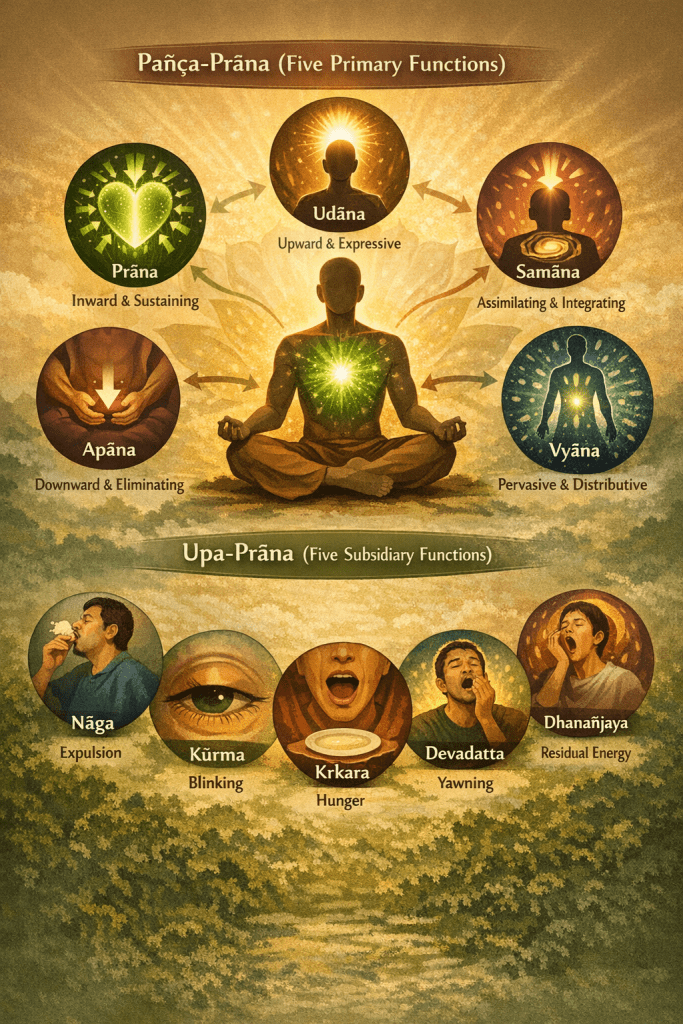
We now turn to the śāstric statement itself. The Gheraṇḍa Saṁhitā (Chapter 5, Verse 60) presents the classification of prāṇa as follows:
prāṇo’pānaḥ samānaś ca, udāno vyāna eva ca |
nāgaḥ kūrmaś ca kṛkaro, devadatto dhanañjayaḥ || 5.60 ||
Meaning : “Prāṇa, Apāna, Samāna, Udāna, and Vyāna — and also Nāga, Kūrma, Kṛkara, Devadatta, and Dhanañjaya — these are the ten prāṇic functions (vāyus).”
This verse shows that prāṇa, though one in principle, functions in multiple ways within the embodied system. These are traditionally understood as ten:
Pañca-Prāṇa Vāyus (Five Primary Functional Modes)
- Prāṇa — primarily associated with inward (inhalation) and life-sustaining functions
- Apāna — primarily associated with downward movement, elimination, and releasing functions
- Samāna — primarily associated with digestion, assimilation, and balancing functions.
- Udāna — primarily associated with upward movement, expression (Speech and voice, Verbal communication), and transformative functions.
- Vyāna — primarily associated with circulation and distribution throughout the body.
Upa-Prāṇa (Five Subsidiary Functional Modes)
- Nāga — primarily associated with expulsion functions such as belching or burping.
- Kūrma — primarily associated with eye functions such as blinking and eye protection.
- Kṛkara — primarily associated with hunger, thirst, and stimulating appetite.
- Devadatta — primarily associated with yawning and relaxation functions.
- Dhanañjaya — primarily associated with residual vital functions, retention, and post-death persistence in the body.
This classification does not divide prāṇa into separate entities. Rather, it shows different modes of functioning within a single principle. Prāṇa remains one, but appears in distinct functional expressions according to the needs of the system. Each vāyu represents a particular pattern of activity—such as intake, elimination, assimilation, expression, and distribution—through which embodied life is sustained.
These functions are not uniform. Some are predominantly associated with specific regions, indicating localized activity, while others—such as vyāna—operate throughout the entire system. This shows that prāṇic functioning is both localized and pervasive, supporting both specific processes and overall integration.
The subsidiary modes further refine this understanding by accounting for subtle and often unnoticed physiological processes. They show that prāṇa is not limited to major life functions, but extends even to the smallest operations that maintain continuity within the system.
Taken together, this tenfold presentation helps us understand prāṇa as a coordinated and integrated functioning. Though it appears as many, it remains one—expressing itself in diverse ways within the embodied system.
1. Prāṇa Vāyu — The Primary Inward Functional Force
hṛdi prāṇo vaset nityam
— “Prāṇa resides in the heart region”
(Gheraṇḍa Saṁhitā 5.61)
Prāṇa Vāyu functions in the heart-field (hṛd), understood not as a fixed anatomical location but as the central field of inward activation. Here vitality is received, sustained, and made available for the functioning of the whole embodied system. Prāṇa Vāyu represents the primary activating movement that makes life responsive and capable of engagement.
Through Prāṇa Vāyu, both levels of embodiment operate. The Sthūla Śarīra (gross body) functions physiologically, while the Sūkṣma Śarīra (subtle body) becomes capable of perception, cognition, and experience. It governs inward movement — the intake of breath, sensory impressions, and psychological engagement — and therefore stands at the beginning of all functional processes.
At the gross level, Prāṇa Vāyu expresses most clearly as inhalation, supporting respiration, cardiac activity, oxygenation, vitality, and the operational readiness of the sensory organs. Breathing is the most visible manifestation of Prāṇa Vāyu, though the principle itself is deeper than respiration alone.
At the subtle level, Prāṇa Vāyu energizes the antaḥkaraṇa — manas, buddhi, and ahaṅkāra — enabling perception, attention, and thought. The senses may be structurally intact, yet perception does not arise without prāṇic activation. What is often called “weak prāṇa” is not loss of energy but dispersion caused by mental conditioning. Prāṇa always flows according to the state of the inner instrument: agitation scatters it, while steadiness naturally gathers and harmonizes it.
The primary devatā associated with Prāṇa Vāyu is Indra Devatā, indicating the activating intelligence through which vitality, cognition, and sensory functioning become operative. Prāṇa Vāyu functions as the principle of inward reception. Every act of taking in — breathing, sensing, attending, or engaging with experience — depends upon its movement. Thoughts arise in the mind, but they remain active only through prāṇic support. Thus Prāṇa Vāyu does not produce knowledge; it enables the conditions in which knowing becomes possible.
Because it governs intake and initial activation, Prāṇa Vāyu forms the basis for all other vāyus. Without intake there can be no assimilation (Samāna), distribution (Vyāna), expression (Udāna), or elimination (Apāna). It therefore stands at the beginning of the entire functional sequence of life.
Disturbance in Prāṇa Vāyu appears physically as irregular breathing, fatigue, or instability, and subtly as restlessness or difficulty sustaining attention. These disturbances arise not from loss of prāṇa but from imbalance in living patterns and mental agitation. When balance is restored, breathing becomes smooth, vitality steady, perception clear, and attention naturally stable.
Philosophically, Prāṇa Vāyu belongs entirely to Prakṛti. It is a functional principle that enables activity but does not illumine experience. Consciousness (Cit) alone is self-revealing awareness. Maintaining this distinction prevents confusing vitality with the Ātman.
In summary, Prāṇa Vāyu is the primary inward and sustaining functional force that makes the embodied system alive, receptive, and capable of engagement. It prepares the ground for all subsequent prāṇic functions and is complemented by Apāna Vāyu, the equally essential movement of release and completion.
2. Apāna Vāyu — The Downward & Releasing Force
apāno guda-maṇḍale
— “Apāna functions in the anal and pelvic region.”
(Gheraṇḍa Saṁhitā 5.61)
Apāna Vāyu functions primarily in the pelvic field (guda-maṇḍala), understood as the domain of downward movement, grounding, and release. This description indicates a functional field rather than a purely anatomical location. Apāna governs the movement through which processes reach completion and balance is restored within the embodied system.
While Prāṇa Vāyu governs intake and activation, Apāna Vāyu governs release and stabilization. Life is sustained not only by what is received but also by what is relinquished. Without release, accumulation produces stagnation and disturbance. Apāna Vāyu therefore completes and stabilizes the processes initiated by Prāṇa Vāyu.
At the level of the Sthūla Śarīra (gross body), Apāna Vāyu directs all downward and outward physiological functions. These include elimination of waste, urination, reproductive processes, menstrual flow, childbirth, and the expulsion of metabolic by-products. Through these actions the organism maintains equilibrium by removing what has fulfilled its role.
At the level of the Sūkṣma Śarīra (subtle body), Apāna Vāyu operates as the principle of inner release. Just as the body expels physical waste, the antaḥkaraṇa must relinquish accumulated impressions, emotional residues, and completed experiences. Apāna supports the capacity to conclude experience without carrying unnecessary psychological burden forward.
The primary devatā associated with Apāna Vāyu is Yamarāja, representing the regulating intelligence through which release, completion, and lawful balance are maintained within the embodied system. The movement of Apāna reflects the condition of the antaḥkaraṇa. When the mind clings to memories, identities, or outcomes, the natural process of release becomes restricted. This may appear physically as heaviness or irregular elimination, and psychologically as attachment, emotional stagnation, or resistance to change. When the inner instrument becomes steady, Apāna flows naturally and restores balance.
Apāna Vāyu functions as the principle of grounding and stabilization within the prāṇic system. Whereas Prāṇa Vāyu activates and draws energy inward, Apāna anchors and consolidates. By directing movement downward, it prevents dispersion and supports integration of experience.
Because it governs completion, Apāna Vāyu forms an essential part of the functional sequence of the vāyus. Without release, assimilation cannot finalize, distribution becomes burdened, expression loses stability, and renewal becomes impossible. Together, Prāṇa and Apāna establish the primary rhythm of embodied life — reception followed by completion.
Disturbances in Apāna Vāyu appear physically as obstruction, instability, or heaviness, and subtly as fear of letting go, emotional accumulation, or tamasic inertia. These conditions do not arise from loss of prāṇa but from imbalance in living patterns and mental conditioning.
When Apāna Vāyu becomes balanced, stability and lightness arise naturally. Elimination becomes effortless, the body feels grounded, and the mind gains the capacity to release experiences without residue. Balance develops through moderation, non-clinging, and alignment with natural processes rather than forceful control.
Philosophically, Apāna Vāyu belongs entirely to Prakṛti. It enables the process of release but does not illumine experience. Consciousness (Cit) alone is self-revealing awareness. Recognizing this distinction prevents confusing physiological or psychological relief with realization.
In summary, Apāna Vāyu is the downward and releasing functional force operating as physiological elimination in the gross body and experiential clearing in the subtle body. By allowing completion and renewal, it complements Prāṇa Vāyu and prepares the system for the next stage of prāṇic functioning — Samāna Vāyu.
Āsana
haṭhasya prathamāṅgatvād, āsanaṁ pūrvamucyate |
kuryāttad āsanaṁ svairyam, ārogyaṁ cāṅga-lāghavam ||
(Haṭha Yoga Pradīpikā C1 V17)
Meaning : “Āsana is taught first because it is the initial limb of Haṭha Yoga. By practicing āsana, one attains steadiness, freedom from disease, and lightness of the body.”
Āsana is taught first because Haṭha Yoga begins with the refinement of the bodily instrument through which prāṇa operates. The yogic path proceeds by transforming the human system from the gross to the subtle. Before prāṇa can be regulated and higher practices undertaken, the body must become stable, purified, and free from obstruction.
The practitioner functions through both the Sthūla Śarīra (gross body) and the Sūkṣma Śarīra (subtle body), which includes prāṇa, the vāyus, and the network of nāḍīs. Āsana serves as the means by which physical structure influences subtle functioning. By establishing correct alignment and reducing unnecessary tension, the body becomes a suitable vessel for balanced prāṇic movement.
Stabilization Through Āsana
Restlessness of the body disturbs prāṇa, and disturbed prāṇa produces instability throughout the system. Through consistent āsana practice, muscular agitation decreases and physiological rhythms become regulated. The practitioner experiences svairyam — natural ease and freedom in posture — where effort becomes relaxed and sustainable rather than forced.
Regulation of Prāṇa
Āsana does not create prāṇa; it removes impediments to its flow. Proper positioning of the spine, chest, and abdomen allows breathing to become effortless, enabling Prāṇa Vāyu to function efficiently. As prāṇic movement becomes orderly, vitality increases and the organism functions with greater clarity and responsiveness.
Harmonization of the Five Vāyus
The stability gained through āsana allows coordinated functioning of all five vāyus:
- Prāṇa Vāyu stabilizes through balanced inhalation.
- Apāna Vāyu becomes grounded through pelvic stability.
- Samāna Vāyu supports digestion and assimilation through balanced abdominal pressure.
- Vyāna Vāyu distributes energy evenly when bodily tension decreases.
- Udāna Vāyu becomes clear when the spine remains upright and unobstructed.
Thus, āsana prevents the scattering of prāṇic energy caused by habitual imbalance and prepares the system for deeper yogic practices.
Harmonization of Nāḍī Flow
Irregular posture and lifestyle create asymmetry in prāṇic movement within the nāḍī network. Through balanced and symmetrical positioning, āsana gradually equalizes these flows. When prāṇa moves evenly, internal stability arises, creating suitable conditions for higher practices of Haṭha Yoga.
Preparation of the Energetic System
Āsana establishes structural and prāṇic stability throughout the body. Rather than forcibly awakening subtle centers, it prepares the ground through purification, balance, and steady cultivation. Transformation occurs naturally as prāṇa flows without obstruction.
Purpose of Āsana
Āsana is therefore not an end in itself but a preparatory sādhana. Through practice, the body becomes healthy (ārogya), light (aṅga-lāghava), and free in movement (svairyam). With physical disturbance reduced and prāṇa harmonized, the practitioner becomes ready for prāṇāyāma and the subsequent stages of Haṭha Yoga.
For this reason, the tradition declares āsana to be the first limb — the foundation upon which the entire process of Haṭha Yoga rests.
Which Āsana Should We Begin With?
When we ask, “Which āsana should we begin with?”, we must understand that Yoga is not merely training the body but preparing the entire embodied system for stable sitting, prāṇāyāma, and meditation. The real question is therefore not which posture comes first, but how the body becomes ready for effortless sitting.
Preparation Before Posture
A common mistake is to begin immediately with advanced seated postures such as Siddhāsana or Padmāsana. When the body is unprepared, strain appears in the knees, hips resist opening, the spine collapses, breathing becomes irregular, and prāṇa becomes disturbed. Meditation cannot arise from discomfort; Yoga begins with intelligent preparation rather than ambition.
Āsana must first prepare the whole field through which prāṇa operates.
Beginning at the Foundation
Preparation starts with the lower limbs, the base of support. Mobilizing the toes, ankles, knees, and hips establishes grounding and prevents strain in seated practice. True readiness for meditation arises from hip freedom, not forcing the knees into position. At the prāṇic level, this stabilizes Apāna Vāyu, providing the necessary foundation for higher practices.
Pelvis and Trunk — The Central Axis
Preparation then moves to the pelvis and trunk. The pelvis must be stable yet relaxed, the spine upright without rigidity, and the abdominal region balanced to support digestion and breath. Here Prāṇa Vāyu and Samāna Vāyu begin to cooperate, allowing breathing and internal balance to synchronize.
Upper Body Relaxation
The shoulders, arms, and hands remain free of unnecessary effort. When tension reduces, Vyāna Vāyu distributes energy evenly throughout the body, preventing fatigue and supporting sustained posture.
Neck and Head — Quieting the System
Finally, alignment reaches the neck and head. The throat softens, the jaw relaxes, and the eyes become quiet. This supports Udāna Vāyu and reduces sensory agitation, allowing prāṇa to settle inward.
The True Beginning
Thus, the first āsana is not a single posture but systematic preparation of the whole body. Only then do seated postures such as Svastikāsana, Vajrāsana, Siddhāsana, or Padmāsana arise naturally.
When preparation is complete:
- Apāna provides grounding,
- Prāṇa flows freely,
- Samāna stabilizes the center,
- Vyāna distributes energy evenly,
- Udāna supports uprightness and inner elevation.
Āsana therefore brings the vāyus into cooperation. As the body becomes quiet, prāṇa stabilizes; as prāṇa stabilizes, the mind settles. Meditation then arises naturally rather than through force.
3. Samāna Vāyu — The Integrative & Balancing Force :
samāno nābhi-deśe tu
— “Samāna operates in the navel region.”
(Gheraṇḍa Saṁhitā 5.61)
Samāna Vāyu functions primarily in the navel field (nābhi-deśa), understood not merely as an anatomical location but as the central field of processing, assimilation, and equilibrium. In this domain what has been received is transformed, integrated, and brought into harmonious balance. Samāna represents the stabilizing middle that reconciles the polarity between intake and release.
If Prāṇa Vāyu governs intake and Apāna Vāyu governs release, Samāna Vāyu serves as the principle of integration between these two movements. It ensures that what is taken in is properly processed and that release occurs in appropriate measure. Without Samāna, the system would oscillate between accumulation and expulsion without achieving coherence or stability.
At the level of the Sthūla Śarīra (gross body), Samāna Vāyu governs digestion and physiological assimilation. It regulates how food is processed, nutrients absorbed, and energy balanced within the organism. Nourishment depends not merely on intake but on the body’s ability to transform what is received into usable vitality. When Samāna functions harmoniously, digestion becomes steady and efficient; when disturbed, even proper intake fails to nourish the system.
The governing devatā traditionally associated with Samāna Vāyu is Agni, the cosmic principle of fire and transformation. This association arises naturally from the function and location of Samāna Vāyu. The classical yogic texts describe Samāna as operating in the nābhi-deśa, the navel region, which is also recognized as the seat of digestive fire (Jatharāgni). Because Samāna governs digestion, assimilation, and the transformation of intake into nourishment, its presiding intelligence is symbolized by Agni Devatā.
ॐ अग्नये नमः Om Agnaye Namaḥ — Salutations to Agni, the divine fire.
At the level of the Sūkṣma Śarīra (subtle body), Samāna Vāyu governs the assimilation of experience. Perceptions, emotions, and knowledge must be processed and integrated within the antaḥkaraṇa. When experiences are not assimilated, they remain as unresolved impressions that disturb inner clarity. Samāna enables experience to settle into understanding, transforming information into insight and learning into wisdom.
The functioning of Samāna closely reflects the condition of the antaḥkaraṇa, especially buddhi. Clear discrimination allows experiences to be interpreted correctly and integrated smoothly, whereas confusion or emotional reactivity leads to incomplete assimilation and repetitive psychological patterns. Thus, inner clarity naturally supports balanced prāṇic functioning.
Samāna Vāyu acts as the harmonizing force between Prāṇa and Apāna. It prevents intake from becoming excess and release from becoming depletion, maintaining proportionality within the system. Through this balancing role, it establishes internal order and centeredness, allowing the organism to function with stability rather than fluctuation.
Disturbances in Samāna Vāyu appear physically as irregular digestion, bloating, or unstable energy levels, and subtly as difficulty integrating learning, emotional volatility, or the accumulation of unresolved impressions. Such imbalance often arises from overstimulation, irregular living patterns, or continuous activity without sufficient assimilation or reflection.
When Samāna Vāyu becomes balanced, a natural centeredness emerges. Digestion stabilizes, understanding deepens, and emotional experiences resolve without lingering disturbance. The system begins to function in dynamic equilibrium, allowing engagement with life without fragmentation.
Samāna also supports self-regulation, enabling recognition of sufficiency — knowing when enough has been taken in and when release is appropriate. This sensitivity fosters moderation, restraint, and intelligent participation in life, preventing both excess and deprivation.
Philosophically, Samāna Vāyu belongs entirely to Prakṛti. It is a functional principle that enables balance and integration but does not illumine experience. Consciousness (Cit) alone is self-revealing awareness. Maintaining this distinction prevents confusing inner balance or psychological harmony with realization of the Ātman.
In summary, Samāna Vāyu is the integrative and balancing functional force that operates as digestion and physiological assimilation in the Sthūla Śarīra, and as the assimilation of experience in the Sūkṣma Śarīra. By harmonizing intake and release, it establishes coherence within the embodied system and prepares the ground for the next stage of prāṇic functioning — the coordinated distribution governed by Vyāna Vāyu.
Yogaśāstra
mitāhāraṁ vinā yastu yogārambhaṁ tu kārayet |
nānārogo bhavettasya kiñcidyogo na sidhyati || 16 ||
Meaning : One who begins the practice of yoga without observing a moderate diet (mitāhāra) develops many diseases, and yoga does not succeed for such a person.
śālyannaṁ yavapiṣṭaṁ vā tathā godhūmapiṣṭakam |
mudraṁ māṣacaṇakādi śubhraṁ ca tuṣavarjitam || 17 ||
Meaning : A yogin should eat rice, preparations of barley, and preparations of wheat, along with mung beans, black gram, chickpeas, and similar pulses, which are clean and free from husk.
paṭolaṁ suraṇaṁ mānaṁ kakkolaṁ ca śukāśakam |
drāḍhikāṁ karkaṭīṁ rambhāṁ ḍumbarīṁ kaṇṭakaṇṭakam || 18 ||
Meaning : Foods such as paṭola (pointed gourd), suraṇa (yam), māna, kakkola, śukāśaka, drāḍhikā, cucumber, banana, fig, and thorny vegetables are suitable for consumption.
āmarambhāṁ bālarambhāṁ rambhādaṇḍaṁ ca mūlakam |
vārṭākīṁ mūlakaṁ ṛddhiṁ yogī bhakṣaṇam ācaret || 19 ||
Meaning : Also mango, tender banana, the inner stem of the banana plant, radish, eggplant, and other roots and vegetables may be eaten by a yogin.
bālaśākaṁ kālaśākaṁ tathā paṭolapatrakam |
pañcaśākaṁ praśaṁsīyād vāstūkaṁ himalocikām || 20 ||
Meaning : Tender leafy greens, dark leafy greens, paṭola leaves, the group of five recommended greens (pañca-śāka), vāstūka, and himalocikā are praised as suitable foods.
śuddhaṁ sumadhuraṁ snigdham udarārdhavivarjitam |
bhujyate surasaṁ prītyā mitāhāram imaṁ viduḥ || 21 ||
Meaning : Moderate diet is known as food that is pure, pleasant in taste, mildly sweet, and slightly unctuous, taken with enjoyment, while leaving half of the stomach empty.
annena pūrayed ardhaṁ toyena tu tṛtīyakam |
udarasya turīyāṁśaṁ saṁrakṣed vāyucāraṇe || 22 ||
Meaning : One should fill half the stomach with food, one quarter with water, and leave the remaining quarter empty for the proper movement of air.
Explanation : These verses emphasize the importance of mitāhāra — moderation and purity in diet — as a fundamental discipline in the practice of yoga. The text begins by stating that without proper regulation of food, the practice of yoga cannot succeed. When diet is excessive, irregular, or unsuitable, the body becomes disturbed and prone to illness. Since the body serves as the instrument for yogic practices such as āsana, prāṇāyāma, and meditation, maintaining its balance and health through proper nourishment becomes essential.
The verses then describe the kinds of foods considered suitable for a yogin. Grains such as rice, barley, and wheat, along with pulses like mung beans, black gram, and chickpeas, provide steady nourishment and strength. These foods are simple, wholesome, and sustaining, supporting the body without creating heaviness or agitation. The emphasis on food that is clean and free from husk reflects the traditional concern for purity and proper preparation, ensuring that nourishment remains both healthy and easily digestible.
In addition to grains and pulses, the text recommends a variety of vegetables, fruits, and plant foods such as gourds, roots, cucumbers, bananas, figs, and leafy greens. These foods are natural, fresh, and generally light on digestion. A diet rich in such simple plant-based foods helps maintain clarity in the body and steadiness in the mind, qualities that are highly valued in yogic discipline. By choosing foods that are mild, nourishing, and balanced, the practitioner supports the harmonious functioning of the body and the internal energies.
The text then explains the true meaning of mitāhāra. It is not merely eating less, but eating food that is pure, pleasant in taste, mildly sweet, and slightly unctuous, taken with contentment and in proper measure. Such food nourishes the body without burdening it. The spirit of mitāhāra also includes an attitude of appreciation and calmness while eating, recognizing food as a means of sustaining the body for a higher purpose.
Finally, the verses describe the proper proportion in eating. The stomach should be filled half with food, one quarter with water, and the remaining quarter left empty. Leaving space within the stomach allows the natural movement of air and supports proper digestion and internal balance. In this way, moderation in quantity, along with purity and simplicity of food, helps maintain a light and healthy body, creating the conditions necessary for steady and successful progress in the practice of yoga.
4. Vyāna Vāyu — The Pervasive & Coordinating Force
vyāno vyāpya śarīre tu
— “Vyāna pervades the entire body.”
(Gheraṇḍa Saṁhitā 5.62)
Vyāna Vāyu is described as that which pervades the whole body (vyāpya śarīre). Unlike the other vāyus that function through specific operational fields, Vyāna is diffusive and all-encompassing. It operates as the principle of distribution and coordination, ensuring that the entire system functions as an integrated whole rather than as isolated parts.
While Prāṇa Vāyu governs intake, Apāna Vāyu governs release, and Samāna Vāyu governs assimilation and balance, Vyāna Vāyu distributes what has been properly processed throughout the system. It connects all functions, allowing vitality, energy, and activity to move wherever required. Without Vyāna, even a nourished and balanced system would remain fragmented and inefficient.
At the level of the Sthūla Śarīra (gross body), Vyāna Vāyu governs circulation and coordinated movement. It supports the distribution of nutrients, energy, and physiological impulses throughout the organism. Posture, balance, muscular coordination, and smooth bodily movement depend upon its pervasive functioning. When Vyāna operates harmoniously, action becomes efficient and fluid rather than strained or disjointed.
At the level of the Sūkṣma Śarīra (subtle body), Vyāna Vāyu coordinates intention and execution. A decision arising in the antaḥkaraṇa must be translated into organized action involving many systems simultaneously. Vyāna ensures that thought, movement, and response operate together in harmony, allowing intention to manifest as coherent activity.
The presiding devatā traditionally associated with Vyāna Vāyu is Śrī Viṣṇu, the sustaining and all-pervading principle. This association reflects the very nature of Vyāna itself. Just as Śrī Viṣṇu sustains and pervades the universe, maintaining harmony and order within creation, Vyāna Vāyu pervades the embodied system and maintains coordination among all its functions. Through this sustaining intelligence, vitality and activity are distributed evenly throughout the organism.
ॐ विष्णवे नमः – Om Viṣṇave Namaḥ — Salutations to Viṣṇu, the sustaining and all-pervading Lord.
Vyāna maintains systemic coherence by synchronizing multiple processes at once. When balanced, there is continuity between intention, action, and completion. Effort feels natural and sustained rather than forced. When the antaḥkaraṇa becomes scattered by competing impulses, Vyāna distributes energy unevenly, producing inefficiency, fatigue, and inconsistency in action.
Disturbances in Vyāna Vāyu appear physically as lack of coordination, irregular movement, or unexplained fatigue, and subtly as scattered effort or difficulty carrying intentions through to completion. Such imbalance often arises from overextension, irregular rhythms of living, or divided attention across many directions.
When Vyāna Vāyu becomes balanced, activity gains rhythm and integration. Movement becomes coordinated, effort efficient, and actions follow understanding naturally. Vitality is distributed evenly, allowing sustained engagement without exhaustion.
Vyāna is refined through regularity, balanced effort, and aligned action. Rhythmic living, mindful transitions between activities, and moderation in exertion support its coordinating function. When action arises from clarity rather than compulsion, Vyāna naturally regains coherence.
Philosophically, Vyāna Vāyu belongs entirely to Prakṛti. It enables coordination and distribution but does not illumine experience. Consciousness (Cit) alone is self-revealing awareness, and coordinated activity should not be mistaken for realization.In summary, Vyāna Vāyu is the pervasive and coordinating functional force operating throughout the entire system. It distributes vitality, integrates action, and maintains unity among all bodily and psychological processes, preparing the ground for the final stage of prāṇic functioning — the ascending and expressive movement governed by Udāna Vāyu.
Yogaśāstra
kaṭvamlaṁ lavaṇaṁ tiktaṁ bhraṣṭaṁ ca dadhitakrakam |
śākotkaṭaṁ tathā madyaṁ tālaṁ ca panasaṁ tathā || 23 ||
Meaning : A yogin should avoid foods that are excessively pungent, sour, salty, or bitter, as well as fried preparations, curd and buttermilk, very spicy vegetables, alcoholic drinks, palmyra fruit, and jackfruit. In practical terms, this includes foods that are extremely spicy or stimulating, such as dishes prepared with large amounts of chilli, strong pickles (achar), very sour tamarind-based preparations, heavily salted snacks, or intensely bitter foods taken in excess. Fried foods such as pakoras, bhajis, puris, samosas, and other deep-fried snacks are also discouraged, as they tend to be heavy and difficult to digest.
Such foods not only disturb the body but also influence the antaḥkaraṇa (the inner instrument of mind). Foods that are excessively pungent, sour, or salty tend to increase rajas, which manifests as restlessness, agitation, and heightened sensory stimulation. Deep-fried, stale, or heavy foods increase tamas, leading to dullness, lethargy, and lack of clarity in the mind. When rajas and tamas dominate, the mind becomes either restless or dull, making it difficult to sustain the calm attention required for practices such as prāṇāyāma and meditation.
In particular, curd and buttermilk are traditionally understood to increase mucus in the body, which may obstruct the respiratory passages and disturb the smooth movement of breath. Since prāṇāyāma depends upon clear breathing and a balanced internal condition, foods that promote heaviness or excess mucus are discouraged during disciplined practice.
The underlying purpose of these dietary restrictions is to protect and cultivate sattva, the quality of clarity, harmony, and steadiness within the antaḥkaraṇa. When sattva predominates, the mind becomes calm, attentive, and receptive, allowing the practitioner to engage more deeply in the practices of yoga. Therefore, the yogin is encouraged to choose foods that maintain lightness in the body and purity in the mind, supporting the steady development of inner awareness.
Important Note : This verse does not specifically mention meat, but in yoga meat is avoided because it is considered heavy and tamasic, which may dull the antaḥkaraṇa and make meditation and prāṇāyāma more difficult.
kulatthaṁ masuraṁ pāṇḍu kūṣmāṇḍaṁ śākadaṇḍakam |
tumbī-kola-kapitthaṁ ca kaṇṭabilvaṁ palāśakam || 24 ||
Meaning : Horse gram, lentils, certain varieties of gourd, coarse vegetable stalks, bottle gourd, kola fruit, wood apple, thorny bel fruit, and palāśa are advised to be avoided by the yogin. These foods are generally regarded as heavy, coarse, or difficult to digest, and may produce excessive gas or disturbance in the digestive system. In practical terms, this may include foods such as heavy lentil preparations, dense pulse dishes, or fibrous vegetable stalks that place a greater burden on digestion.
When digestion becomes strained or irregular, the body experiences heaviness and internal discomfort, which may disturb the smooth movement of prāṇa. This physical imbalance also affects the antaḥkaraṇa, since the condition of the body and mind are closely connected. Heavy or difficult-to-digest foods tend to increase tamas, producing dullness and lethargy, while digestive discomfort can increase rajas, creating restlessness and agitation.
kadambaṁ jambīraṁ bimbaṁ laku caṁ laśunaṁ viṣam |
kāmaraṅga piyālaṁ ca hiṅgu-śālmalikemukam || 25 ||
Meaning : Kadamba fruit, citron, bimba fruit, lakuca fruit, garlic, poisonous or harmful substances, star fruit, piyāla fruit, asafoetida, products of the silk-cotton tree, and areca nut are advised to be avoided by the yogin. Many of these foods are considered excessively sharp, sour, or strongly stimulating in nature, and may disturb the internal balance required for disciplined yogic practice.
Substances such as garlic and asafoetida possess very strong and penetrating qualities that stimulate the senses and the nervous system. While they may have medicinal uses, in the context of yoga they are understood to increase rajas, which can manifest as restlessness, agitation, and heightened sensory activity within the antaḥkaraṇa. Similarly, substances that are harsh, intoxicating, or harmful can increase tamas, producing dullness, heaviness, or lack of clarity in the mind.
yogārambhe varjayec ca pathi-strī-vahni-sevanam || 26 ||
Meaning : At the beginning of yoga practice, the yogin should avoid long travel, excessive sexual engagement, and excessive exposure to fire or intense heat. Frequent travel can disturb regular routines and create physical fatigue, making it difficult for the body and mind to settle into the steadiness required for disciplined practice. Similarly, excessive sensual indulgence may dissipate vital energy and stimulate the senses, increasing rajas within the antaḥkaraṇa, which manifests as restlessness and agitation of the mind.
Prolonged exposure to strong heat or fire may also disturb the body’s internal balance and aggravate the system, especially during practices such as prāṇāyāma that already generate internal heat. Such disturbances can affect both the body and the antaḥkaraṇa, reducing the calmness and stability required for yogic discipline.
Since the early stages of yoga aim to cultivate sattva—clarity, steadiness, and harmony within the antaḥkaraṇa—the practitioner is encouraged to maintain moderation and stability in lifestyle. By conserving energy, regulating daily habits, and avoiding excessive stimulation, the yogin creates the inner and outer conditions necessary for steady progress in the practice of yoga.
navanītaṁ ghṛtaṁ kṣīraṁ śarkarādyaikṣavaṁ guḍam |
pakva-rambhāṁ nārikelaṁ dāḍimba-maśivāsavam |
drākṣāṁ tu lavalīṁ dhātrīṁ rasam amla-vivarjitam || 27 ||
Meaning : Fresh butter, ghee, milk, sugar, sugarcane products, jaggery, ripe bananas, coconut, pomegranate, wholesome herbal drinks, grapes, lavalī fruit, and āmalakī (Indian gooseberry), along with juices that are not sour, are considered suitable foods for the yogin. These foods are generally nourishing, gentle on digestion, and capable of sustaining strength and vitality without creating excessive heaviness or disturbance in the body.
Such foods help maintain balance within the body and support the smooth functioning of prāṇa, which is essential for yogic practices such as prāṇāyāma. Because they are mild, wholesome, and easily digestible, they tend to promote sattva, the quality of clarity, harmony, and steadiness within the antaḥkaraṇa. When sattva is supported through proper nourishment, the mind becomes calm, clear, and stable, enabling the practitioner to engage more deeply in meditation and breath regulation.
In contrast to foods that stimulate rajas or produce tamas, these simple and nourishing foods sustain the body while preserving mental clarity. By maintaining such a balanced and wholesome diet, the yogin supports both physical well-being and the cultivation of a sattvic state of mind that is conducive to the steady practice of yoga.
elā-jāti-lavaṅgaṁ ca pauruṣaṁ jambu-jāmbalam |
harītakīṁ ca kharjūraṁ yogī bhakṣaṇam ācaret || 28 ||
Meaning : Cardamom, nutmeg, clove, fragrant herbs, jambu fruit, jambala fruit, harītakī, and dates may be taken by the yogin. These foods and spices are mild, aromatic, and supportive of healthy digestion when consumed in moderation. They assist the digestive system in properly assimilating nourishment, helping to maintain balance within the body without producing heaviness or agitation.
Because proper digestion supports the smooth movement of prāṇa, such foods indirectly contribute to stability in the antaḥkaraṇa. When digestion is balanced, the body remains light and the mind becomes calm and clear. Foods of this nature tend to support sattva, the quality of clarity and harmony, which is essential for practices such as prāṇāyāma and meditation. By aiding digestion and maintaining internal balance, these foods help the practitioner sustain steadiness and clarity in the disciplined practice of yoga.
laghupākaṁ priyaṁ snigdhaṁ tathā dhātu-prapoṣaṇam |
mano’bhilaṣitaṁ yogyaṁ yogī bhojanam ācaret |
kaṭhinaṁ duritaṁ pūtim uṣṇaṁ paryuṣitaṁ tathā |
atiśītaṁ cāti-coṣṇaṁ bhakṣyaṁ yogī vivarjayet || 29 ||
Meaning : A yogin should take food that is light to digest, pleasant in taste, slightly unctuous, and capable of nourishing the bodily tissues (dhātus). The food should also be suitable to one’s constitution and agreeable to the mind, supporting both physical well-being and mental steadiness. When food is wholesome, balanced, and easily digestible, it helps maintain the smooth functioning of the body and supports the balanced movement of prāṇa.
Proper nourishment also influences the antaḥkaraṇa, since the condition of the body and digestion affects the state of the mind. Foods that are balanced and moderate tend to support sattva, promoting clarity, calmness, and steadiness within the mind. In contrast, foods that are hard to digest, impure, stale, spoiled, excessively hot, extremely cold, or otherwise unsuitable can disturb digestion and create imbalance in the system. Such disturbances may increase rajas, leading to agitation and restlessness, or tamas, resulting in heaviness and dullness of mind.
Because yoga requires a steady and clear antaḥkaraṇa, the practitioner is advised to choose foods that sustain the body without burdening it. By maintaining a diet that supports digestion and inner balance, the yogin creates the physical and mental conditions necessary for the steady practice of prāṇāyāma and meditation.
prātaḥ snānopavāsādi kāya-kleśa-vidhiṁ tathā |
ekāhāraṁ nirāhāraṁ yāmānte ca na kārayet || 30 ||
Meaning : The yogin should avoid practices that cause excessive strain or hardship to the body, such as severe austerities, prolonged fasting, or other forms of physical deprivation. Irregular eating habits, such as eating only once a day or remaining completely without food at unsuitable times, are also discouraged. Such practices may weaken the body and disturb the natural balance required for the disciplined practice of yoga.
When the body is subjected to excessive strain or deprivation, digestion becomes irregular and the flow of prāṇa may become disturbed. This physical imbalance also affects the antaḥkaraṇa, as weakness or discomfort in the body can produce restlessness and agitation in the mind, increasing rajas, or dullness and fatigue, increasing tamas. Both conditions hinder the cultivation of sattva, the clarity and steadiness that are essential for yogic practices.
Therefore, rather than engaging in extreme austerities, the practitioner is encouraged to maintain moderation and balance in daily habits. By caring for the body and avoiding unnecessary strain, the yogin supports a stable and harmonious condition of both body and antaḥkaraṇa, which is conducive to steady progress in the practice of yoga.
evaṁ vidhi vidhānena prāṇāyāmaṁ samācaret |
ārambhe prathame kuryāt kṣīrājyaṁ nitya-bhojanam |
madhyāhne caiva sāyāhne bhojana-dvayam ācaret || 31 ||
Meaning : Following these prescribed guidelines, the practitioner should undertake the practice of prāṇāyāma. In the beginning stage of yoga practice, the yogin is advised to maintain a nourishing and balanced diet that includes milk and ghee as regular foods, as these are traditionally regarded as sustaining and supportive of strength and vitality. The practitioner should also maintain moderation and regularity in eating by taking two meals a day, one at midday and another in the evening.
Such a balanced and regulated diet helps maintain stability in the body and supports the smooth movement of prāṇa, which is essential for the proper practice of prāṇāyāma. When nourishment is steady and digestion remains balanced, the body becomes strong yet light, creating favorable conditions for yogic discipline. This stability in the body also supports the antaḥkaraṇa, allowing sattva—the qualities of clarity, calmness, and steadiness—to become more prominent. By avoiding excess and maintaining a regular pattern of nourishment, the yogin cultivates both physical balance and mental harmony, which are necessary for steady progress in the practice of yoga.
5. Udāna Vāyu — The Ascending & Expressive Force
udānaḥ kaṇṭha-madhyagaḥ
— “Udāna is situated in the middle of the throat.”
(Gheraṇḍa Saṁhitā 5.61)
Udāna Vāyu is described as functioning in the throat region (kaṇṭha-madhya), the field associated with ascent and expression. Unlike the other vāyus that govern intake, release, assimilation, and distribution, Udāna represents the upward and outward movement through which integrated understanding becomes expressed in speech, action, and purposeful engagement.
While Prāṇa Vāyu governs intake, Apāna Vāyu governs release, Samāna Vāyu governs assimilation and balance, and Vyāna Vāyu governs distribution and coordination, Udāna Vāyu enables the final stage of prāṇic functioning — expression. It allows what has been received, processed, balanced, and distributed to rise into manifestation. Without Udāna, even a well-coordinated system would remain unexpressed and inactive.
At the level of the Sthūla Śarīra (gross body), Udāna Vāyu governs speech and vocal expression. It lifts inner impulses into audible form, supporting speaking, chanting, teaching, and all forms of articulation. Clarity of voice, steadiness of speech, and ease of expression depend upon its functioning. When Udāna operates harmoniously, expression becomes natural and appropriate rather than strained or obstructed.
At the level of the Sūkṣma Śarīra (subtle body), Udāna Vāyu governs initiative and upward-directed effort. A thought or understanding arising in the antaḥkaraṇa must be translated into deliberate action. Udāna provides the ascending movement that converts readiness into engagement, allowing intention to manifest as purposeful activity.
The presiding devatā traditionally associated with Udāna Vāyu is Śrī Rudra (Śiva), the principle of ascent, transformation, and withdrawal. This association reflects the essential nature of Udāna itself. Just as Rudra governs dissolution and transition — including the withdrawal of life at the time of death — Udāna Vāyu governs the upward movement through which expression arises and through which prāṇic activity ultimately disengages from the body. Through this transformative force, inner potential is lifted into manifestation and, at the final stage, into release.
ॐ नमः शिवाय — Om Namaḥ Śivāya — Salutations to Śiva, the transforming and ascending Lord.
Udāna maintains expressive coherence by linking understanding with articulation and action. When balanced, there is continuity between clarity, expression, and execution. Effort becomes directed and meaningful rather than hesitant or fragmented. When the antaḥkaraṇa is disturbed or conflicted, Udāna expresses this imbalance through hesitation, suppression, or reactive expression.
Disturbances in Udāna Vāyu appear physically as difficulty in speech, weak or strained voice, or obstructed expression, and subtly as lack of initiative, hesitation, or inability to sustain purposeful effort. Such imbalance often arises from suppressed expression, excessive strain, or action undertaken without clarity.
When Udāna Vāyu becomes balanced, expression gains ease and precision. Speech becomes clear, effort becomes directed, and actions arise naturally from understanding rather than compulsion. Initiative becomes steady, allowing engagement without force or resistance.
Udāna is refined through clarity of intention, measured effort, and aligned expression. Speaking truthfully, acting with purpose, and maintaining continuity between understanding and action support its upward movement. When expression arises from clarity rather than compulsion, Udāna naturally regains balance.
Philosophically, Udāna Vāyu belongs entirely to Prakṛti. It enables expression and transformation but does not illumine experience. Consciousness (Cit) alone is self-revealing awareness, and expression should not be mistaken for realization.
In summary, Udāna Vāyu is the ascending and expressive functional force operating throughout the system. It governs speech, initiative, and transformation, allowing what has been received, assimilated, balanced, and coordinated to be fully expressed, completing the cycle of prāṇic functioning.
Yogaśāstra
Atyāhāraḥ prayāsaśca, prajalpo niyamāgrahaḥ |
Janasaṅgaśca laulyaṁca, ṣaḍbhiryogo vinaśyati || 1.15
Meaning : Yoga is destroyed by six factors: overeating, overexertion, excessive talking, rigid or improper adherence to rules, association with worldly people, and restlessness (or fickleness of mind).
This verse identifies six disturbances that weaken yoga by disrupting the natural balance of prāṇa, agitating the guṇas, and destabilizing the antaḥkaraṇa. Yoga depends upon integration, but these factors produce fragmentation at every level of the system.
Atyāhāra (overeating) disturbs Samāna Vāyu, impairing digestion and assimilation. This leads to heaviness and dullness, increasing tamas in both body and mind. Over time, it reinforces saṁskāras of indulgence and strengthens vāsanās of consumption, making moderation difficult.
Prayāsa (overexertion) disturbs the balance of Vyāna and Udāna Vāyu. Instead of coordinated and efficient action, effort becomes strained and excessive. This intensifies rajas, exhausting prāṇa and creating saṁskāras of compulsion, where action is driven by restlessness rather than clarity.
Prajalpa (excessive speech) directly dissipates Udāna Vāyu, the force of expression. When speech is unregulated, prāṇa flows outward without purpose, weakening inner steadiness. This reinforces rajas in the antaḥkaraṇa, creating scattered saṁskāras of distraction and strengthening vāsanās for externalization.
Niyamāgraha (rigid adherence to rules) reflects a distortion within the buddhi. Discipline, when guided by clarity, refines the system; but when mechanical or ego-driven, it becomes restrictive. This can manifest as subtle rajas (forcefulness) or tamas (inflexibility), reinforcing saṁskāras of rigidity rather than wisdom.
Janasaṅga (indiscriminate association) affects the entire antaḥkaraṇa by exposing it to varied external impressions. These impressions form new saṁskāras, often strengthening latent vāsanās and increasing mental agitation. As a result, rajas becomes dominant, and attention loses inward orientation.
Laulya (restlessness or fickleness) is both a cause and effect of imbalance. It reflects a predominance of rajas in the antaḥkaraṇa, where attention continually seeks movement and novelty. This perpetuates unstable saṁskāras, preventing depth in practice and reinforcing outward-seeking vāsanās.
These six factors collectively disturb the equilibrium of prāṇa, causing:
- Improper intake (Prāṇa & Samāna imbalance)
- Strained action (Vyāna & Udāna disturbance)
- Dissipated expression (Udāna leakage)
At the same time, they agitate the guṇas:
- Tamas through heaviness and dullness
- Rajas through restlessness and excess activity
This imbalance destabilizes the antaḥkaraṇa, preventing clarity in manas, discrimination in buddhi, and proper alignment of ahaṅkāra.
As these patterns repeat, they form saṁskāras, which in turn reinforce deeper vāsanās, creating a self-sustaining cycle of imbalance. Yoga is thus “destroyed” not suddenly, but through the gradual strengthening of these unconscious tendencies.
6. Nāga — The Expulsive Upward-Releasing Force :
udgāre nāga ākhyātaḥ
— “Nāga is known to function in belching (upward expulsion).”
(Gheraṇḍa Saṁhitā 5.63)
Nāga Vāyu is described as functioning in udgāra—the upward expulsion of accumulated pressure, commonly experienced as belching. This is not merely a physical reflex, but the expression of a specific prāṇic function. Nāga represents the upward-releasing force that removes localized excess, particularly within the upper digestive and thoracic regions, thereby preventing obstruction and maintaining functional balance.
Within the broader framework of prāṇa, Nāga belongs to the group of upa-prāṇas, the secondary functional modes that support and refine the operation of the five principal vāyus. While Prāṇa governs intake, Apāna governs release, Samāna governs assimilation and balance, Vyāna governs distribution and coordination, and Udāna governs expression, Nāga performs a corrective role. It ensures that excess accumulation does not interfere with these primary processes, preserving the smooth functioning of the system.
At the level of the Sthūla Śarīra (gross body), Nāga Vāyu governs belching and similar upward expulsive actions. These actions relieve pressure generated during digestion and prevent discomfort or disturbance in the upper digestive tract. When Nāga functions properly, this release is natural, effortless, and spontaneous, reflecting the system’s inherent regulatory intelligence.
At the level of the Sūkṣma Śarīra (subtle body), Nāga represents the principle of releasing localized excess through upward movement. Whenever accumulation becomes obstructive—whether gross or subtle—Nāga facilitates its discharge. Unlike Udāna, which governs intentional and structured upward expression, Nāga operates as a spontaneous corrective mechanism. Its movement arises not from deliberate intention, but from functional necessity within the system.
Nāga Vāyu works in close relationship with Samāna and Udāna Vāyu. Samāna governs digestion and assimilation, and when this process becomes excessive or incomplete, accumulation may occur. Nāga assists by releasing this excess upward, preventing further disturbance. In relation to Udāna, which governs purposeful upward movement and expression, Nāga represents an involuntary and immediate upward release, functioning as correction rather than expression.
Disturbances in Nāga Vāyu appear physically as excessive or suppressed belching, discomfort or pressure in the upper abdomen or chest, and irregular upward release following intake. Subtly, these disturbances may manifest as a sense of blockage in upward movement or an inability to relieve internal pressure. Such imbalance often arises from improper digestion, overeating, irregular habits, or overload of Samāna, requiring compensatory release through Nāga.
When Nāga Vāyu is balanced, upward release occurs naturally and unobstructed. Pressure is relieved without discomfort, digestion remains smooth, and the system experiences lightness and ease. This reflects the body’s innate ability to correct minor deviations without conscious effort.
Nāga illustrates an important principle within the prāṇic system: not all regulation is deliberate. Certain processes function automatically to restore balance when deviation occurs. Nāga is one such corrective force, ensuring that minor imbalances do not accumulate into larger disturbances that would disrupt overall functioning.
Philosophically, Nāga Vāyu belongs entirely to Prakṛti. It arises, functions, and subsides according to conditions within the system. It does not illumine experience, nor is it the experiencer. Consciousness (Cit) alone is self-revealing awareness. Recognizing this prevents identification even with subtle corrective processes and preserves clarity regarding the nature of Ātman.
In summary, Nāga Vāyu is the upward expulsive corrective force operating within the system. It governs spontaneous release of accumulated excess, supporting digestion and maintaining internal balance. Though secondary in role, it is essential in preventing obstruction and preserving the harmony of prāṇic functioning.
Yogaśāstra
utsāhāt-sāhasād-dhairyāt-tattva-jñānācca niścayāt |
jana-saṅga-parityāgāt-ṣaḍbhir-yogaḥ prasiddhyati || 1.16 ||
Meaning: Yoga becomes successful through enthusiasm, determined effort, steady patience, knowledge of truth, unwavering conviction, and by withdrawing from distracting company.
Commentary: This verse outlines six essential dispositions that support the successful unfolding of Yoga. These are not external techniques, but inner attitudes that sustain and guide practice over time.
Utsāha (enthusiasm) provides the initial energy and inspiration to begin and continue the path. Without this inner willingness, even the most effective methods remain unused. It is the positive orientation of the mind that keeps one engaged.
Sāhasa (determined effort) ensures that this enthusiasm is translated into action. It reflects the readiness to apply oneself, to move forward despite difficulty, and to remain committed to practice rather than postponing or avoiding it.
Dhairya (steady patience) stabilizes effort. Progress in Yoga is not immediate, and without patience, the mind becomes restless or discouraged. Dhairya allows one to remain composed and consistent, even when results are not immediately visible.
Tattva-jñāna (knowledge of truth) provides direction. Effort without understanding can become misdirected or mechanical. Clear knowledge of the nature of reality, the self, and the purpose of practice ensures that one’s effort remains aligned and meaningful.
Niścaya (unwavering conviction) gives firmness to the path. Doubt weakens continuity, while conviction sustains it. This is not blind belief, but a settled clarity that supports steady engagement without inner conflict.
Jana-saṅga-parityāga (withdrawal from distracting company) protects the mind from disturbance. Association influences thought and behavior; therefore, withdrawing from environments that create distraction or agitation helps preserve clarity and focus.
Together, these six form a complete support system for practice. Enthusiasm begins the journey, effort sustains movement, patience stabilizes it, knowledge guides it, conviction strengthens it, and disciplined association protects it. When these are present, Yoga does not remain theoretical—it becomes established and fruitful.
7. Kūrma — The Stabilizing & Opening Force
kūrmas tūnmīlane smṛtaḥ
— “Kūrma is known to function in the opening (of the eyes).”
(Gheraṇḍa Saṁhitā 5.63)
Kūrma Vāyu is described as functioning in unmīlana—the opening of the eyes. This is not merely a mechanical act, but the expression of a specific prāṇic function. Kūrma represents the stabilizing force that maintains openness, continuity, and responsiveness in perception, particularly through the organs of vision.
Within the broader framework of prāṇa, Kūrma belongs to the group of upa-prāṇas, the secondary functional modes that support and refine the operation of the five principal vāyus. While Prāṇa governs intake, Apāna governs release, Samāna governs assimilation and balance, Vyāna governs distribution and coordination, and Udāna governs expression, Kūrma performs a stabilizing role. It ensures that the channels of perception remain open, steady, and capable of sustained engagement, thereby preserving the continuity of perceptual functioning.
At the level of the Sthūla Śarīra (gross body), Kūrma Vāyu governs the opening and closing of the eyelids, including blinking and ocular stabilization. These subtle yet essential actions protect the eyes, maintain moisture, and enable clear vision. When Kūrma functions properly, blinking is natural and rhythmic, and the eyes remain relaxed, stable, and capable of sustained perception without strain.
At the level of the Sūkṣma Śarīra (subtle body), Kūrma represents the principle of sustained openness in perception and attention. It allows awareness to remain receptive without becoming fatigued or unstable. Perception is not merely the act of seeing, but the ability to remain steadily engaged with what is perceived. Kūrma supports this continuity, ensuring that attentional engagement remains stable and uninterrupted.
Kūrma Vāyu functions in close relationship with Prāṇa and Vyāna Vāyu. Prāṇa enables inward reception, Vyāna coordinates systemic functioning, and Kūrma ensures that the organs of perception remain open and steady, allowing these processes to operate effectively. In this way, it serves as a subtle yet essential support within the system of perception and engagement.
Disturbances in Kūrma Vāyu manifest both physically and subtly. Physically, they appear as dryness of the eyes, excessive or reduced blinking, strain, or difficulty maintaining visual steadiness. Subtly, they manifest as restlessness in perception, instability of attention, or inability to sustain focus. Such imbalance often arises from overuse, excessive sensory stimulation, or prolonged engagement without adequate rest, leading to depletion of the system’s stabilizing capacity.
When Kūrma Vāyu is balanced, the eyes remain naturally open, relaxed, and steady. Blinking occurs effortlessly, perception is clear, and attention is sustained without fatigue. The system remains open without becoming overwhelmed, reflecting a harmonious balance between receptivity and stability.
Kūrma illustrates an important principle within the prāṇic system: openness must be supported by stability. Without stability, openness leads to exhaustion; without openness, stability becomes rigidity. Kūrma maintains this balance, ensuring that perception remains both active and sustainable.
Philosophically, Kūrma Vāyu belongs entirely to Prakṛti. It arises, functions, and subsides according to conditions within the system. It does not illumine experience, nor is it the experiencer. Consciousness (Cit) alone is self-revealing awareness. Recognizing this prevents identification even with perception itself and preserves clarity regarding the nature of Ātman.
In summary, Kūrma Vāyu is the stabilizing and opening force operating within the system. It governs the maintenance of perceptual openness and steadiness, supporting clear vision and sustained attention. Though secondary in role, it is essential in preserving the continuity and comfort of perception, ensuring that engagement with the world remains stable and effortless.
Yogaśāstra
ahiṁsā satyamasteyaṁ brahmacaryaṁ kṣamā dhṛtiḥ |
dayārjavaṁ mitāhāraḥ śaucaṁ caiva yamā daśa ||
Meaning: The ten Yamas (restraints) are: non-violence, truthfulness, non-stealing, continence, forgiveness, fortitude, compassion, sincerity, moderation in diet, and purity.
Commentary: This verse presents the ten Yamas as foundational disciplines that regulate one’s interaction with the world. They are not merely moral injunctions, but practical restraints that refine behavior, stabilize the mind, and prepare the individual for higher stages of Yoga. By governing actions, speech, and attitudes, they create the inner order necessary for sustained spiritual practice.
Ahiṁsā (non-violence) is the absence of harm in thought, word, and action. It establishes a state of non-aggression, allowing both oneself and others to remain free from disturbance. It is the basis upon which all other disciplines rest.
Satya (truthfulness) aligns speech and understanding with reality. It is not merely factual correctness, but the expression of what is beneficial and free from distortion. Truth stabilizes relationships and removes inner conflict.
Asteya (non-stealing) is the absence of taking what is not rightfully one’s own, whether physically, mentally, or emotionally. It cultivates contentment and removes the tendency to acquire through improper means.
Brahmacarya (continence) regulates the use of energy, particularly in relation to sensory and vital impulses. It is not suppression, but intelligent conservation and redirection, ensuring that energy is available for higher pursuit.
Kṣamā (forgiveness) allows one to remain undisturbed by the actions of others. It removes the burden of resentment and maintains inner composure, preventing agitation from taking root.
Dhṛti (fortitude) provides steadiness in the face of difficulty. It is the capacity to endure challenges without losing direction, ensuring continuity in practice despite obstacles.
Dayā (compassion) reflects sensitivity to the condition of others. It softens the personality and prevents rigidity, allowing one’s actions to be guided by understanding rather than indifference.
Ārjava (sincerity) brings simplicity and straightforwardness into conduct. It removes duplicity and inner fragmentation, allowing one to act with clarity and consistency.
Mitāhāra (moderation in diet) regulates intake, ensuring that consumption supports rather than disturbs the system. It reflects balance and discipline in one of the most fundamental aspects of daily living.
Śauca (purity) encompasses both external cleanliness and internal clarity. It removes impurities that cloud perception and supports a state of lightness and order within the system.
Together, these ten Yamas establish a disciplined and harmonious way of living. They reduce disturbance, conserve energy, and align the individual with principles that support clarity and stability. When these restraints are properly understood and practiced, they create a firm foundation upon which the higher limbs of Yoga can unfold naturally and effectively.
