3. Prāṇa Vāyu & Apāna Vāyu
In the previous session, we understood prāṇa as a functional principle. It is not a substance, not a mystical entity, and not an independent conscious force. Prāṇa is the organized functioning of vitality within Prakṛti. Prāṇa does not think, know, or decide. It possesses no awareness of its own. Awareness belongs to the Jīva as the conscious Seer, while prāṇa belongs entirely to the domain of Prakṛti. Its role is to enable activity. Because of prāṇa, the sūkṣma śarīra and sthūla śarīra function as a living system. The antaḥkaraṇa (citta) becomes active, the indriyas operate, and the body becomes capable of participating in experience.
A key distinction must therefore be remembered:
- Cit (awareness) illumines.
- Prāṇa functions.
Cit is self-revealing awareness through which the Jīva knows experience. Prāṇa is organized vitality through which the instruments of experience operate.
Without awareness, nothing is known.
Without prāṇa, nothing functions.
Pañca-Prāṇa Vāyus and Upa-Prāṇa — Their Functional Modes and Fields of Expression
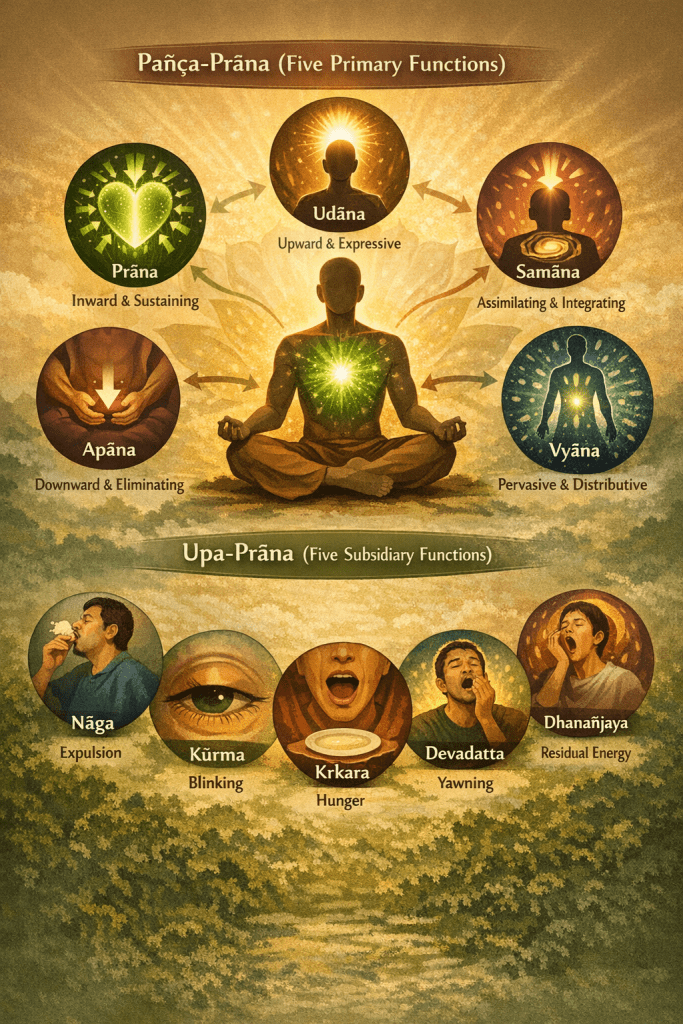
We now turn to the śāstric statement itself. The Gheraṇḍa Saṁhitā (Chapter 5, Verse 60) presents the classification of prāṇa as follows:
prāṇo’pānaḥ samānaś ca, udāno vyāna eva ca |
nāgaḥ kūrmaś ca kṛkaro, devadatto dhanañjayaḥ || 5.60 ||
Meaning : “Prāṇa, Apāna, Samāna, Udāna, and Vyāna — and also Nāga, Kūrma, Kṛkara, Devadatta, and Dhanañjaya — these are the ten prāṇic functions (vāyus).”
This verse shows that prāṇa, though one in principle, functions in multiple ways within the embodied system. These are traditionally understood as ten:
Pañca-Prāṇa Vāyus (Five Primary Functional Modes)
- Prāṇa — primarily associated with inward (inhalation) and life-sustaining functions
- Apāna — primarily associated with downward movement, elimination, and releasing functions
- Samāna — primarily associated with digestion, assimilation, and balancing functions.
- Udāna — primarily associated with upward movement, expression (Speech and voice, Verbal communication), and transformative functions.
- Vyāna — primarily associated with circulation and distribution throughout the body.
Upa-Prāṇa (Five Subsidiary Functional Modes)
- Nāga — primarily associated with expulsion functions such as belching or burping.
- Kūrma — primarily associated with eye functions such as blinking and eye protection.
- Kṛkara — primarily associated with hunger, thirst, and stimulating appetite.
- Devadatta — primarily associated with yawning and relaxation functions.
- Dhanañjaya — primarily associated with residual vital functions, retention, and post-death persistence in the body.
This classification does not divide prāṇa into separate entities. Rather, it shows different modes of functioning within a single principle. Prāṇa remains one, but appears in distinct functional expressions according to the needs of the system. Each vāyu represents a particular pattern of activity—such as intake, elimination, assimilation, expression, and distribution—through which embodied life is sustained.
These functions are not uniform. Some are predominantly associated with specific regions, indicating localized activity, while others—such as vyāna—operate throughout the entire system. This shows that prāṇic functioning is both localized and pervasive, supporting both specific processes and overall integration.
The subsidiary modes further refine this understanding by accounting for subtle and often unnoticed physiological processes. They show that prāṇa is not limited to major life functions, but extends even to the smallest operations that maintain continuity within the system.
Taken together, this tenfold presentation helps us understand prāṇa as a coordinated and integrated functioning. Though it appears as many, it remains one—expressing itself in diverse ways within the embodied system.
1. Prāṇa Vāyu — The Primary Inward Functional Force
hṛdi prāṇo vaset nityam
— “Prāṇa resides in the heart region”
(Gheraṇḍa Saṁhitā 5.61)
Prāṇa Vāyu functions in the heart-field (hṛd), understood not as a fixed anatomical location but as the central field of inward activation. Here vitality is received, sustained, and made available for the functioning of the whole embodied system. Prāṇa Vāyu represents the primary activating movement that makes life responsive and capable of engagement.
Through Prāṇa Vāyu, both levels of embodiment operate. The Sthūla Śarīra (gross body) functions physiologically, while the Sūkṣma Śarīra (subtle body) becomes capable of perception, cognition, and experience. It governs inward movement — the intake of breath, sensory impressions, and psychological engagement — and therefore stands at the beginning of all functional processes.
At the gross level, Prāṇa Vāyu expresses most clearly as inhalation, supporting respiration, cardiac activity, oxygenation, vitality, and the operational readiness of the sensory organs. Breathing is the most visible manifestation of Prāṇa Vāyu, though the principle itself is deeper than respiration alone.
At the subtle level, Prāṇa Vāyu energizes the antaḥkaraṇa — manas, buddhi, and ahaṅkāra — enabling perception, attention, and thought. The senses may be structurally intact, yet perception does not arise without prāṇic activation. What is often called “weak prāṇa” is not loss of energy but dispersion caused by mental conditioning. Prāṇa always flows according to the state of the inner instrument: agitation scatters it, while steadiness naturally gathers and harmonizes it.
The primary devatā associated with Prāṇa Vāyu is Indra Devatā, indicating the activating intelligence through which vitality, cognition, and sensory functioning become operative. Prāṇa Vāyu functions as the principle of inward reception. Every act of taking in — breathing, sensing, attending, or engaging with experience — depends upon its movement. Thoughts arise in the mind, but they remain active only through prāṇic support. Thus Prāṇa Vāyu does not produce knowledge; it enables the conditions in which knowing becomes possible.
Because it governs intake and initial activation, Prāṇa Vāyu forms the basis for all other vāyus. Without intake there can be no assimilation (Samāna), distribution (Vyāna), expression (Udāna), or elimination (Apāna). It therefore stands at the beginning of the entire functional sequence of life.
Disturbance in Prāṇa Vāyu appears physically as irregular breathing, fatigue, or instability, and subtly as restlessness or difficulty sustaining attention. These disturbances arise not from loss of prāṇa but from imbalance in living patterns and mental agitation. When balance is restored, breathing becomes smooth, vitality steady, perception clear, and attention naturally stable.
Philosophically, Prāṇa Vāyu belongs entirely to Prakṛti. It is a functional principle that enables activity but does not illumine experience. Consciousness (Cit) alone is self-revealing awareness. Maintaining this distinction prevents confusing vitality with the Ātman.
In summary, Prāṇa Vāyu is the primary inward and sustaining functional force that makes the embodied system alive, receptive, and capable of engagement. It prepares the ground for all subsequent prāṇic functions and is complemented by Apāna Vāyu, the equally essential movement of release and completion.
2. Apāna Vāyu — The Downward & Releasing Force
apāno guda-maṇḍale
— “Apāna functions in the anal and pelvic region.”
(Gheraṇḍa Saṁhitā 5.61)
Apāna Vāyu functions primarily in the pelvic field (guda-maṇḍala), understood as the domain of downward movement, grounding, and release. This description indicates a functional field rather than a purely anatomical location. Apāna governs the movement through which processes reach completion and balance is restored within the embodied system.
While Prāṇa Vāyu governs intake and activation, Apāna Vāyu governs release and stabilization. Life is sustained not only by what is received but also by what is relinquished. Without release, accumulation produces stagnation and disturbance. Apāna Vāyu therefore completes and stabilizes the processes initiated by Prāṇa Vāyu.
At the level of the Sthūla Śarīra (gross body), Apāna Vāyu directs all downward and outward physiological functions. These include elimination of waste, urination, reproductive processes, menstrual flow, childbirth, and the expulsion of metabolic by-products. Through these actions the organism maintains equilibrium by removing what has fulfilled its role.
At the level of the Sūkṣma Śarīra (subtle body), Apāna Vāyu operates as the principle of inner release. Just as the body expels physical waste, the antaḥkaraṇa must relinquish accumulated impressions, emotional residues, and completed experiences. Apāna supports the capacity to conclude experience without carrying unnecessary psychological burden forward.
The primary devatā associated with Apāna Vāyu is Yamarāja, representing the regulating intelligence through which release, completion, and lawful balance are maintained within the embodied system. The movement of Apāna reflects the condition of the antaḥkaraṇa. When the mind clings to memories, identities, or outcomes, the natural process of release becomes restricted. This may appear physically as heaviness or irregular elimination, and psychologically as attachment, emotional stagnation, or resistance to change. When the inner instrument becomes steady, Apāna flows naturally and restores balance.
Apāna Vāyu functions as the principle of grounding and stabilization within the prāṇic system. Whereas Prāṇa Vāyu activates and draws energy inward, Apāna anchors and consolidates. By directing movement downward, it prevents dispersion and supports integration of experience.
Because it governs completion, Apāna Vāyu forms an essential part of the functional sequence of the vāyus. Without release, assimilation cannot finalize, distribution becomes burdened, expression loses stability, and renewal becomes impossible. Together, Prāṇa and Apāna establish the primary rhythm of embodied life — reception followed by completion.
Disturbances in Apāna Vāyu appear physically as obstruction, instability, or heaviness, and subtly as fear of letting go, emotional accumulation, or tamasic inertia. These conditions do not arise from loss of prāṇa but from imbalance in living patterns and mental conditioning.
When Apāna Vāyu becomes balanced, stability and lightness arise naturally. Elimination becomes effortless, the body feels grounded, and the mind gains the capacity to release experiences without residue. Balance develops through moderation, non-clinging, and alignment with natural processes rather than forceful control.
Philosophically, Apāna Vāyu belongs entirely to Prakṛti. It enables the process of release but does not illumine experience. Consciousness (Cit) alone is self-revealing awareness. Recognizing this distinction prevents confusing physiological or psychological relief with realization.
In summary, Apāna Vāyu is the downward and releasing functional force operating as physiological elimination in the gross body and experiential clearing in the subtle body. By allowing completion and renewal, it complements Prāṇa Vāyu and prepares the system for the next stage of prāṇic functioning — Samāna Vāyu.
Āsana
haṭhasya prathamāṅgatvād, āsanaṁ pūrvamucyate |
kuryāttad āsanaṁ svairyam, ārogyaṁ cāṅga-lāghavam ||
(Haṭha Yoga Pradīpikā C1 V17)
Meaning : “Āsana is taught first because it is the initial limb of Haṭha Yoga. By practicing āsana, one attains steadiness, freedom from disease, and lightness of the body.”
Āsana is taught first because Haṭha Yoga begins with the refinement of the bodily instrument through which prāṇa operates. The yogic path proceeds by transforming the human system from the gross to the subtle. Before prāṇa can be regulated and higher practices undertaken, the body must become stable, purified, and free from obstruction.
The practitioner functions through both the Sthūla Śarīra (gross body) and the Sūkṣma Śarīra (subtle body), which includes prāṇa, the vāyus, and the network of nāḍīs. Āsana serves as the means by which physical structure influences subtle functioning. By establishing correct alignment and reducing unnecessary tension, the body becomes a suitable vessel for balanced prāṇic movement.
Stabilization Through Āsana
Restlessness of the body disturbs prāṇa, and disturbed prāṇa produces instability throughout the system. Through consistent āsana practice, muscular agitation decreases and physiological rhythms become regulated. The practitioner experiences svairyam — natural ease and freedom in posture — where effort becomes relaxed and sustainable rather than forced.
Regulation of Prāṇa
Āsana does not create prāṇa; it removes impediments to its flow. Proper positioning of the spine, chest, and abdomen allows breathing to become effortless, enabling Prāṇa Vāyu to function efficiently. As prāṇic movement becomes orderly, vitality increases and the organism functions with greater clarity and responsiveness.
Harmonization of the Five Vāyus
The stability gained through āsana allows coordinated functioning of all five vāyus:
- Prāṇa Vāyu stabilizes through balanced inhalation.
- Apāna Vāyu becomes grounded through pelvic stability.
- Samāna Vāyu supports digestion and assimilation through balanced abdominal pressure.
- Vyāna Vāyu distributes energy evenly when bodily tension decreases.
- Udāna Vāyu becomes clear when the spine remains upright and unobstructed.
Thus, āsana prevents the scattering of prāṇic energy caused by habitual imbalance and prepares the system for deeper yogic practices.
Harmonization of Nāḍī Flow
Irregular posture and lifestyle create asymmetry in prāṇic movement within the nāḍī network. Through balanced and symmetrical positioning, āsana gradually equalizes these flows. When prāṇa moves evenly, internal stability arises, creating suitable conditions for higher practices of Haṭha Yoga.
Preparation of the Energetic System
Āsana establishes structural and prāṇic stability throughout the body. Rather than forcibly awakening subtle centers, it prepares the ground through purification, balance, and steady cultivation. Transformation occurs naturally as prāṇa flows without obstruction.
Purpose of Āsana
Āsana is therefore not an end in itself but a preparatory sādhana. Through practice, the body becomes healthy (ārogya), light (aṅga-lāghava), and free in movement (svairyam). With physical disturbance reduced and prāṇa harmonized, the practitioner becomes ready for prāṇāyāma and the subsequent stages of Haṭha Yoga.
For this reason, the tradition declares āsana to be the first limb — the foundation upon which the entire process of Haṭha Yoga rests.
Which Āsana Should We Begin With?
When we ask, “Which āsana should we begin with?”, we must understand that Yoga is not merely training the body but preparing the entire embodied system for stable sitting, prāṇāyāma, and meditation. The real question is therefore not which posture comes first, but how the body becomes ready for effortless sitting.
Preparation Before Posture
A common mistake is to begin immediately with advanced seated postures such as Siddhāsana or Padmāsana. When the body is unprepared, strain appears in the knees, hips resist opening, the spine collapses, breathing becomes irregular, and prāṇa becomes disturbed. Meditation cannot arise from discomfort; Yoga begins with intelligent preparation rather than ambition.
Āsana must first prepare the whole field through which prāṇa operates.
Beginning at the Foundation
Preparation starts with the lower limbs, the base of support. Mobilizing the toes, ankles, knees, and hips establishes grounding and prevents strain in seated practice. True readiness for meditation arises from hip freedom, not forcing the knees into position. At the prāṇic level, this stabilizes Apāna Vāyu, providing the necessary foundation for higher practices.
Pelvis and Trunk — The Central Axis
Preparation then moves to the pelvis and trunk. The pelvis must be stable yet relaxed, the spine upright without rigidity, and the abdominal region balanced to support digestion and breath. Here Prāṇa Vāyu and Samāna Vāyu begin to cooperate, allowing breathing and internal balance to synchronize.
Upper Body Relaxation
The shoulders, arms, and hands remain free of unnecessary effort. When tension reduces, Vyāna Vāyu distributes energy evenly throughout the body, preventing fatigue and supporting sustained posture.
Neck and Head — Quieting the System
Finally, alignment reaches the neck and head. The throat softens, the jaw relaxes, and the eyes become quiet. This supports Udāna Vāyu and reduces sensory agitation, allowing prāṇa to settle inward.
The True Beginning
Thus, the first āsana is not a single posture but systematic preparation of the whole body. Only then do seated postures such as Svastikāsana, Vajrāsana, Siddhāsana, or Padmāsana arise naturally.
When preparation is complete:
- Apāna provides grounding,
- Prāṇa flows freely,
- Samāna stabilizes the center,
- Vyāna distributes energy evenly,
- Udāna supports uprightness and inner elevation.
Āsana therefore brings the vāyus into cooperation. As the body becomes quiet, prāṇa stabilizes; as prāṇa stabilizes, the mind settles. Meditation then arises naturally rather than through force.
