Chapter 5 -Dialogue between Vidura and Maitreya—Tattvas and their Deities
Śrī Śuka said:
1.) Vidura, the noblest among the Kuru lineage, whose heart had been sanctified by unwavering devotion to the imperishable Lord Śrī Kṛṣṇa, approached the sage Maitreya—an ocean of transcendental wisdom—who was then residing at Haridvāra (the gateway of the celestial river, Gaṅgā, so-called because the river descends into the plains at this point). Pleased by Vidura’s pure-hearted nature, humility, and virtuous conduct, the sage graciously received him, whereupon Vidura reverently inquired as follows:
Vidura said:
2.) O venerable sage, people engage in countless actions in pursuit of happiness, yet neither do they attain true joy nor do they find release from sorrow. On the contrary, bound by the very fruits of their deeds, they repeatedly fall into the cycle of suffering. Therefore, O revered one, kindly enlighten me with your compassion—what, then, is truly auspicious and worth pursuing in such a condition?
3.) The blessed devotees of Lord Janārdana (Śrī Kṛṣṇa), wander this world not for their own sake, but out of boundless compassion—to bestow divine grace upon those unfortunate souls who, deluded by ignorance, have turned away from the Lord and fallen into the path of adharma. Ensnared by suffering and bereft of true direction, such souls are uplifted only by the merciful presence of these saintly beings (such as you).
4.) O most exalted sage, kindly reveal to me that sacred and blessed path by which a person may attain the grace of the Supreme Person (Śrī Kṛṣṇa). By treading the path of devotion, one’s heart becomes purified, and the Lord—pleased by such sincere surrender—is unveiled in due course within their purified hearts. In His boundless mercy, He then bestows the eternal and primordial wisdom, through which the seeker comes to behold the highest Truth in all its radiance.
5-6.) I humbly beseech you to reveal to me the divine deeds of the Supreme Person—He who is the sovereign of all three worlds and completely free from all constraints. What divine play does He enact when He graciously descends into the realm of matter? How does He, though ever actionless and complete in Himself, initiate the creation of this cosmos at the dawn of time? How does He, having manifested the universe upon a stable foundation, sustain all living beings with the means for their subsistence (such as maintenance, nourishment, support & livelihood)? And how does He, at the end of the cosmic cycle, withdraw the entire creation into the sanctuary of His own being, ceasing all outward activity and abiding in deep union with His Yogamāyā? Finally, how does that same One—unchanging, all-pervading, the indwelling Lord and supreme Master of all yogīs—recreate the universe and, entering it as the Inner Controller, manifest Himself in countless diverse forms, though ever remaining one without a second?
7.) Kindly narrate to me as well the divine glories of the Lord who joyfully enacts in His various avatāras—sacred descents into this world—undertaken solely for the protection and upliftment of the brāhmaṇas, the cows, and the celestial gods. Though He performs these wondrous acts as a mere līlā (divine sport), their glory is boundless and sanctifying. My heart is never satisfied, however much I hear the ambrosial tales of Śrī Kṛṣṇa (the crest-jewel of true glory), for His glories are like nectar to the soul, ever fresh and ever captivating.
8-9.) O foremost among the brāhmaṇas, I humbly entreat you to reveal yet another mystery: By what divine principles did the Supreme Person, the sovereign ruler of all worlds, bring forth the various realms of existence, along with their presiding deities? How did He, the Self-existent Nārāyaṇa—the eternal Creator of the universe—manifest even the dark regions that lie beyond the great mountain of Lokāloka, wherein dwell countless classes of beings, each assigned their unique roles? And how did that all-knowing Lord endow every created being with its own distinct nature, function, form, and name, fashioning the grand cosmic order with His unfathomable wisdom and will?
Special Note – In vedic cosmology, Lokāloka is considered as a colossal mountain belt that plays a significant role as a cosmic boundary. It refers to a great cosmic mountain range that serves as a boundary between the known, inhabited universe (loka) and the regions of darkness and unmanifestation (aloka).
Meaning of this word Lokāloka, Loka = world, realm, region of existence. Aloka = non-world, realm of darkness or non-existence. Lokāloka = the border between loka (inhabited, illuminated worlds) and aloka (unmanifest, dark, uninhabited space).
Boundary between Light and Darkness: Its name literally means “a world and no world,” or “bright and dark” (Loka means world/light, Aloka means no world/darkness). It acts as a dividing line between the illuminated regions of the universe, where the sun and other celestial bodies shed their light, and the vast, dark void of unilluminated space beyond.
Edge of the Known Universe: In many Puranic descriptions, Lokāloka encircles the seven concentric island-continents (dvīpas) and oceans that constitute the known world (Bhūmaṇḍala). Beyond this mountain lies an area of perpetual darkness, effectively marking the limits of the visible or directly perceivable universe for most beings.
Immensely Large: It’s described as being incredibly vast, often cited as ten thousand yojanas (a unit of ancient Indian measurement, roughly 8 miles per yojana) in both breadth and height.
Inhabited by Special Beings/Uninhabited: While it delineates regions, some texts mention specific beings or guardians (like the four Diggajas, elephant deities) residing on its slopes, while other descriptions emphasize that the land itself beyond it is uninhabited or barren.
Cosmic Barrier: It’s seen as a natural barrier that regulates the spread of light from the sun and other luminaries, ensuring that certain regions remain in darkness.

10.) O revered sage, I have on many occasions heard from the divine lips of Śrī Vyāsa the description of duties prescribed for the different varṇas (& Āśrama) in the society. Yet, having pondered deeply, I find myself weary of all such dharmas that lead only to fleeting and trivial pleasures. My heart now seeks no delight other than the ambrosial stream of divine kathā—the nectarean narrations of Śrī Kṛṣṇa’s glories, in which alone I find true fulfillment and eternal joy.
11.) Indeed, who could ever feel satiated by the divine narrations of Śrī Kṛṣṇa—whose lotus feet are the very fountain of all sanctity—when such sacred stories are extolled by great sages like Nārada and echoed in the holy assemblies of saintly souls like yourself? For when these nectarean tales enter through the gateway of the ears, the Lord Himself takes residence within the heart and severs the binding knots of worldly attachment—especially to home and family—that hurl the soul into the ceaseless whirlpool of birth and death.
12.) It was with the noble intent of glorifying the divine qualities of the Supreme Lord that your esteemed friend, the sage Kṛṣṇa Dvaipāyana (Vyāsa), composed the great Mahābhārata. Though it outwardly portrays worldly themes and the allure of sense pleasures, it subtly and skillfully draws the minds of humans toward the eternal stories of Śrī Hari. Thus, even while appearing to narrate mundane events, it leads the sincere listener toward the supreme goal—devotion to the Lord.
13.) The divine attraction awakened by hearing the sacred glories of Śrī Hari gradually deepens in the heart of the devoted listener, and as it blossoms, it naturally gives rise to dispassion toward all other worldly pursuits. Indeed, for the one who has tasted the bliss born of constant remembrance of the Lord’s lotus feet, this devotion swiftly dispels all sorrow and suffering, leaving the person immersed in the nectar of divine joy.
14.) I feel pity at the plight of those ignorant souls who, due to the burden of their own sins, turn away from the sacred narrations of Śrī Hari. Such unfortunate beings are truly worthy of compassion—even from those who themselves are objects of pity. Wasting their precious lives in vain speech, futile actions, and idle thoughts, they remain blind to the eternal truth. Meanwhile, the relentless Lord of Time silently shortens each moment of their allotted lifespan, drawing them ever closer to death, while they remain aloof to the glory of the Lord.
15.) Therefore, O Maitreya, noble son of Kuśāru and compassionate friend of the sorrowing, I earnestly entreat you: just as a bee gathers the nectar from many blossoms, kindly distill for me the very essence of all sacred narrations—the divine stories of Śrī Hari, the Supreme Giver of auspiciousness and the Eternal Abode of all sacred glory. Please recount them to me for my highest welfare, that my heart may be sanctified and my soul awakened through the nectar of His divine līlās.
16.) Please narrate to me the wondrous and superhuman feats of the Supreme Person, which He manifests when He descends into the realm of matter, veiling Himself through His own divine energy—Māyā—for the purpose of creation, sustenance, and dissolution of the cosmos. May my heart be illumined by the glorious līlās of that timeless Master who, though untouched by the world, enters it out of boundless compassion.
Śrī Śuka said:
17.) Thus lovingly questioned by Vidura, whose heart longed for the highest good of all beings, the venerable sage Maitreya (noble son of Kuśāru), honored him with deep reverence and began to speak, his words flowing with the grace of wisdom and devotion.
Maitreya said:
18.) O noble-hearted Vidura, your question is a great blessing for all of humanity, for it touches upon the highest truth and the eternal welfare of all beings. Indeed, your mind is already fixed in unwavering devotion upon the Supreme (Śrī Kṛṣṇa), who is beyond the grasp of the senses. Because of this divine inclination, your fame shall resound throughout the world, sanctified by your quest for the Absolute.
19.) O Vidura, it is no surprise that you have so thoroughly devoted your heart to Śrī Hari, the Lord of all creation, through your exclusive and unwavering devotion. After all, you are the illustrious son of the great sage Bādarāyaṇa (Vedavyāsa), whose very birth was for the upliftment of the world. Such pure devotion as yours is but a natural fruit that one receives when surrendered to Śrī Hari.
20.) You are verily none other than the exalted Yama, the divine chastiser and upholder of righteousness, who has descended to this world by the will of destiny—incarnated through the womb of a maidservant, as ordained by the curse of the sage Māṇḍavya. This birth took place through the great sage Vyāsa, son of Satyavatī, to fulfill a divine purpose following the passing of her son, King Vicitravīrya. O Vidura, though born in such a manner, your true identity shines forth as the very embodiment of dharma.
21.) Indeed, you are ever dear to the Supreme Lord and equally beloved by His faithful devotees. Therefore, when the Lord prepared to withdraw His divine presence from this world, He entrusted me with the sacred task of imparting to you the highest wisdom (of God Realization)—knowing well that your heart is a sanctified abode, fit to receive His eternal truth.
22.) Therefore, I shall now recount to you, in their proper sequence, the divine pastimes of the Supreme Lord—wondrous acts manifested through His inscrutable Yogamāyā—for the creation, sustenance, and dissolution of the universe. These sacred līlās are not bound by worldly causality, but are revelations of His infinite will and compassion.
23.) In the beginning—before all names, forms, and multiplicities came into being—there existed only the One Supreme Bhagavān (Ādī Nārāyaṇa / Māhā Viṣṇu), who is the all-pervading Self (Brahma / Consciousness) of all selves (jīvas), the limitless Lord (Nārāyaṇa), alone existed. By His own sovereign will (ātma-icchā), He manifested Himself as the diverse multitude of living beings (expanded Himself as the individual souls / jīvas, & non living beings), bearing distinct natures and characteristics, yet all rooted in Him alone. By His own will, He remained alone—self-effulgent, complete, and immersed in the bliss of His own infinite being.

24.) Verily, He alone existed then as the one eternal Seer—the sole Light that illumines all. Yet, there was nothing to behold (as an object), for the universe had not yet emerged. Though His divine vision was ever-awake, His potencies—such as Māyā and all creative energies—lay in a dormant state (unmanifest). In that profound stillness, the all-conscious Lord, though fully aware, beheld none but Himself and seemed, in His own līlā of concealment, as though He did not exist at all.
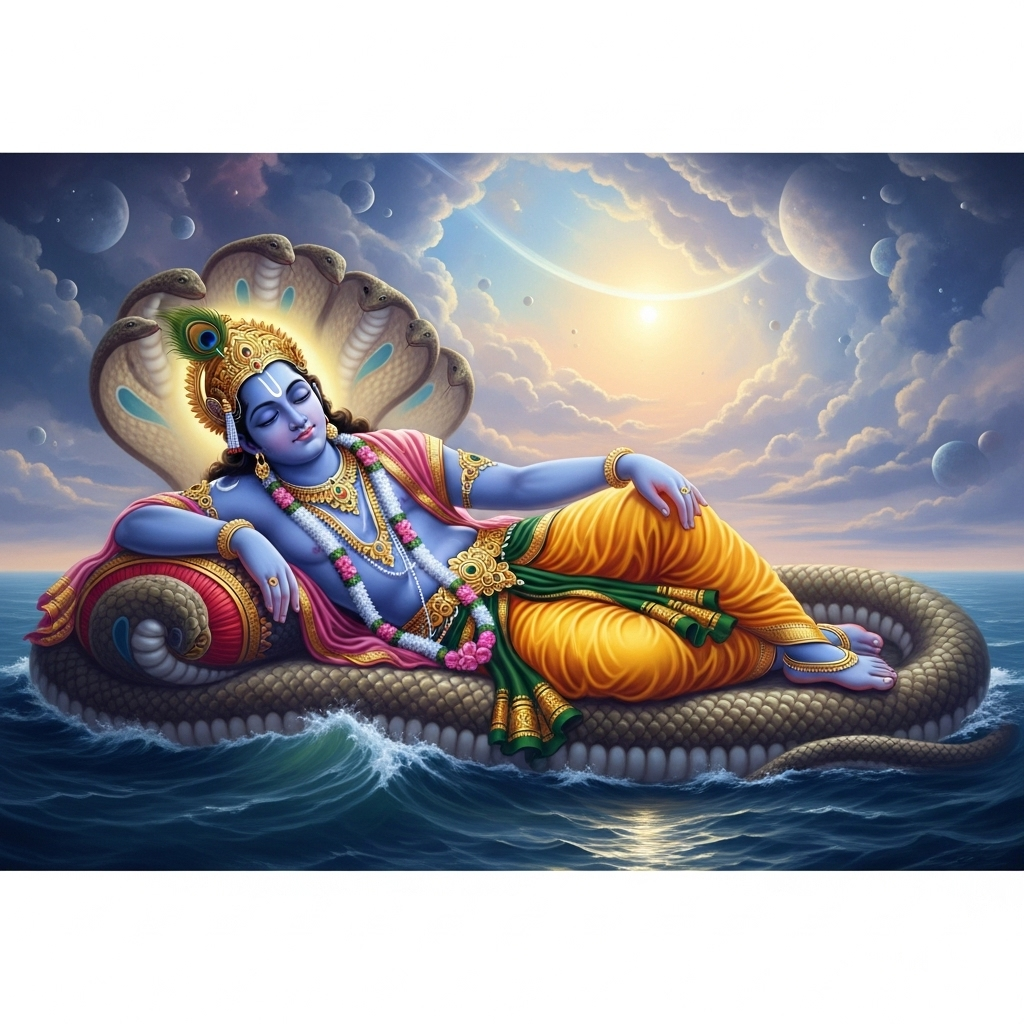
25.) It is that divine energy of the all-seeing Lord (manifesting in the form of search for an object) that is known as Māyā, the mysterious power that veils and reveals, being both the cause and the effect. O blessed Vidura, through this wondrous Māyā, the all-pervading Lord, full of inconceivable potencies, brought forth this vast universe in accordance with His divine will and playful līlā.

26.) When the perfect equilibrium of the three guṇas—constituting the Lord’s own inscrutable Māyā—was stirred (disturbed) by the irresistible force of Time, then the Supreme Lord, ever transcendent and untouched by matter, lovingly cast His glance upon it. Into that primordial field, He entered as the Puruṣa—His own divine expansion—and gently implanted the subtle seed of consciousness, the Cidābhāsa (jīva / reflected consciousness), destined to journey through His sacred creation.

27.) From that Unmanifest Reality (Prakṛti / Māyā) and stirred into activity by the glance of Kāla (Time)—there arose the Mahat-tattva (the cosmic principle of divine intelligence). Endowed with the power to dispel the darkness of ignorance, it shines with the radiance of spiritual understanding (vijñāna). Within it lies the potential of the universe in its subtle, unmanifest state, awaiting the loving will of the Supreme Lord to blossom forth into creation.

28.) Impelled by the reflected consciousness (cidābhāsa, the conditioned jīva / reflected consciousness), stirred by the three guṇas (the subtle forces of Māyā) and activated by the flow of Time, this Mahat-tattva came under the compassionate vision of the Supreme Lord. Moved by His divine will, it underwent a transformation, embracing the intention to manifest this universe as a part of His infinite līlā, wherein even creation becomes an expression of His love and mercy.

29.) As the Mahat-tattva underwent further transformation under the Lord’s divine will, there emerged the subtle principle of Ahaṅkāra (the ego) not separate from Him, yet bound by Māyā. This Ahaṅkāra, pervaded by the threefold potencies of Adhibhūta (the material elements), Adhyātma (the individual self), and Adhidaiva (the presiding deities), became the root cause of the five gross elements (also known as bhūtas such as earth, water, fire, air, space), the ten indriyas (organs of perception and action), and the mind (manas). All these arose to serve the unfolding of the Lord’s cosmic play.

Special Note –
1. Adhibhūta = Gross elements / Body
2. Adhyātma = Inner self / Jīva / Soul
3. Adhidaiva = Celestial/divine forces / Sun-god, Moon-god, etc.
30.) The principle of Ahaṅkāra (ego), born of the Lord’s will—manifests in three distinct forms, each governed by a predominant guṇa: the Vaikārika (sāttvika) which is radiant with clarity and harmony; the Taijasa (rājasa) which is dynamic and impelled by action; and the Tāmasa (tamas) which is veiled in darkness and inertia. From the Vaikārika aspect of this ego, the mind (manas) emerged—subtle, reflective, and ever restless, yet ultimately meant to be stilled in the remembrance of the Lord. From this same sāttvika Ahaṅkāra arose the divine controllers—the devatās (who preside over the functions of the senses). By their grace and presence, the jīva is enabled to perceive the objects of the world, though all such perception ultimately exists to awaken the soul’s vision of the Supreme, the true seer and source of all.

31.) From the rājasa aspect of ahaṅkāra (the ego colored by the guṇa of passion and activity) arose the ten instruments of interaction: the five senses of perception (jñānendriyas) and the five organs of action (karmendriyas), through which the jīva, deluded by separation, engages with the world. From the tāmasa ahaṅkāra, veiled in ignorance, evolved the subtle principle of sound (śabda-tanmātra), the seed of all further material manifestation. From this subtle sound emerged ākāśa—ether—pervading all things and serving as a reflection of the Supreme Spirit, Brahma, whose presence is all-encompassing, yet untouched. Just as ether supports all forms without itself being constrained, so too does the Lord, ever-present and all-pervading, uphold the cosmos while remaining transcendental, untouched by the guṇas.
32.) When ākāśa (ether), infused with the subtle essence of sound, came under the compassionate gaze of the Supreme Lord—accompanied by Kāla (divine Time), Māyā (the Lord’s illusory potency), and the jīva (aṃśa / his part / reflected consciousness)—it gave rise to the subtle sensation of touch (sparśa-tanmātra). As this subtle element underwent transformation by His will, the element of vāyu (air) was brought forth—endowed with motion and life, a vital force that serves as an invisible servant in the unfolding of the Lord’s cosmic līlā.
33.) That mighty vāyu—the all-pervading air, vibrant with the Lord’s potency—underwent further transformation by His divine will. In union with ākāśa (ether), it gave rise to the subtle essence of form and color (rūpa-tanmātra). From this subtle principle emerged tejas (fire), the radiant illuminator of the worlds. It is fire that reveals form, dispels darkness, and symbolizes the shining presence of the Supreme Lord Himself (who is the original light behind all lights, the flame within each being of this creation).
34.) When tejas (fire), glowing with the Lord’s divine potency, came under His gracious vision and underwent transformation, it united with vāyu (air), along with the ever-present forces of Kāla (Time), Māyā (the deluding potency), and the jīva (reflected consciousness). From this sacred confluence arose the subtle essence of taste (rasa-tanmātra), from which emerged āpah (water)—cool, life-sustaining, and purifying. Water, born of divine intention, reflects the Lord’s compassion, for it nourishes all beings and softens the hardness of material existence, preparing the soul for its inward journey toward Him.
35.) When āpah (water), sanctified by the gracious sight of the all-seeing Supreme—who, as Brahma, beholds all through His infinite consciousness—came under His divine vision and underwent transformation, it joined with tejas (fire), along with Kāla (Time), Māyā (His illusory potency), and the jīva (the conditioned soul). From this sacred convergence was born pṛthvī (earth), the densest of the elements, bearing gandha (fragrance) as its unique quality. Earth, as the final evolute, becomes the ground of all manifestation, yet even in its apparent solidity, it remains but a servant of the Lord’s eternal līlā—a stage upon which the soul may awaken to His loving remembrance and return to His lotus feet.
36.) O blessed Vidura, know this with firm understanding: among the elements beginning with ākāśa (ether, air, fire, water, and earth), each successive element in the divine sequence of manifestation holds within itself an increasing array of qualities. For every effect, by its very nature, inherits the attributes of its cause, while also expressing its own distinct properties. Thus, the later elements, being further evolved, carry within themselves the composite qualities of the earlier ones, manifesting the Lord’s wondrous artistry, wherein cause and effect are lovingly interwoven in His cosmic līlā.
37.) The presiding deities of the mahat-tattva and other cosmic principles—though endowed with the traits of Kāla (Time), Māyā (the Lord’s deluding potency), and the jīva (individual consciousness, transformation, distraction, and sentience) are but radiant emanations (aṃśa-rūpas) of Lord Viṣṇu Himself, the Supreme Source of all. Yet, when they found themselves incapable of carrying out the divine task of creation—due to the diversity of their natures and the absence of harmonious coordination—they folded their palms in reverence and surrendered at the lotus feet of the Almighty Lord, offering heartfelt prayers, seeking His supreme guidance and grace.
Gods said:
38.) O Lord! We bow down at Your lotus-like feet, which, like a celestial umbrella, offer cooling relief to those scorched by the blazing heat of material existence. Even from afar, the renounced sages who take shelter of these divine feet are instantly freed from the vast miseries of saṁsāra. Such is the boundless grace that flows from surrender unto You.
39.) O Supreme Lord, Creator and sovereign Master of the universe! In this vast realm of saṁsāra, living beings, tormented by the threefold miseries (ādhyātmika, ādhidaivika, and ādhibhautika) find no true happiness. Therefore, O Paramātmā, O all-pervading Supreme Soul, we now seek refuge in the cooling shade of Your lotus feet, which bestow divine wisdom and dispel the darkness of ignorance.
40.) We take refuge at Your sanctifying lotus feet, O Lord—source of the sacred Gaṅgā, the holiest of all rivers, whose purifying waters wash away all sins. Those divine feet are ceaselessly sought by the great sages, whose minds are free from attachment, as they navigate the vast skies of Truth with the wings of the Vedas. And those very Vedas find their resting place—their eternal nest—in the lotus-like radiance of Your divine face.
41.) We take refuge in the sacred ground that bears Your divine lotus feet, O Lord—feet that are meditated upon within the purified hearts of Your devotees. Through reverent devotion—expressed by hearing and chanting Your holy names and glories—their hearts become sanctified. Thus, with wisdom fortified by dispassion, they gain mastery over the restless mind and abide in Your remembrance.
42.) O Lord! You have descended into this world of matter out of Your boundless compassion—to create, sustain, and dissolve the universe according to Your divine will. We all seek shelter at Your lotus feet, which, when meditated upon with faith and devotion, bestows supreme fearlessness upon those who worship them. They are the eternal refuge for all souls wandering in fear and bondage.
43.) O Supreme Lord! We offer our worship at Your lotus-like feet, which remain ever beyond the reach of those deluded souls who, though You dwell within their very hearts as the indwelling Self (antaryāmin), remain blind to You. Clinging obstinately to the wretched body as ‘I’ and to home and possessions as ‘mine’, they are unable to behold Your divine presence. But to the surrendered soul, those sacred feet are the highest and most radiant abode of refuge and divine love.
44.) O Lord of Lords, glorified by the greatest of beings! It is well known that those whose minds are swept away by the turbulent senses—drawn outward by the allure of external objects—fail to perceive the presence of Your devotees who have surrendered themselves to the dust of Your gracious and all-purifying feet. Absorbed in fleeting pleasures, such people remain blind to the luminous path of bhakti that Your true servants tread (for realizing You).
45.) But they, O Lord—whose hearts have been purified through deep devotion, kindled and intensified by relishing the nectar of Your divine līlās and sacred narrations—truly attain that sublime spiritual vision whose very core is dispassion. Endowed with such insight, they effortlessly ascend to Your eternal Abode, Vaikuṇṭha, the realm beyond sorrow, where pure souls dwell in loving service at Your lotus feet.
46.) Even so, O Supreme Lord, those wise ones who, through intense austerity and the discipline of yoga—fixing their minds upon the Self—conquer Your formidable energy of Māyā, do indeed merge into You, the Supreme Spirit. Yet their path is arduous and steep. In contrast, the path of devotion—worshiping You with love and surrender—is gentle and free from such hardship, for You are easily attained by bhakti alone.
47.) O Primal Lord, Eternal Origin of all! We, who are ever Yours, have been brought forth by You—each of us manifesting one after another—through the agency of the three guṇas: sattva, rajas, and tamas, which form the essence of our respective natures, all for the purpose of manifesting this universe. Yet, due to the diversity of our inherent dispositions, we remain fragmented and disconnected from one another, unable to act in perfect unity. Thus, O Lord, we find ourselves incapable of presenting before You the universe that is meant to serve as the sacred stage for the unfolding of Your divine pastimes (līlās).
48.) Therefore, O Unborn Lord, timeless and ever-compassionate! Kindly devise a means by which we may fulfill the task entrusted to us—so that we may bring forth the creation and offer it as a complete offering at Your divine feet at the appointed time. Let that divine arrangement also sustain us, and ensure that all beings yet to come may be firmly established, nourished without obstruction, and enabled to render their homage—both unto You, their Supreme Master, and unto us, according to Your will.
49.) You alone, O Immutable and Eternal Person, are the original cause—the very source—of us, the gods, and of all the subsequent evolutes of creation. It was You, O Unborn Lord, who in the beginning implanted the seed of conscious life—the jīva—into the womb of Your own divine energy, Māyā, who is the fountainhead of the three guṇas and the origin of all activity within this universe.
50.) O Supreme Soul! What service can we—the deities presiding over the Mahat-tattva and other principles of creation—offer unto You, for indeed, it is solely for this purpose that we have been brought into existence. O Lord, we exist only by Your mercy and depend entirely upon Your grace. Therefore, for the successful fulfillment of our divine task, we humbly pray: please bless us with Your divine vision and bestow upon us the power of Your creative energy, so that we may act as instruments in manifesting Your will.
Thus ends the fifth discourse entitled “Dialogue between Vidura and Maitreya—Tattvas and their Deities”, in Book Three of the great and glorious Bhāgavata Purāṇa, otherwise known as the Paramahaṁsa-Saṁhitā (the book of the God-realized Souls).
Summarization Of The Entire Chapter :
When Vidura, the great devotee of Bhagavān, returned to holy Haridvāra, his heart was already sanctified by unwavering love for Śrī Kṛṣṇa. There, he approached the noble sage Maitreya, who shone as an ocean of divine wisdom. With folded palms and humility, Vidura placed his deepest questions before the sage, not for his own sake, but for the eternal welfare of all souls wandering in this vast creation. His heart yearned to know: What is truly auspicious for humanity? How does Bhagavān, though ever perfect and actionless, create, sustain, and withdraw the universe? How do His incarnations, appearing out of sheer compassion, protect dharma and uplift the helpless? Vidura longed only for kathā—nectarean narrations of the Lord—which alone can soothe the soul and awaken eternal bliss.
Maitreya, moved by Vidura’s sincerity, honored him with words filled with grace. He declared that Vidura’s questions were not ordinary; they were auspicious for all beings, for they touched the very essence of truth—devotion to the Supreme. He reminded Vidura of his divine identity as Yama, born by the will of providence in human form, yet now sanctified by exclusive devotion to Śrī Hari. Because of this purity, Bhagavān Himself had arranged that the highest wisdom should be revealed to him through the lips of saintly teachers.
Maitreya then began unfolding the mystery of creation as a revelation of Bhagavān’s love. Before time, before name and form, before the play of Māyā, only He—the Supreme Nārāyaṇa—existed, self-effulgent, immersed in His own bliss. Out of His own will, He glanced upon His dormant energies, and with the stirring of Time, the perfect balance of the guṇas was disturbed. Thus, the great principle Mahat arose, shining with divine intelligence, followed by ahaṅkāra and the unfolding of the subtle and gross elements. Ether, air, fire, water, and earth—each in turn blossomed forth under His compassionate gaze, each carrying more qualities than the one before, becoming instruments for His līlā of creation.
But the gods who presided over these tattvas, though radiant emanations of Bhagavān, found themselves powerless to bring harmony to this vast diversity. In humility, they surrendered to His lotus feet and prayed with love. Their hymns were suffused with bhakti: they praised His feet as the cooling refuge in the burning desert of saṁsāra, as the source of the Gaṅgā’s sanctity, as the eternal shelter for the surrendered. They lamented how the deluded fail to recognize Him within their very hearts, clinging instead to false notions of “I” and “mine.” They glorified the power of bhakti, which alone easily grants access to Him, while other paths are arduous. And they pleaded: “O Lord, we are but instruments, unable to unite by ourselves. Please empower us with Your creative śakti, so that we may fulfill Your will and manifest the universe as an offering at Your divine feet.”
Thus, the chapter reveals in all tenderness how even creation is not a mechanical process, but an act of Bhagavān’s compassion. Every element, every deity, every principle is simply His own potency, arranged by His love. The devas themselves confess their helplessness and pray for His grace. And Vidura, the pure devotee, shows us the heart’s true aspiration: not fleeting dharmas or temporary duties, but the nectar of hearing and remembering Śrī Hari’s glories.
In this way, the Bhāgavata here teaches that the highest knowledge begins with surrender, that the mystery of creation is but the stage for Bhagavān’s eternal līlā, and that prema-bhakti—loving devotion to His lotus feet—is the only true refuge for the soul.
Short Questions & Answers :
Q1. Who was Vidura, and to whom did he approach for guidance?
A1. Vidura, the noblest among the Kuru lineage and sanctified by unwavering devotion to Bhagavān Śrī Kṛṣṇa, approached the sage Maitreya at Haridvāra, seeking divine wisdom for the highest welfare of all beings.
Q2. What did Vidura ask Maitreya about human suffering?
A2. Vidura inquired why, despite performing countless actions to seek happiness, people never attain true joy nor freedom from sorrow, but remain bound in saṁsāra. He asked what is truly auspicious and worth pursuing in such a condition.
Q3. How did Vidura describe the role of devotees and sages in the world?
A3. He glorified the devotees of Bhagavān as merciful souls who wander the world not for themselves but to uplift those deluded by ignorance and trapped in suffering—granting them divine grace and guidance back to the Lord.
Q4. What sacred knowledge did Vidura beg from Maitreya?
A4. He asked to be shown the blessed path that purifies the heart, draws down the grace of Śrī Kṛṣṇa, and reveals the eternal Truth, leading to liberation and eternal love of Bhagavān.
Q5. What specific questions did Vidura raise about Bhagavān’s cosmic līlā?
A5. He asked:
- How does Bhagavān create the universe at the dawn of time?
- How does He sustain and nourish all beings?
- How does He dissolve the cosmos at the end of time and reabsorb it into Himself?
- How does He then recreate it and enter it as the Inner Controller in infinite forms?
Q6. What did Vidura ask about Bhagavān’s avatāras?
A6. He asked to hear of the wondrous deeds of the Lord’s incarnations—performed to protect brāhmaṇas, cows, and devas—and desired the nectar of these līlās, which never lose their charm.
Q7. What did Vidura ask regarding cosmic realms like Lokāloka?
A7. He asked how Bhagavān manifested the various realms, including Lokāloka mountain, which divides the illuminated worlds from the dark, unmanifest regions, and how He gave each being its unique form, function, and destiny.
Q8. What was Vidura’s attitude toward worldly dharmas?
A8. Though he had heard descriptions of varṇāśrama-dharma from Vyāsa, Vidura confessed he had grown weary of them, seeing them as trivial. He only desired the ambrosial narrations of Śrī Hari’s glories.
Q9. Why did Vidura emphasize hearing kṛṣṇa-kathā?
A9. He said hearing Hari’s glories severs worldly attachments, especially to home and family, and installs Bhagavān Himself in the heart. This alone grants true fulfillment.
Q10. How did Vidura compare the Mahābhārata to kṛṣṇa-kathā?
A10. He explained that although the Mahābhārata outwardly narrates worldly events, it secretly directs people toward Śrī Hari, just as Vyāsa intended—to awaken devotion amidst apparent stories of dharma and pleasure.
Q11. How did Vidura express compassion for those who avoid hearing Hari-kathā?
A11. He pitied such souls as most unfortunate, wasting life in vain pursuits while Time steals away their lifespan, and they remain blind to the nectar of the Lord’s glories.
Q12. What final request did Vidura make of Maitreya?
A12. Like a bee collecting nectar, Vidura begged Maitreya to distill the essence of all scriptures—the divine līlās of Śrī Hari—and narrate them for his heart’s purification and eternal welfare.
Q13. How did Maitreya respond to Vidura’s questions?
A13. Maitreya honored Vidura, praised his devotion, and revealed his true identity as Yama born by destiny. He said Bhagavān Himself had entrusted him (Maitreya) to impart this wisdom to Vidura before His withdrawal from the world.
Q14. What did Maitreya first describe about creation?
A14. He said that before creation, only the One Bhagavān existed—self-effulgent, blissful, and complete. By His will and through His divine potency Māyā, the universe was manifested as His līlā.
Q15. What is the role of Māyā and Time in creation, according to Maitreya?
A15. Māyā is Bhagavān’s divine energy that veils and reveals reality. When Time disturbs the balance of the guṇas, the Lord glances upon Māyā, and from that glance arises Mahat-tattva (cosmic intelligence), followed by Ahaṅkāra (ego) and the subtle and gross elements.
Q16. How do the elements evolve step by step?
A16. From Ahaṅkāra arise:
- Mind and Devatās (sāttvika aspect),
- Senses and organs of action (rājasa aspect),
- Tanmātras and gross elements—sound → ether, touch → air, form → fire, taste → water, smell → earth (tāmasa aspect).
Each successive element inherits and expands the qualities of the previous.
Q17. What difficulty did the presiding deities face after their manifestation?
A17. Although born from the guṇas and Bhagavān’s will, they found themselves unable to coordinate or carry out creation due to their diverse natures.
Q18. What did the devas do in this helpless state?
A18. They folded their palms, surrendered to Bhagavān, and offered heartfelt prayers at His lotus feet, acknowledging Him as the true Creator and begging Him to empower them to fulfill their roles as His instruments.
Q19. How did the devas glorify Bhagavān in their prayers?
A19. They praised His lotus feet as the refuge of sages, the source of the Gaṅgā, and the object of Vedic hymns. They declared that His feet alone grant liberation, fearlessness, and bliss, and lamented that ignorant souls, bound by body-identification, cannot perceive Him.
Q20. What final prayer did the devas make?
A20. They acknowledged that they exist only by Bhagavān’s grace and prayed that He bestow His creative energy upon them so they could manifest creation, sustain beings, and offer everything back to His divine lotus feet.
