Chapter 22 – Marriage of Kardama and Devahūti
1.) Maitreya continued: The emperor, though inwardly humbled by hearing his own exalted virtues and glorious exploits being praised, composed himself with modesty and spoke in reply to the venerable sage, who was living the noble life of a recluse.
2.) The Manu said: From the mouth of the Cosmic Being, the Veda-svarūpa Puruṣa (the Being who is the very embodiment of the Vedas), were manifested you, the brāhmaṇas, endowed with profound austerity, sacred learning, and the power of yoga—ever detached from worldly pleasures of the senses. You were thus created for the protection and preservation of His very Self, manifest in the eternal Vedas.
3.) And for the protection of the brāhmaṇas, that same thousand-headed and thousand-footed Puruṣa brought forth us, the kṣatriyas, from His thousand mighty arms. Therefore, the brāhmaṇas is revered as His heart, while the kṣatriyas is honored as His protective limbs.
4.) For this reason, the brāhmaṇas and the kṣatriyas safeguard one another, and by doing so, they also uphold their own dharma. Yet, in truth, it is Bhagavān Himself—who is simultaneously the cause and the effect, and yet eternally immutable—who protects both, through each sustaining the other.
5.) All my doubts have now been dispelled merely by beholding you, for by your own compassionate will you have lovingly instructed me regarding the sacred duties of a king who seeks to protect his subjects.
6.) It is indeed my supreme fortune that I have gained your audience, for you are not easily perceived by those whose minds remain uncontrolled. My blessedness has increased manifold, for I have bowed down and touched with my head the sanctifying dust of your holy feet.
7.) By great fortune, I have now been instructed by your divine words, and in this way an immeasurable favor has been bestowed upon me. And how blessed I am, for with eager and open ears I have listened to the nectarine flow of your enchanting speech.
8.) Therefore, O venerable sage, kindly grant me your gracious attention once more, for my heart is troubled out of deep affection for my beloved daughter, Devahūti.
9.) This daughter of mine—sister to Priyavrata and Uttānapāda—is seeking a worthy match, one who is equal to her in age, noble character, and exalted virtues.
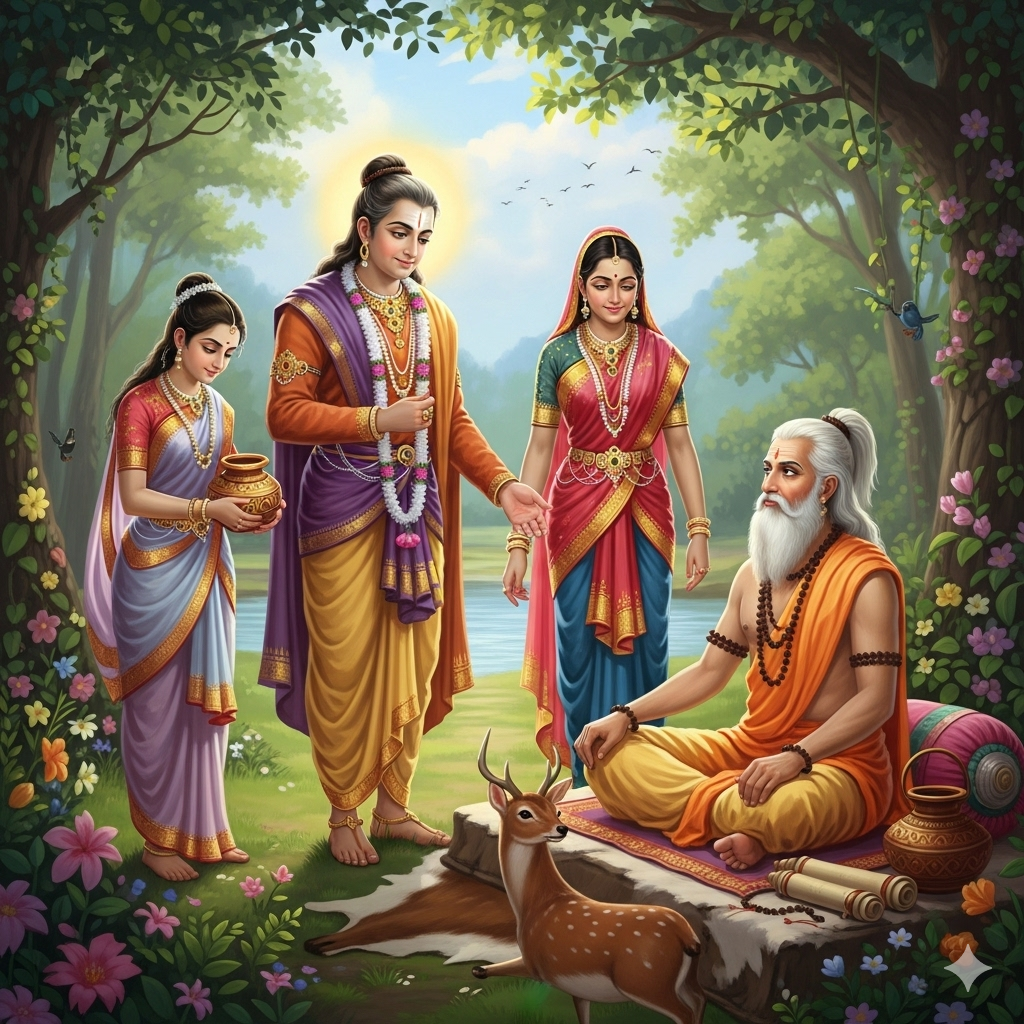

10.) Indeed, from the lips of sage Nārada she has heard of your noble qualities—your wisdom, youthful beauty, learning, and spotless character—and ever since, her mind has been fixed firmly upon you.
11.) Therefore, O foremost among the brāhmaṇas, I now offer her reverentially unto you. Accept her as your wife, for in every way she is fit to become your devoted helpmate in the discharge of sacred household duties.
12.) For it is not praiseworthy—even for one completely free from worldly attachment, and what to speak of one still drawn to sense-pleasures—to reject an object of desire when it comes unsought of its own accord.
13.) He who spurns what is freely offered to him, yet later begs the same from a miserly person, loses his good repute, and his pride is crushed by the disrespectful conduct of others.
14.) Moreover, O wise one, I have heard that you are inclined towards marriage. Therefore, I now offer you her hand. Accept it, for you have not taken the vow of perpetual celibacy, and I, her father, present her to you with joy.
15.) The sage replied: Truly, I too cherish the desire to marry, and since your daughter has not been given in marriage to another, our union according to the brāhma form—the most sacred among all rites—will indeed be supremely fitting.
Special Note – In this sacred form of marriage, the maiden, adorned according to her family’s means, is given by her father to a learned and worthy groom, following the procedures enjoined in the śāstras.

16.) Thus, the purpose of my household life, ordained by dharma, may be fulfilled through this daughter of yours. And who would not with honor accept Devahūti, who by her natural beauty and artless grace outshines even the brilliance of her ornaments?
17.) Once, as she sported upon the rooftop of her royal palace, her delicate form radiant, her graceful steps adorned with the melodious tinkling of anklets, she followed her ball with restless, bewildered eyes. At that very moment, the celestial Gandharva Viśvāvasu, celebrated for his beauty, beheld her and was overcome with infatuation, so much so that he fell stupefied from his aerial chariot.
18.) Tell me, what wise person would not welcome her—the very crest-jewel of womanhood, the noble daughter of Svāyambhuva Manu, the beloved sister of Uttānapāda—she who is unattainable even to those who have not worshipped the gracious feet of Bhagavān, and who now comes of her own accord, offering her hand to me?

19.) Therefore, I shall accept this virtuous maiden as my wife, with the understanding that I shall remain with her until she conceives by me a radiant offspring, a divine ray of the Supreme Spirit. After that, my resolve is to devote myself wholly to disciplines of renunciation and self-restraint, practices that bring no harm to any being, the very path of a true saṃnyāsī, which has been directly taught to me by Paramātmā Himself.
20.) For me, the highest authority in all these matters is none other than the immortal Bhagavān Śrī Hari, sovereign even over the Prajāpatis—the cosmic progenitors—from whom this wondrous universe has sprung forth, within whom it rests, and into whom it shall ultimately dissolve once again.
21.) Maitreya continued: O Vidura, wielder of the mighty bow, the sage spoke only this much and then fell silent, his mind absorbed in meditation upon Bhagavān, whose navel is adorned with the blossoming lotus. His serene countenance, graced with a gentle smile, completely captivated the heart of Devahūti.
22.) Understanding clearly the innermost feelings of both the queen and Devahūti, the emperor joyfully offered his daughter—who was a perfect match in every way—to the sage, resplendent with countless virtues.
23.) The empress Śatarūpā, overflowing with motherly affection, bestowed upon the newly-wed couple priceless gifts—jewels, garments, and articles of daily use—fitting for the sacred occasion.
24.) Relieved of his anxieties, the emperor embraced his daughter—now entrusted to a worthy husband—with a heart overwhelmed by tender affection.
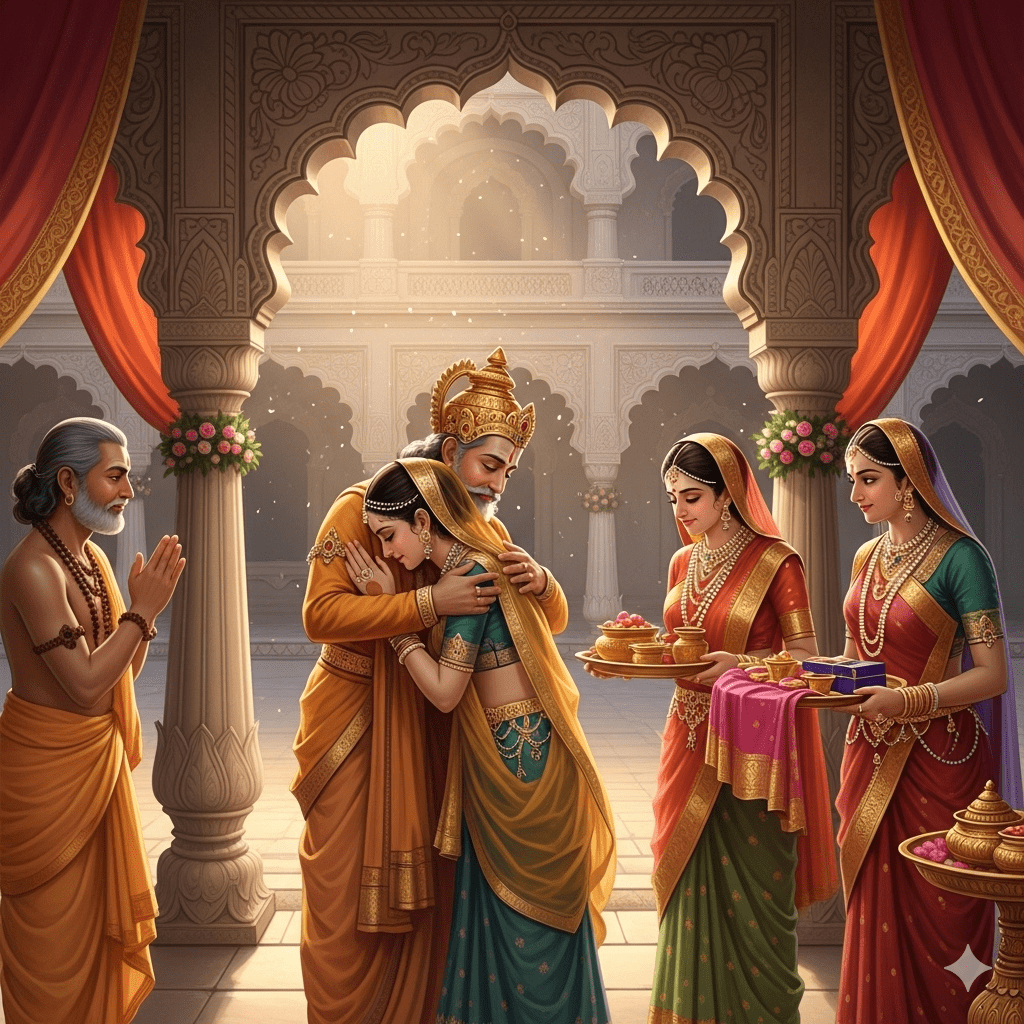
25.) Unable to bear separation from her, his eyes overflowed with tears again and again. Crying aloud, “My daughter, my darling child!”, he drenched her face with the stream of his love.
26–27.) Taking leave of the great sage with due reverence, the monarch mounted his chariot with his queen. Attended by his royal retinue, he journeyed towards his capital, beholding on both charming banks of the sacred Sarasvatī the hermitages of serene sages, who dwelt there in tranquillity and holiness.
28.) Overjoyed at news of his return, the subjects of Brahmāvarta came forth to welcome their sovereign. With songs, praises, and the harmonious sounds of musical instruments, they greeted their beloved ruler.
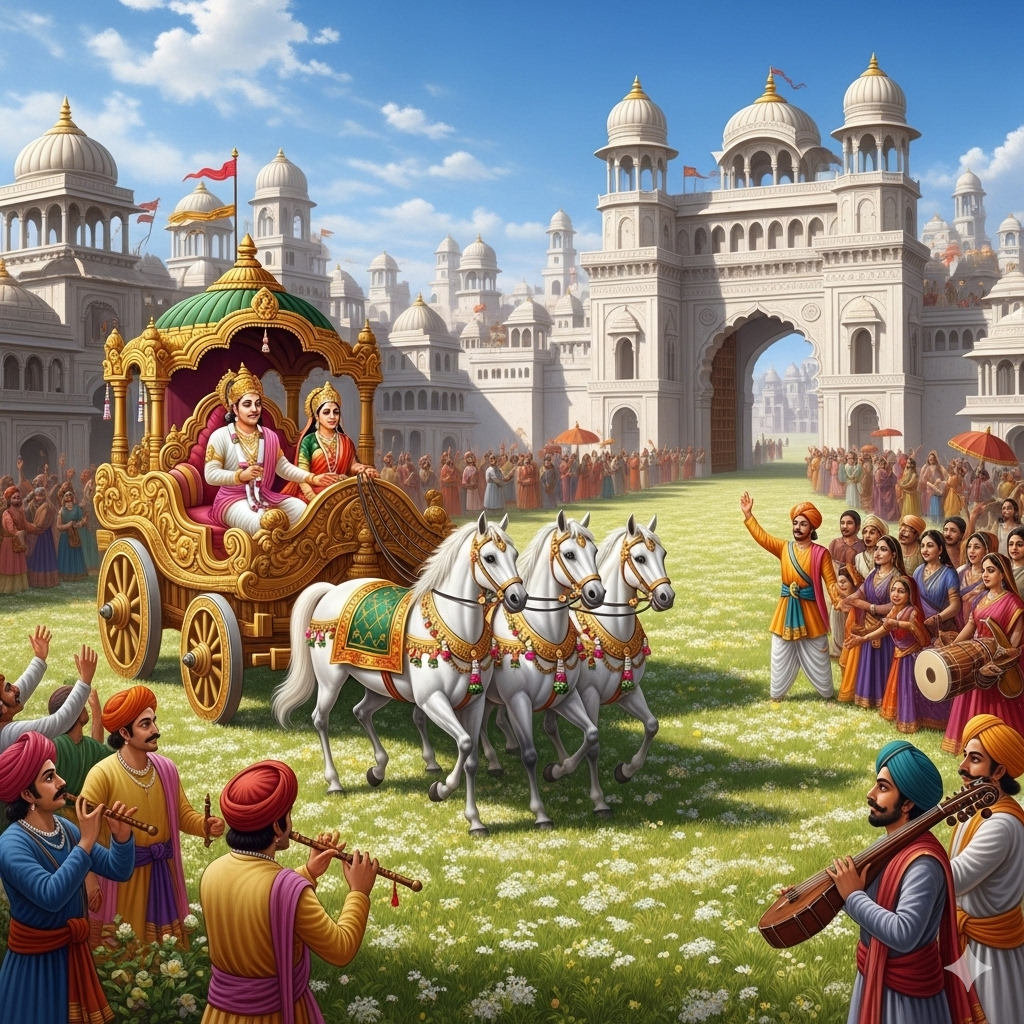
29–30.) That splendid city, known as Barhiṣmatī, was abundant in all prosperity. Its name arose from a wondrous event: when Bhagavān Viṣṇu once assumed the divine form of Varāha, the cosmic Boar, the sacred hairs that fell from His body turned into kuśa grass and kāśa grass, evergreen and sanctified. With these blades, the sages performed sacrifices, driving away obstructing demons, and through those yajñas they worshipped Bhagavān Viṣṇu Himself.
31.) It was there too that the venerable Manu spread a sacred seat woven of kuśa and kāśa, and with heartfelt devotion worshipped the presiding Lord of sacrifice, from whom he had earlier received as a boon the stability of the earth itself.
32.) Arriving in that holy city of Barhiṣmatī, where Manu resided, the emperor entered his palace. The very atmosphere of that place dispelled the threefold miseries: those arising from one’s own body and mind, those born of natural or divine forces, and those caused by other beings.
33.) There, in the company of his wife and children, he enjoyed sense-pleasures in harmony with dharma, never obstructing the higher goals of life—righteousness (dharma), prosperity (artha), and liberation (mokṣa). At dawn each day, celestial musicians with their consorts sang sweet praises of his noble deeds; yet the emperor’s heart delighted only in listening with love to the sacred narrations of Śrī Hari.
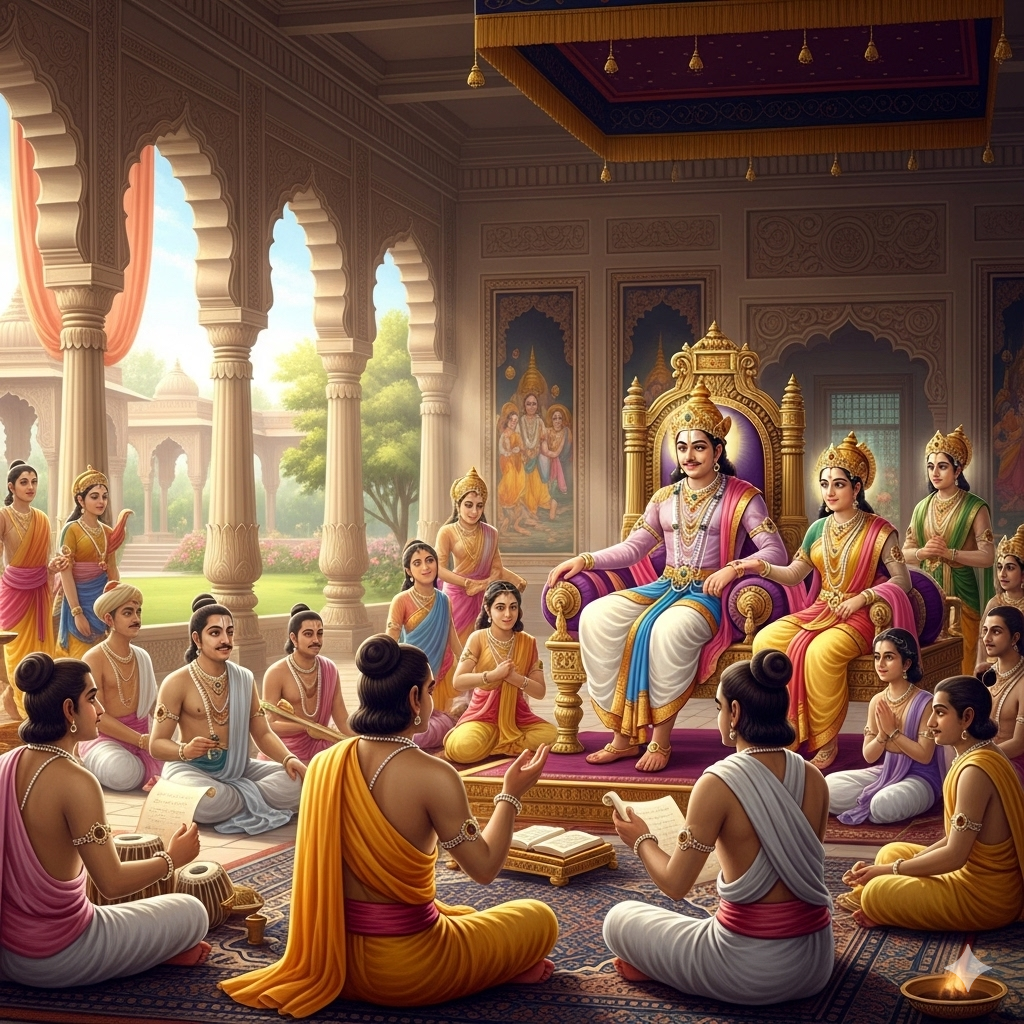
34.) Although Svāyambhuva Manu was a master in creating and arranging avenues of enjoyment, he was never ensnared by them, for his heart was anchored in devotion to Bhagavān and in deep contemplation of His presence.
35.) Thus, his long life, spanning an entire Manvantara, was never wasted. His every moment was absorbed in hearing, reflecting, composing, and narrating the divine stories of Bhagavān Viṣṇu.
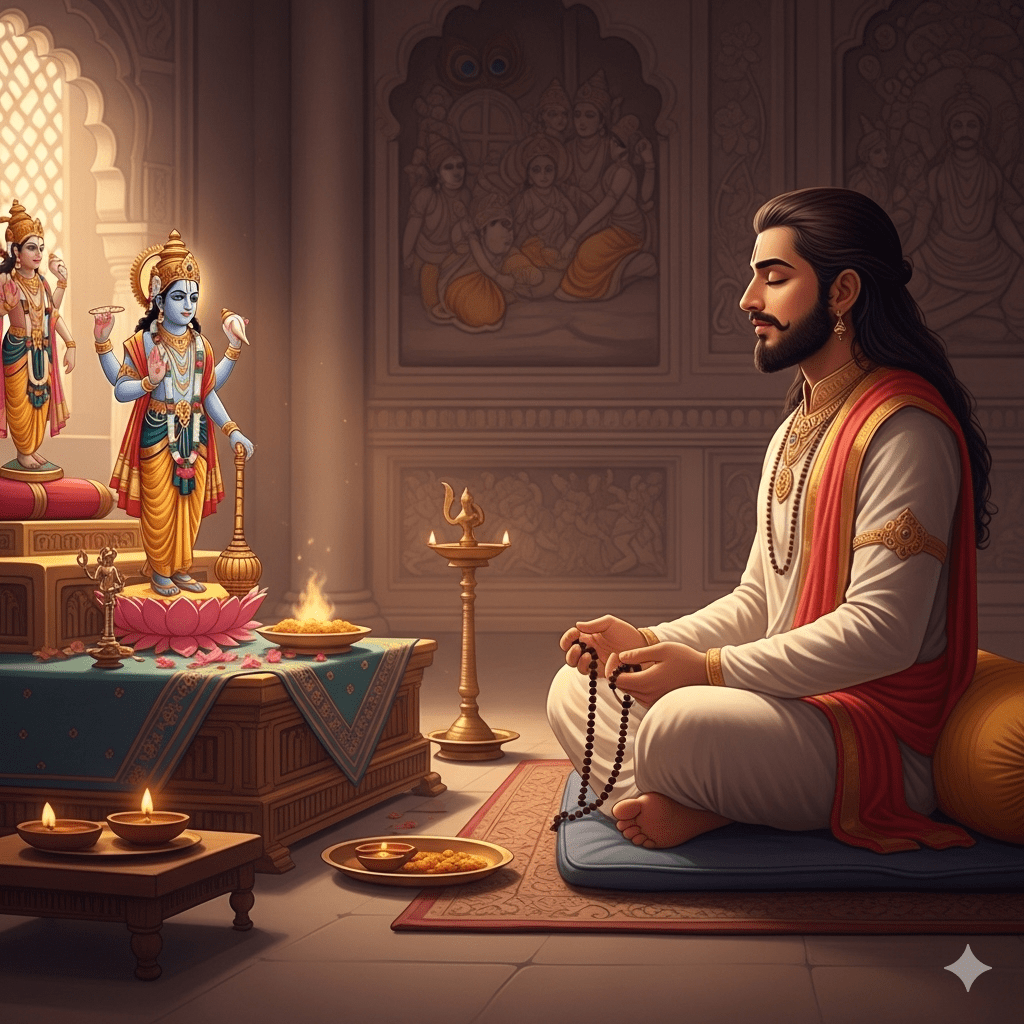
36.) Having transcended the three destinies born of the guṇas—sattva, rajas, and tamas—he spent his Manvantara of seventy-one cycles of the four yugas (Satya, Tretā, Dvāpara, and Kali) in pursuits centered upon Bhagavān Vāsudeva: meditating upon His eternal form, chanting His names and glories, and worshipping His manifestations with devotion.
37.) Tell me, O Vidura, son of Vyāsa, how can bodily or mental sufferings, or afflictions caused by nature, fate, or other beings, touch the one who has fully taken refuge in the lotus feet of Śrī Hari?
38–39.) Thus I have narrated to you the wondrous account of the first sovereign, Svāyambhuva Manu—worthy of all praise—who, out of compassion for every creature, instructed the sages on the sacred duties of humanity at large as well as the dharmas pertaining to each varṇa and each āśrama. Now, O Vidura, listen further to the glorious life of his daughter, the virtuous Devahūti.
Thus ends the twenty-second discourse entitled “Marriage of Kardama and Devahūti”, in Book Three of the great and glorious Bhāgavata Purāṇa, otherwise known as the Paramahaṁsa-Saṁhitā (the book of the God-realized Souls).
