Chapter 21 – Kardama’s Penance – Śrī Viṣṇu’s Boon
Vidura said:
1.) Among all dynasties upon this Earth, the lineage of Svāyambhuva Manu shines forth as the most revered and celebrated. O worshipful sage, I earnestly pray, please narrate to me in detail about that exalted race, whose progeny spread forth through the sacred union of household life.

2.) (You have already told us that) the two illustrious sons of Svāyambhuva Manu—Priyavrata and Uttānapāda—who, with righteous conduct and piety, governed the entire globe, dividing it into its seven great divisions (the dvīpas as they are called).
3.) And his noble daughter, the virtuous princess Devahūti, O holy brāhmaṇa, you have described as the devoted wife of the great sage Kardama, a Prajāpati and foremost among the progenitors of beings, O sinless one.
4.) Therefore, please tell me, O venerable sage, how many children were born to that exalted yogī Kardama through the princess Devahūti, who was herself adorned with the eightfold limbs of yoga—beginning with the yamas. I am eager to hear this in full, for my heart longs for such sacred knowledge.
5.) In the same way, O holy sage, please tell me how the venerable Ruci—another Prajāpati—and Dakṣa, the son of Brahmā and himself a progenitor of beings, begot children after receiving in marriage the other two daughters of Svāyambhuva Manu, namely Ākūti and Prasūti.
Maitreya replied:
6.) Commanded by Brahmā with the words, “Bring forth progeny!”, the worshipful sage Kardama engaged in intense austerities upon the sacred banks of the Sarasvatī river for a full period of ten thousand years.
7.) During those long years of penance, the great sage devotedly worshipped Śrī Hari, the merciful Bhagavān who bestows blessings upon those who surrender unto Him, engaging in various forms of worship, all accompanied by deep and unwavering meditation.
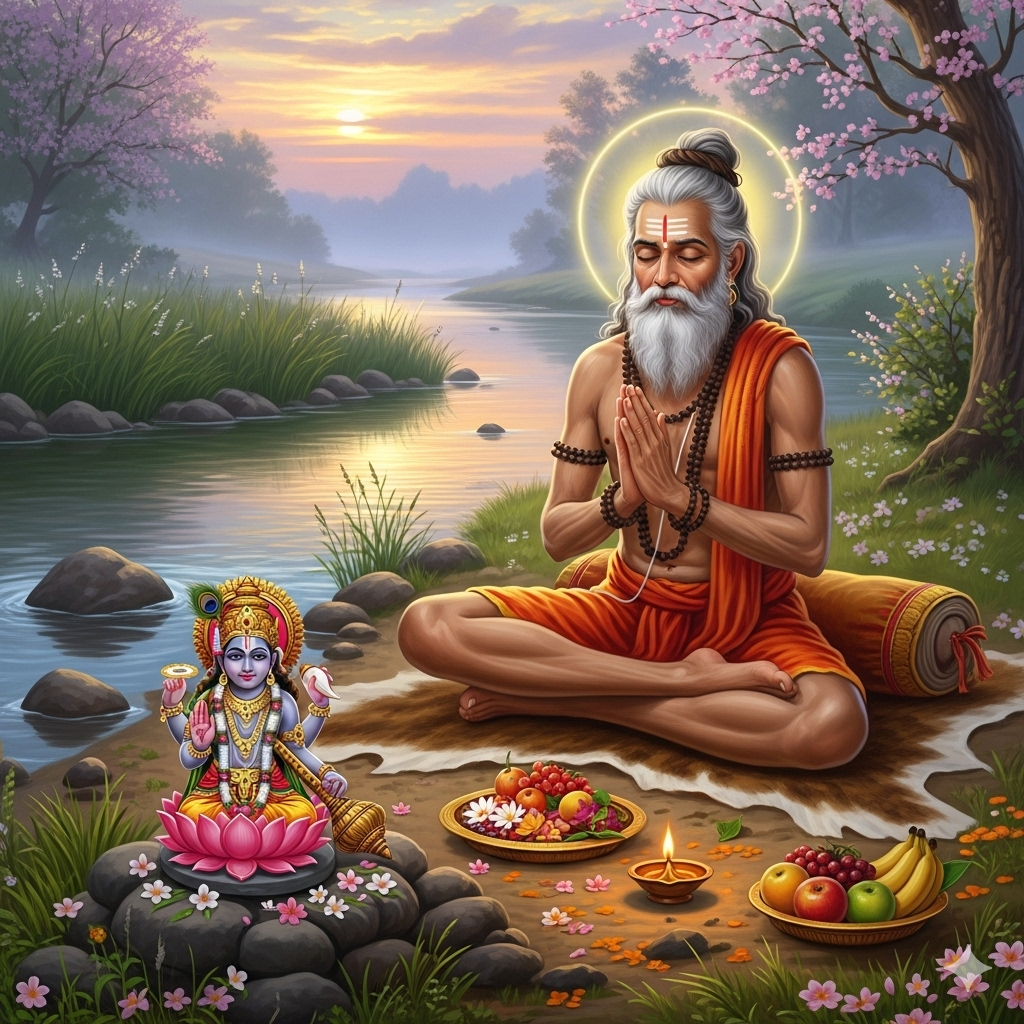
8.) Pleased by these austerities, O Vidura, the lotus-eyed Bhagavān revealed Himself to Kardama at the dawn of the Satya-yuga, manifesting in His own eternal, divine form—ordinarily known only through the revelation of the Vedas.
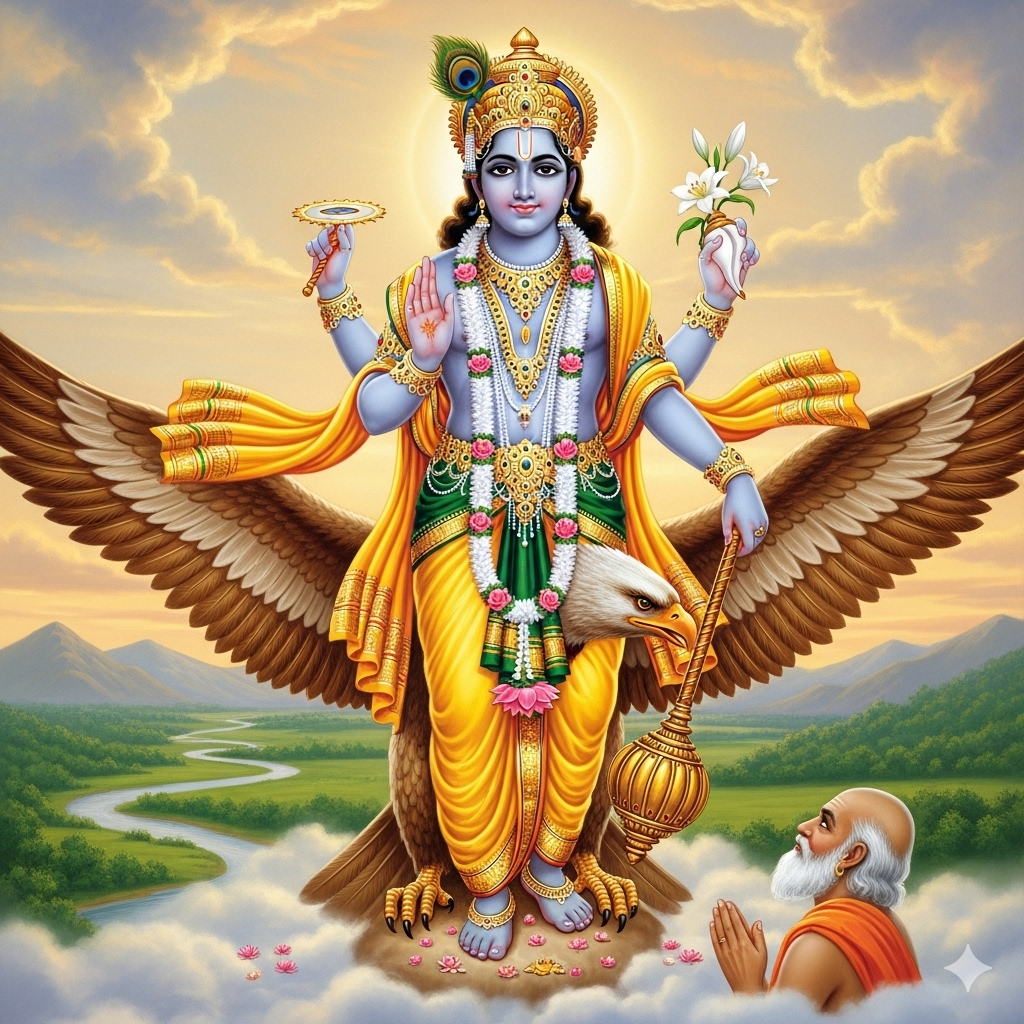
9.) The sage Kardama beheld Bhagavān in that supremely effulgent form, shining like the radiant sun, adorned with a garland of white lotuses and water-lilies, clad in spotless yellow silken garments, His lotus-like face framed with soft, curly, dark locks of hair.
10.) His head was crowned with a resplendent diadem, His ears decked with brilliant earrings. In His hands He held the divine śaṅkha (conch), cakra (Sudarśana discus), and gadā (mace); and in His fourth hand, a beautiful white lily for play. His charming smile, filled with compassion, captivated the heart.
11.) Standing aloft upon the mighty shoulders of Garuḍa, His lotus-feet resting there with grace, Bhagavān appeared in the sky. His broad chest bore the golden streak of Śrī Lakṣmī, and from His neck shone the famed Kaustubha gem, dazzling in brilliance.
12.) Realizing that the supreme desire of his heart had now been fulfilled, the sage Kardama, overwhelmed with joy, fell prostrate, bowing with his head to the ground. Rising, he joined his palms in reverence, and with a heart overflowing in love, he extolled Bhagavān in words of praise.
Sage Kardama said:
13.) Ah! Today the highest fruit of my eyes has been attained, for I behold You, O Bhagavān, the very abode of all auspiciousness. Your sight is so rare that even yogīs established in profound meditation, after ascending through births higher and higher, long to behold but seldom attain.
14.) Your lotus feet are a veritable boat to cross over the vast ocean of worldly existence. Yet, those who have been deluded by Your own Māyā worship those feet only for trivial and fleeting pleasures of the senses—pleasures obtainable even in hell. And yet, O Śrī Hari, You graciously bestow even such fleeting joys upon them.
15.) You are like the kalpavṛkṣa, the wish-fulfilling tree, while my heart remains impure, tainted by worldly desire. Therefore, yearning to marry a wife of similar nature, who may bring forth prosperity and fulfill the threefold goals of life, I too have sought the shelter of Your divine feet, which are the fountainhead of all blessings.
16.) This world, O Bhagavān of the universe, is ever bound by desire, tied firmly with the cords of Your command, uttered through the eternal Veda. Following this same path of worldly duty, I too, O embodiment of virtue, bring offerings in the form of my obedient service unto You, who manifest also as Time itself.
17.) Your devotees, however, turn away from worldly humans, and from people like myself, who are engrossed in beastly pursuits. They seek only the shelter of Your lotus feet, which serve as an umbrella shielding them from the scorching sun of rebirth. Sustained by Your grace, they drink deeply of the nectar of Your praises, joyfully chanting them to one another.
18.) Your Wheel of Time turns unceasingly, revolving upon the imperishable axle of Brahma. It bears three hubs, representing the three divisions of the year, each consisting of four months. It is fitted with thirteen spokes, denoting the twelve months together with the extra intercalary month that recurs in every third year. Upon it are fixed three hundred and sixty joints, the days of the year; it is encircled by six rims, the six changing seasons; and it is adorned with countless markings, like innumerable leaves, symbolizing the fleeting moments. Swiftly revolving with irresistible force, this wheel steadily shortens the lifespan of all created beings. Yet, O Eternal One, it has no power over the lives of those devoted to You; the span of Your devotees remains untouched by the ravages of Time.
19.) Though You are one without a second, You assume the wondrous potency of Yogamāyā, which is none other than Yourself, and with its help, through the guṇas of sattva and others, You create, sustain, and finally dissolve the universe into Yourself—just as a spider spins its web, maintains it, and then withdraws it into its own being.
20.) O Supreme Bhagavān, we know well that the pleasures of the senses—bestowed through the play of Your Māyā-śakti—are not truly pleasing to You. Yet, if such enjoyments should come to us, let them arise only in such a way that they lead us ultimately toward the highest good, the final attainment of liberation. For now, before us, You stand revealed in a wondrous form—adorned with a splendid garland of fragrant Tulasi leaves—a form that, though appearing finite through the veil of Māyā, is in truth the infinite embodiment of eternal bliss.
21.) Though You are ever beyond the bonds of karma, O Paramātmā, You nevertheless conduct the affairs of the world through Your playful will, and even grant the desires of those who worship You with worldly motives. Again and again I bow to You, whose lotus feet are worshipped by all beings.
Maitreya resumed:
22.) Thus sincerely praised with heartfelt words, Bhagavān Viṣṇu, lotus-naveled and radiant upon the shoulders of Garuḍa, replied to the sage. His speech was as sweet as nectar, and with a graceful movement of His brows and a tender smile of affection, He looked upon Kardama.
Bhagavān said:
23.) O sage, knowing the thoughts hidden in your heart, I have already arranged for that which you sought through your long worship, performed with control of mind and senses.
24.) Worship directed to Me by those who fix their minds exclusively upon Me—especially from pure-hearted beings like yourself, O Prajāpati—never goes in vain.
25.) You know Emperor Svāyambhuva Manu, the illustrious son of Brahmā, renowned for his righteous deeds, rules over the Earth, encircled by the seven oceans, and resides in Brahmāvarta.
26–27.) Accompanied by his noble queen Śatarūpā, that royal sage, knower of Dharma, will come here the day after tomorrow. He will offer his daughter Devahūti unto you in marriage. This princess, adorned with beautiful dark eyes, noble virtues, and commendable qualities, has now reached the age of marriage. She earnestly seeks a husband, and you O sage, are fully worthy of her.
28.) She is exactly the kind of wife you have long desired in your heart, O holy sage. Soon she shall be yours, serving you with deep devotion and fulfilling the longing of your heart.

29.) From your sacred union, she will bring forth nine noble daughters. Through these daughters, great sages such as Marīci will beget their own lineages, thereby expanding creation.
30.) By faithfully executing My command, with your heart purified and offering the fruits of all your actions unto Me, in due course you shall attain to Me.
31.) By showing compassion to all beings during your life as a householder, you will attain Self-realization. Later, renouncing, when you give assurance of fearlessness to all, you will perceive your very Self and the entire universe as resting in Me, and Me as present within you.
32.) And through your wife Devahūti, I Myself shall manifest a portion of My divine essence (as her child). Along with your nine daughters, I shall instruct her in the profound wisdom of Sāṅkhya philosophy, which reveals the eternal principles of Prakṛti, Puruṣa, and the Supreme Īśvara.

Maitreya continued:
33.) Having thus spoken to Kardama, Bhagavān—who reveals Himself only when the senses are withdrawn inward—departed to His own abode of Vaikuṇṭha, leaving the hermitage by the sacred Bindusarovara, around which the river Sarasvatī flowed.
34.) The sage beheld Bhagavān departing along the divine path to Vaikuṇṭha, that path glorified by exalted siddhas. As Garuḍa’s mighty wings resounded, they produced the hymns of the Sāmaveda, filling the air with sacred melody.
35.) Even after the departure of Bhagavān, the sage Kardama remained at Bindusarovara, awaiting the time foretold by Him.
36–37.) Meanwhile, Emperor Svāyambhuva Manu, along with his queen Śatarūpā, ascended his golden chariot and traveled the Earth, bringing with him his daughter Devahūti. On that very day foretold by Bhagavān, they arrived at the hermitage of Kardama, who had just completed his austerities.
38–39.) That sacred lake, Bindusarovara, overflowed with the waters of the Sarasvatī. Hosts of sages frequented its banks, for its waters were sweet as nectar and life-giving. It had received its name because tears of compassion fell from the eyes of Bhagavān upon its waters, moved by His boundless mercy toward the sage Kardama, who had sought His shelter.
40.) Around the lake grew flowering trees and creepers of every season, abundant with fruits and blossoms. The groves sheltered holy animals and birds, and the entire place shone as a divine sanctuary.
41.) The air resounded with the songs of joyous birds, the humming of intoxicated bees, the proud dances of peacocks, and the melodious calls of cuckoos echoing in delight.
42–43.) Surrounding the lake grew kadamba, campaka, aśoka, karañja, bakula, Asana, kunda, mandāra, kuṭaja, and tender mango trees. Its waters echoed with the sweet calls of kārandavas, plavas, swans, ospreys, cranes, cakravākas, and cakoras.
44.) The forest nearby was home to deer, boars, porcupines, gayals, elephants, baboons, lions, monkeys, mongooses, and musk-deer, all living in harmony around the sacred lake.
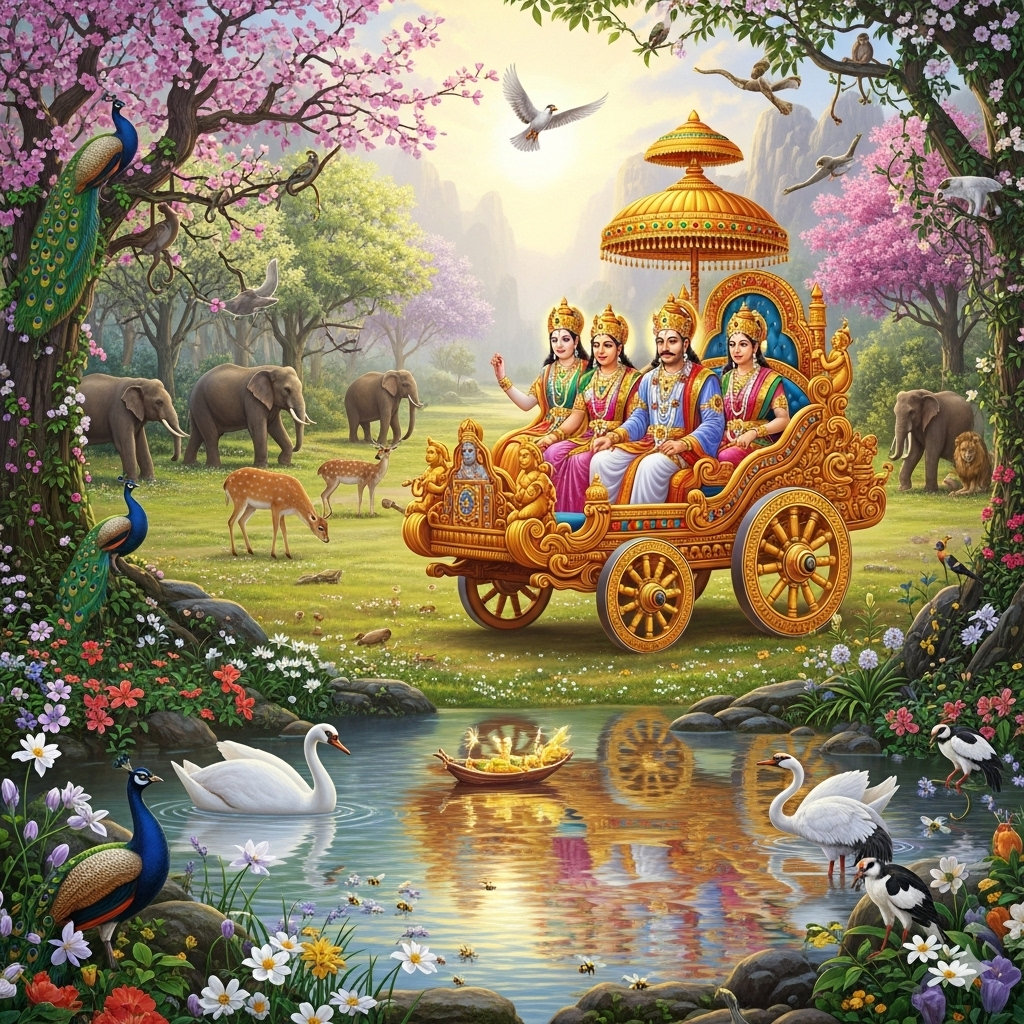
45–47.) Entering this sanctified grove with his daughter Devahūti, Emperor Manu beheld sage Kardama seated near his hermitage, having just performed fire oblations. Though he had engaged in austerity for many years, his body shone with brilliance, for Bhagavān had cast His affectionate glance upon him, and he had drunk deeply of the nectar of His divine words. Tall in stature, with lotus-like eyes, matted locks, and wearing simple garments of bark, he shone like an unpolished but radiant gem.
48.) Beholding the monarch approaching, the sage arose, bowed in return, and welcomed him with due honor.
49.) When the king had seated himself calmly, the sage, recalling the instructions of Bhagavān, spoke gently to him, delighting his heart with sweet and humble words.
50.) “The journey you have undertaken, O noble king, is indeed for the protection of the virtuous and the subduing of the wicked. For you embody the protective power of Śrī Hari upon this Earth.”
51.) “It is you who assume the forms of the sun-god, the moon-god, the god of fire, Indra, the wind-god, Yama, Dharma, and Varuṇa, whenever necessary for the welfare of the world. O king, all glories unto you, who are none other than a manifestation of Bhagavān Viṣṇu Himself.”
52–54.) “If you do not wander this Earth, like the sun in his chariot, bearing your bow and spreading fear in the hearts of the wicked, followed by a mighty army whose tread shakes the ground, then the moral codes of the varṇas and āśramas, established by Bhagavān Himself, would be instantly destroyed by impious men.”
55.) “If such unrighteousness were to prevail, greedy and unruly humans would seize control, and the world would perish, swallowed in adharma.”
56.) “Therefore, O valorous king, tell me the purpose for which you have come here. With a glad heart, I stand ready to fulfill your wish.”
Thus ends the twenty-first discourse entitled “Kardama’s Penance – Śrī Viṣṇu’s Boon”, in Book Three of the great and glorious Bhāgavata Purāṇa, otherwise known as the Paramahaṁsa-Saṁhitā (the book of the God-realized Souls).
