Chapter 20 – Various Creations of Brahmā
Śaunaka said:
- Having secured a foothold in the shape of the earth, O son of Romaharṣaṇa (Sūta), what means did Svāyambhuva Manu adopt for evolving the other creatures that were yet to see the light?
- The great devotee Vidura, whose heart was ever fixed upon Śrī Kṛṣṇa, abandoned his own elder brother Dhṛtarāṣṭra along with the latter’s sons, for they had turned against Śrī Kṛṣṇa.
- Vidura, born of sage Dvaipāyana (Vedavyāsa), was in no way lesser than him in greatness. With all his heart he surrendered to Śrī Kṛṣṇa, and he cherished deep love and attachment for the devotees of Bhagavān.
- Vidura, purifying himself by pilgrimage to sacred tīrthas, approached the wise sage Maitreya, foremost among the knowers of Truth, as he sat in Kuśāvarta (Haridwāra). With humility, what questions did Vidura ask him?
- In the course of their conversation, O Sūta, there must have proceeded sacred stories centring round the lotus-feet of Śrī Hari, and hence capable of wiping out all sins like the waters of the holy Gaṅgā, that have their source in those very feet.
- Please recount to us the wondrous deeds of Śrī Hari, sublime and eternal, worthy of being sung again and again. May Bhagavān bestow His blessings upon you. Tell me—which rasika soul can ever grow satiated while drinking the nectar of Śrī Hari’s līlās (stories)?
- Thus requested by the sages dwelling in the holy forest of Naimiṣa, Ugraśravas fixed his mind on Bhagavān and gently said, “Please hear.”
Sūta said:
- Upon hearing of Śrī Hari’s līlā—how He, assuming the divine form of a boar through His inconceivable māyā, lifted up the earth from Rasātala and effortlessly slew the demon Hiraṇyākṣa—Vidura’s heart overflowed with joy, and he questioned the sage Maitreya as follows.
Vidura said:
- Knowing as you do things unperceived by us, tell me, O holy sage, after bringing forth the Prajāpatis like Marīci, what did the Lord of all Prajās (Brahmā) do to further the creation of beings?
- How did the Brāhmaṇas such as Marīci and Svāyambhuva Manu bring forth this world at the command of Brahmā?
- Did they perform creation through union with their consorts? Or did they act independently? Or perhaps, was this world produced by their combined effort?
Maitreya said:
- When the equilibrium of the three guṇas (constituting Prakṛti or Primordial Matter) got disturbed through the agency of Prarābdha (unseen destiny of bound souls / Jīvas), the working of which is difficult to comprehend, the Supreme Spirit (Ādi Nārāyaṇa) presiding over Prakṛti and Kāla (the Time-Spirit), as well as through mere proximity to Bhagavān, the Mahat-tattva (the principle of cosmic intelligence) was evolved therefrom.
- From Mahat was born Ahaṃkāra, dominated by rajas. This Ahaṃkāra manifested in three forms—Vaikārika, Rājasa, and Tāmasa—and impelled by the destiny of jīvas, it gave rise to the groups of five: the subtle elements (tanmātrās), the five gross elements (earth, water, fire, air, and space), the five organs of action, the five organs of knowledge, and their presiding deities.
- Though these elements existed, separately they could not form the vast Brahmāṇḍa. But when united through the inconceivable power of Bhagavān, they together created the golden cosmic Egg.
- For over one thousand years the egg lay on the cosmic waters of the causal ocean in a lifeless state. At last Bhagavān (the supreme indweller) entered it as its presiding Deity.
- From His divine navel (of Śrī Viṣṇu, who presided over the cosmic Egg), blossomed forth a radiant lotus of resplendence equal to a thousand suns, and was intended to be the very abode of all living beings. Upon that lotus appeared Brahmā.
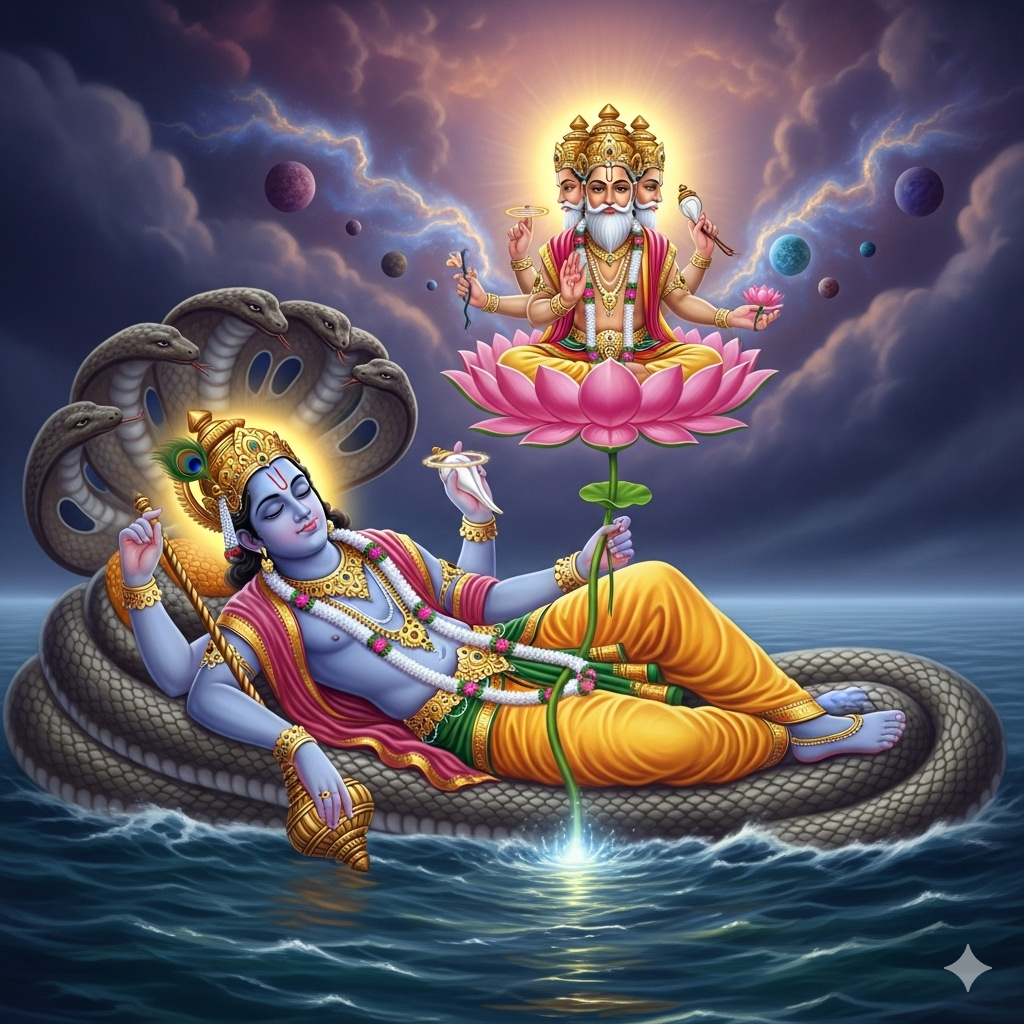
17. When Bhagavān, who sleeps on the waters (in Yoga Nidrā) forming the support of the cosmos entered Brahmā’s heart (as the Inner Controller), Brahmā (the creator) started creating the various worlds according to the plan evolved by him in the preceding Kalpas.
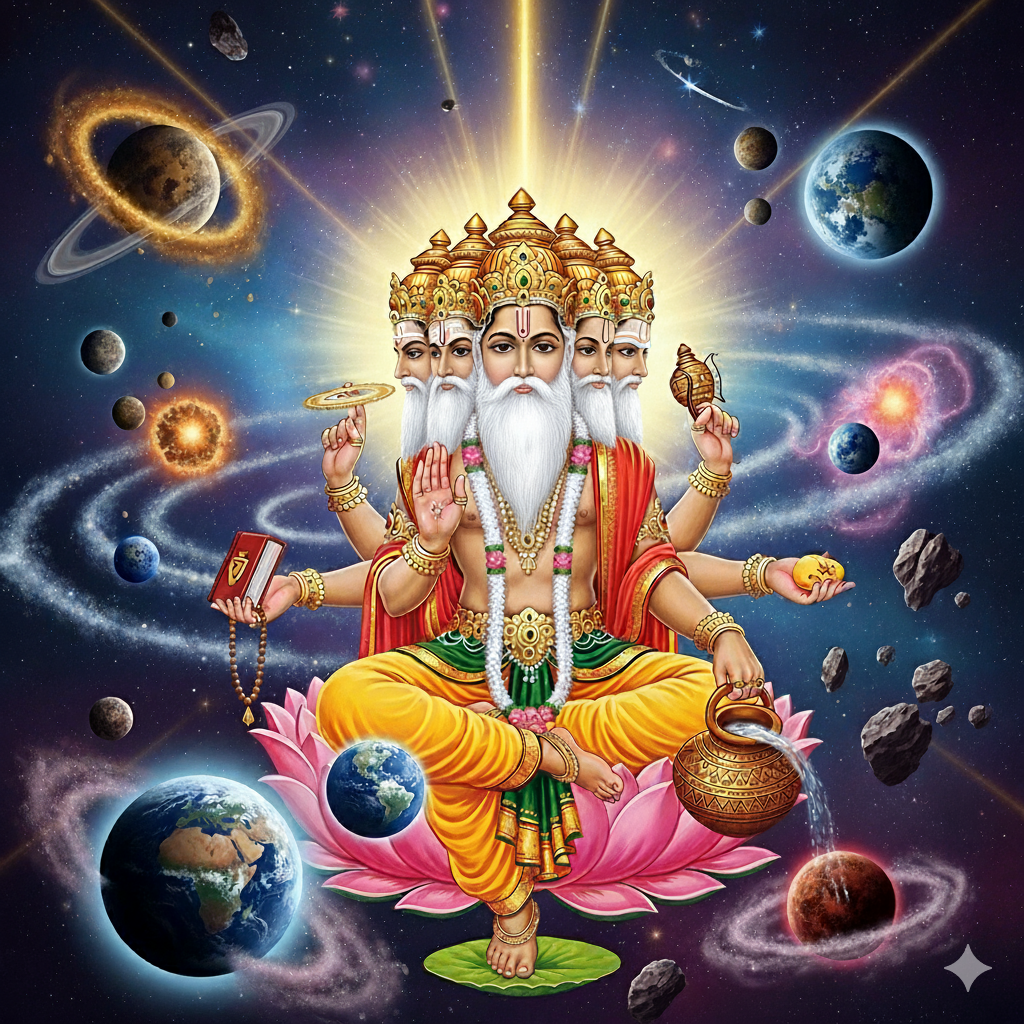
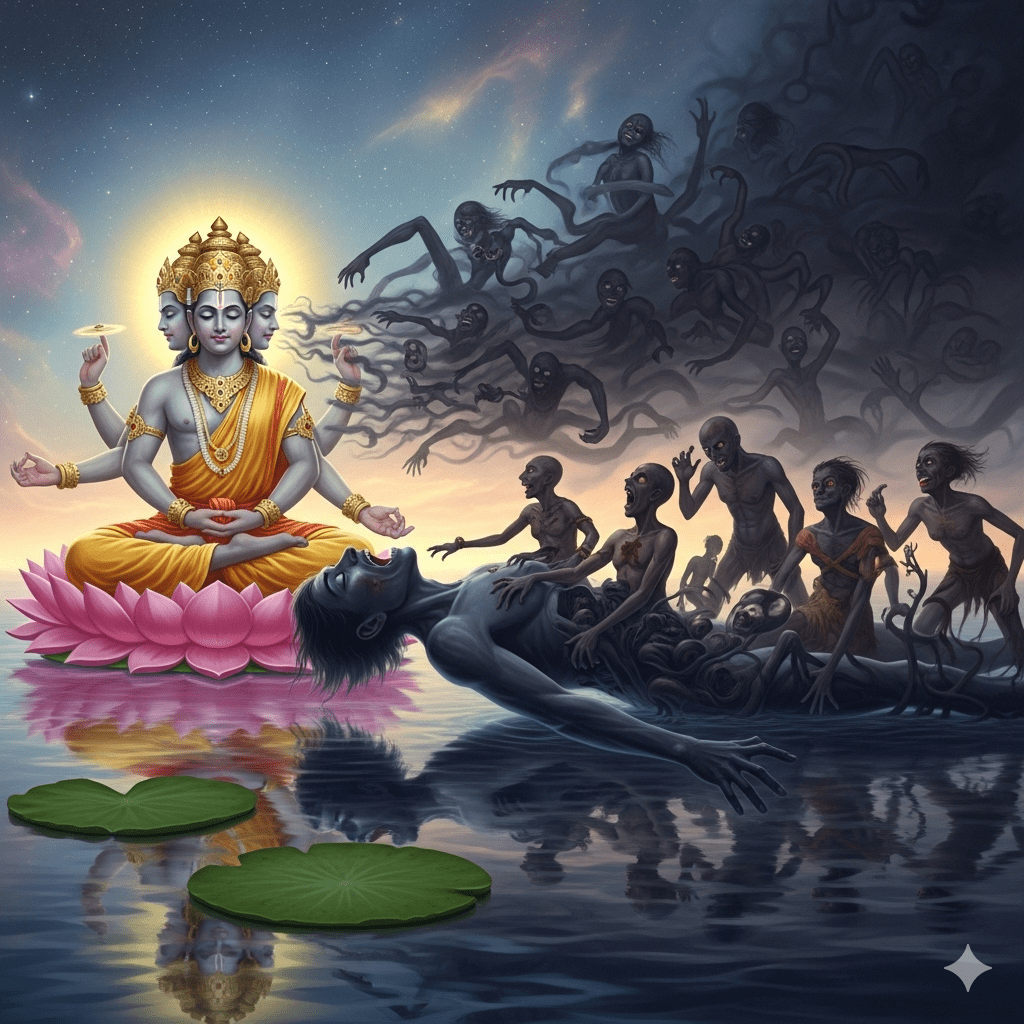
18. Yet, overcome by tamoguṇa, Brahmā gave rise to ignorance in five forms—tāmisra, andhatāmisra, tamas, moha, and mahātamas.
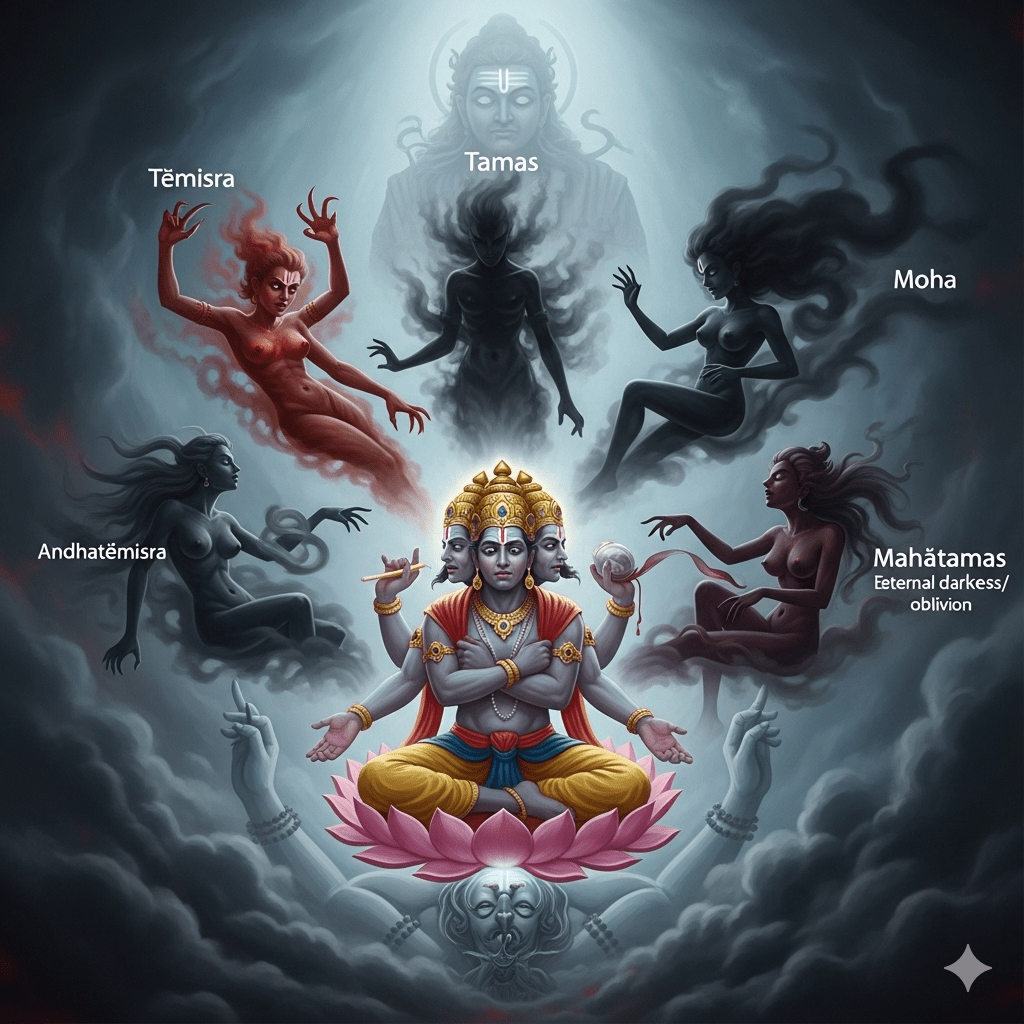
19. Brahmā threw off that body of his (in the form of a shadow); for he did not like it, made up as it was of darkness (ignorance / tamoguṇa). The Yakṣas and Rākṣasas, who had sprung therefrom, took possession of that body, which continued in the form of night and is the source of hunger and thirst.
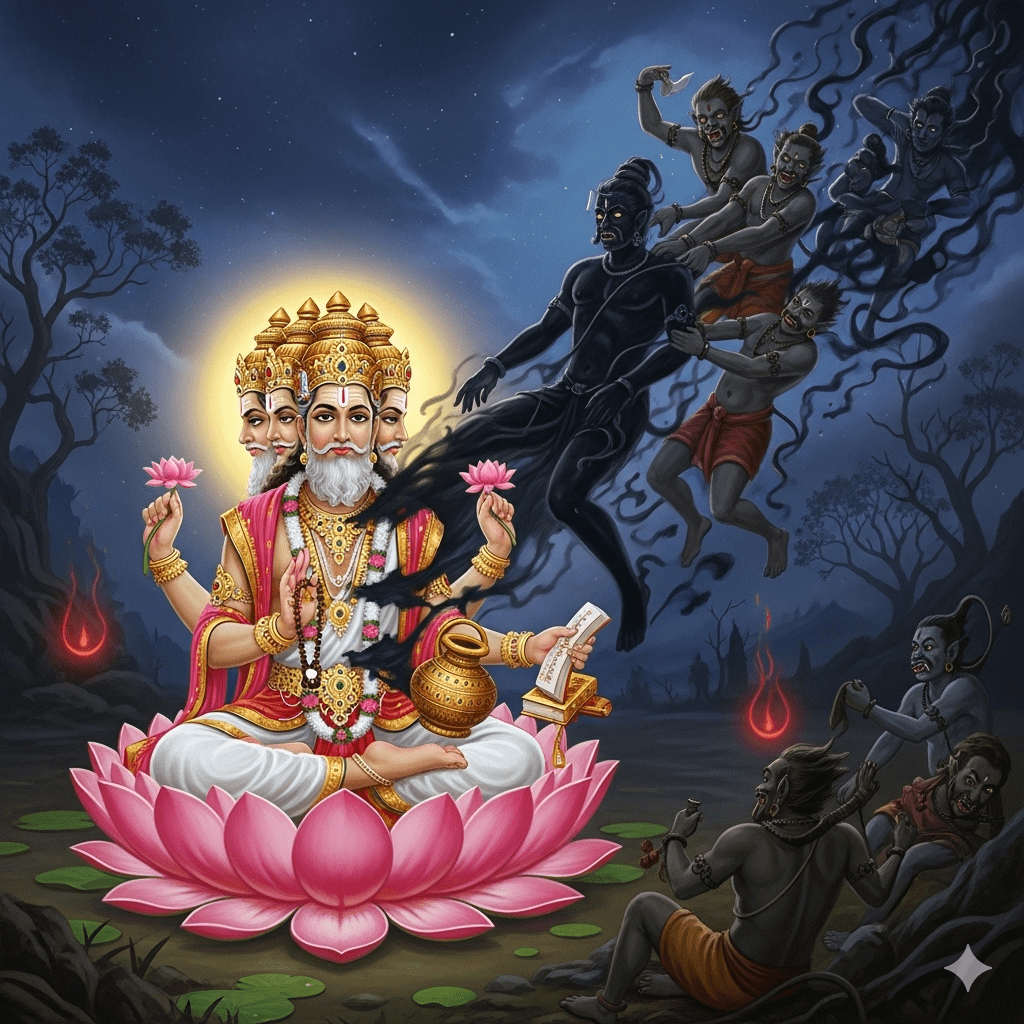
20. Overpowered by hunger and thirst, they ran to devour him from all sides. “Spare him not out of compassion, thinking that he is our father; eat him up!” they all cried, oppressed as they were with hunger and thirst.
21. Frightened, Brahmā pleaded, “O do not devour me, spare me! You Yakṣas and Rākṣasas are my very offspring.”
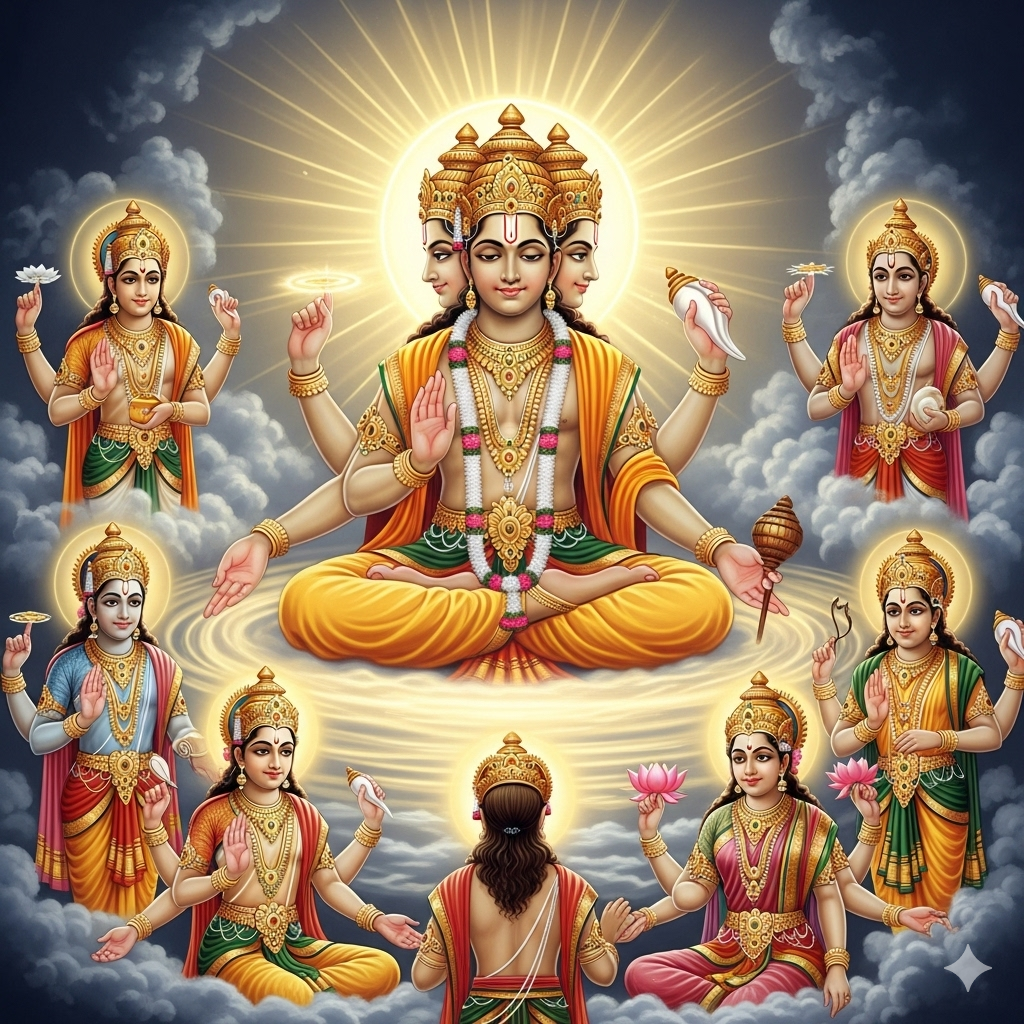
22. Then, shining with glory he created, before all others, the divinities that had the element of Sattva or goodness predominant in them. When Brahmā dropped even that effulgent form out of which he had evolved those divinities, and which now figured as daytime, the Devā’s sportfully took possession of it.
23. From the lower part of his body, Brahmā created the Asuras (demons), charged with excessive passion. Blinded by lust, they approached even their own creator (Brahmā) for union.
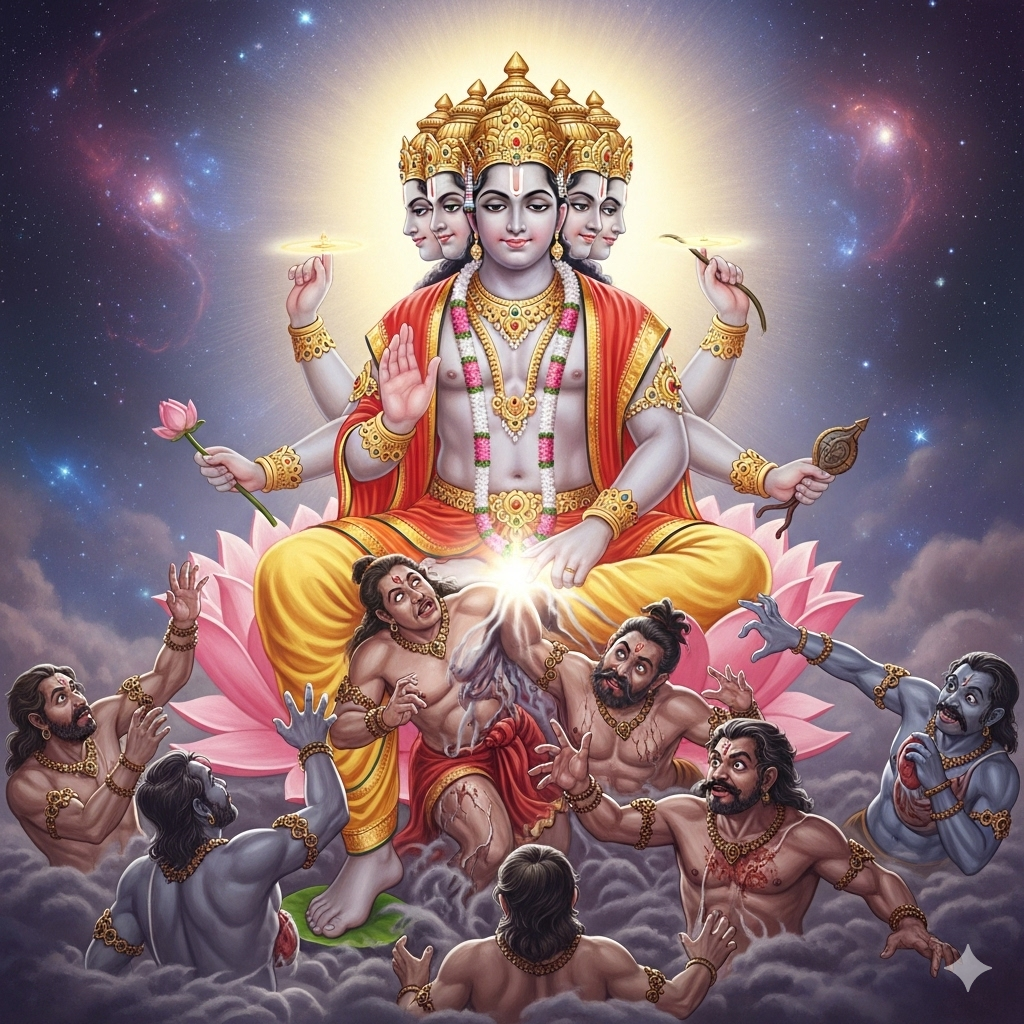
24. The worshipful Brahmā first laughed at their stupidity; but finding the shameless Asuras close upon him, he grew indignant and ran out of fear in great haste.
25. In his distress he turned to Śrī Hari—the compassionate one who removes the sorrows of the afflicted, bestows boons, and appears in forms desired by His devotees—to seek refuge.
26. Praying with folded hands, Brahmā said: “O Supreme Soul, protect me! It is by Your command that I have created these beings. Yet these wicked ones rush upon me (to copulate), maddened as they are with lust.”
27. “You alone can remove the suffering of the afflicted, and You alone can chastise those who do not surrender at Your lotus feet.”
28. Śrī Hari who can distinctly see the mind of others, perceived Brahmā’s distress and said to him, “Cast off this impure body of yours (impure because it has produced the libidinous Asuras and excited their passion)!” Thus commanded by Bhagavān, he dropped it.
29. The body thus shuffled off by Brahmā took the form of the evening twilight, when the day and night meet, and which kindles passion. The Asuras, who are passionate by nature, dominated as they are by the element of Rajas, took it for a damsel whose lotus-feet resounded with the tinkling of anklets, whose eyes were wild with intoxication and whose hips were covered by a fine cloth, over which shone a girdle.
30. Her breasts were projecting upwards because of their clinging to each other, and were too contiguous to admit of any intervening space. She had a shapely nose and beautiful rows of teeth; nay, a lovely smile played on her lips and she cast a sportful glance at the Asuras.
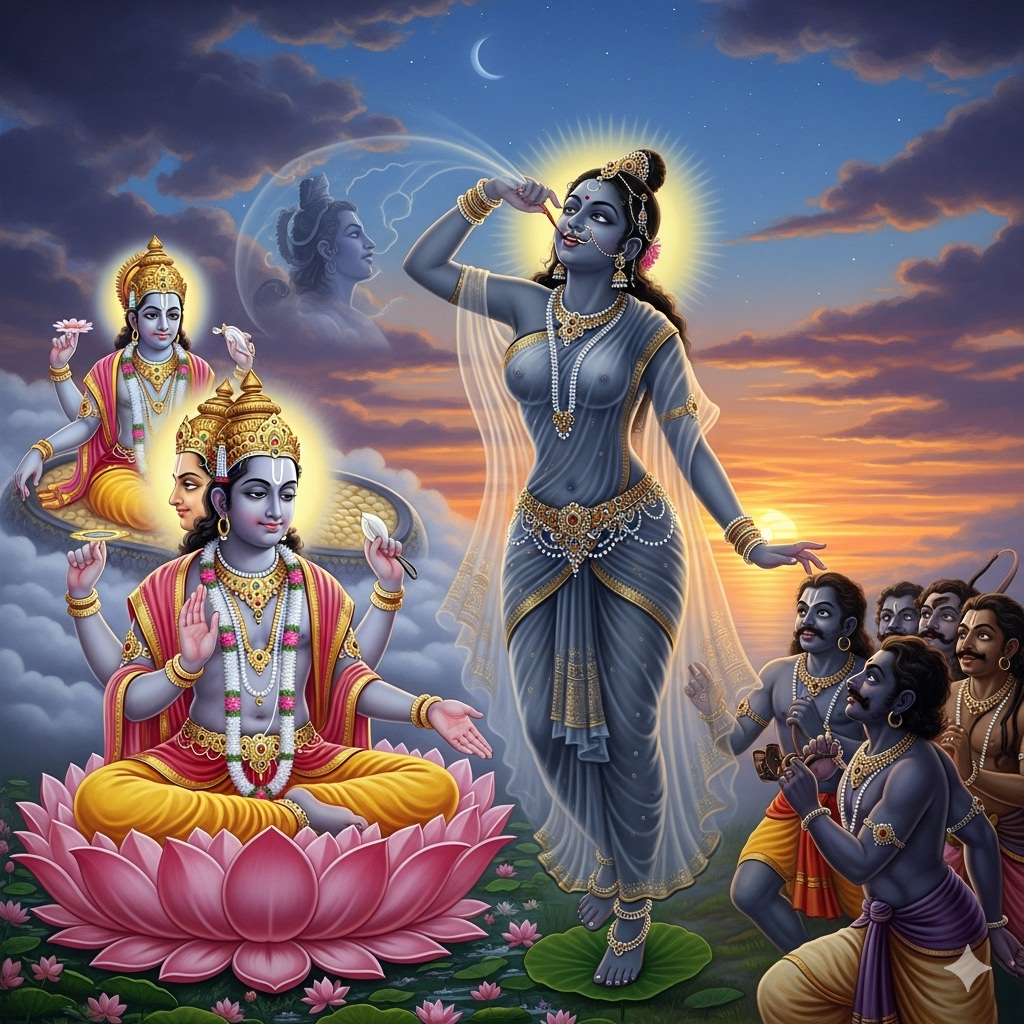
31. Adorned with dark tresses, she was hiding herself, as it were, out of shyness. Perceiving that girl, the Asuras were all infatuated with love.
- Oh! What beauty! what a rare self-control, what a budding youth! In the midst of us all, who are passionately longing for her, she is moving about like one absolutely free from passion !”
33. Indulging in speculations of various kinds about the evening twilight, that appeared to them as endowed with the form of a young woman, the Asuras of wicked mind treated her with respect and fondly asked her:
34. Who are you (by birth)? Whose daughter may you be, O pretty one (lit.,having thighs smooth and tapering like the stem of a plantain tree)? And what can be the object of your coming over here, O proud damsel? Why do you tantalize us, luckless as we are, with the priceless commodity of your beauty?
35. Whosoever you may be, O tender girl, we are fortunate in having been able to see you. While playing with a ball you agitate the mind of the lookers-on.
36. When you strike the bouncing ball against the ground with your hand again and again, O praiseworthy woman, your lotus-feet stay not at one place; oppressed by the weight of your full breasts, your waist gets fatigued and your clear vision grows dull as it were. Pray, braid your comely hair.”
37. Thus the Asuras of clouded understanding took the evening twilight, that showed itself in the form of a young woman, for an alluring damsel and seized her.
38. With a laugh full of deep significance the worshipful Brahmā evolved by his own loveliness, which seemed to enjoy itself by itself, hosts of Gandharvas (celestial musicians) and Apsarās (damsels of heaven).
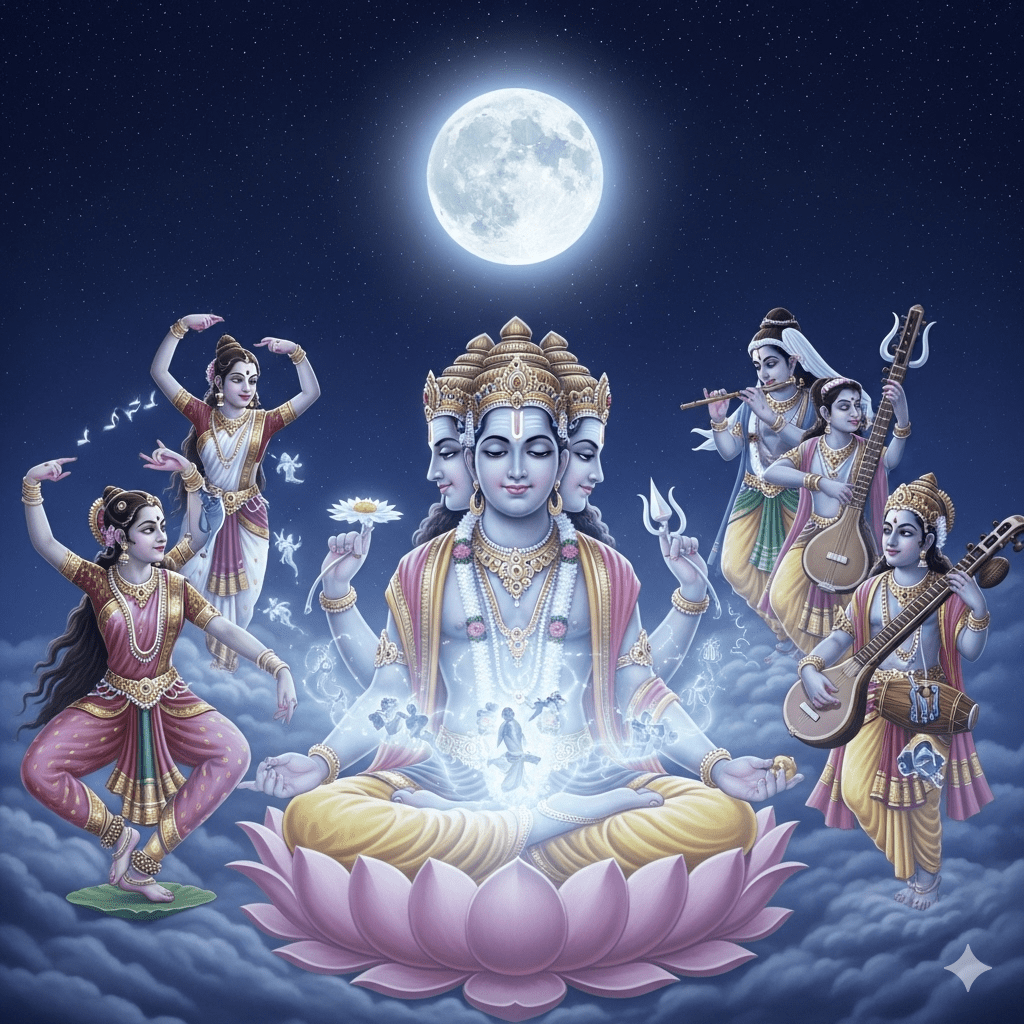
39. After that he gave up that shining and beloved form made of moon-light. Viśvāvasu and the other Gandharvas themselves gladly took possession of it.
40. The glorious Brahmā next evolved out of his sloth the Bhūtas (ghosts) and Piśāca (fiends); but he closed his eyes when he saw them stand naked with their hair dishevelled.
41. The Bhūtas and Piśāca themselves took possession of the body, in the form of yawn, thrown off by Brahmā, the creator of beings. It is also known as sleep, which causes the mouth etc., of living beings to eject running saliva. And these very Bhūtas and Piśācas attack humans who are rendered impure in this way, and such attack of theirs is spoken of as insanity.
42. Recognizing himself as full of vigour and energy, the worshipful Brahmā, the creator of beings, evolved out of his invisible form the hosts of the Sādhyas and the Pitṛs (manes).
43. The Pitṛs themselves took possession of that invisible body, the source of their existence. It is through the medium of this invisible body (of the Pitṛs) that those well-versed in the ritual offer oblations to the Sādhyas and the Pitṛs in the form of their departed ancestors on the occasion of Śrāddha etc.
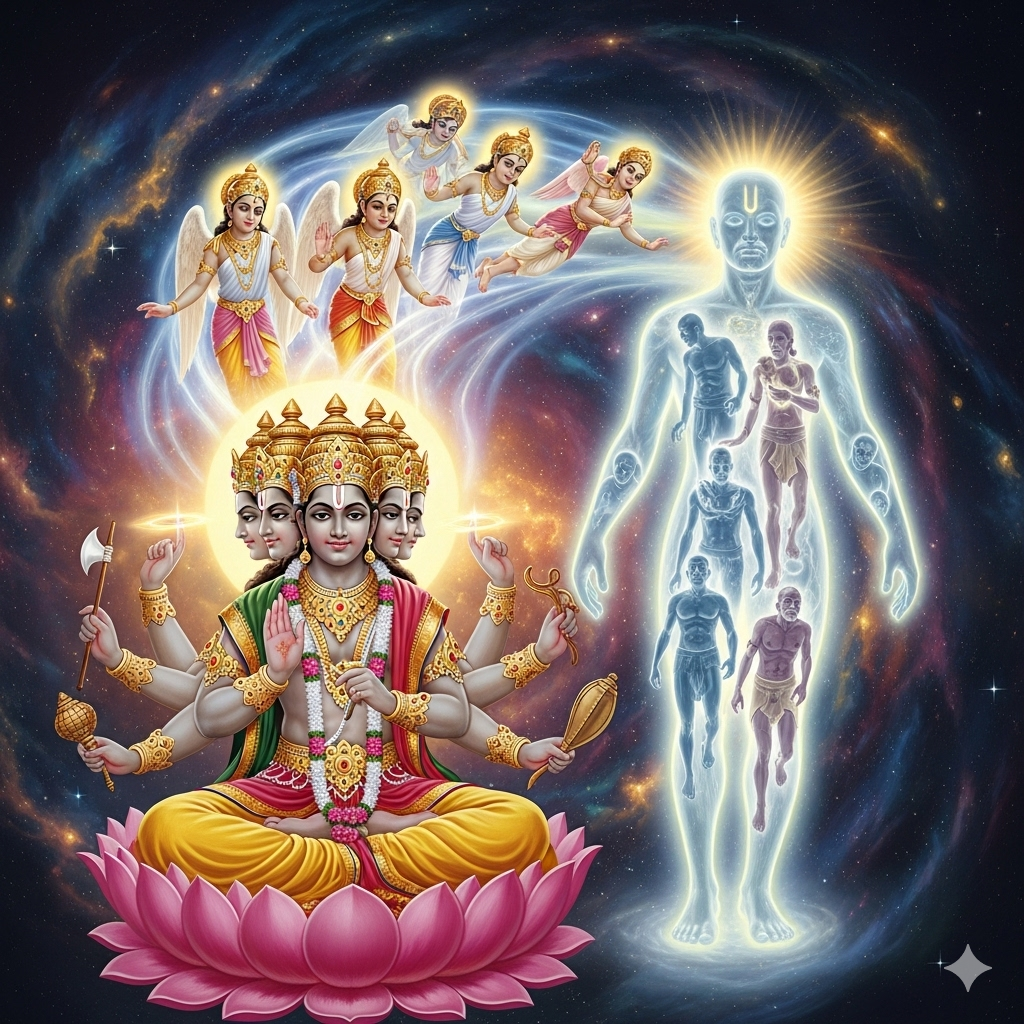
44. By his faculty of remaining hidden from view (power of invisibility) Brahmā evolved the species of living beings called the Siddhas and the Vidyādharas, and gave them that marvellous form of his, known by the name of Antardhāna (the faculty of remaining hidden from view).
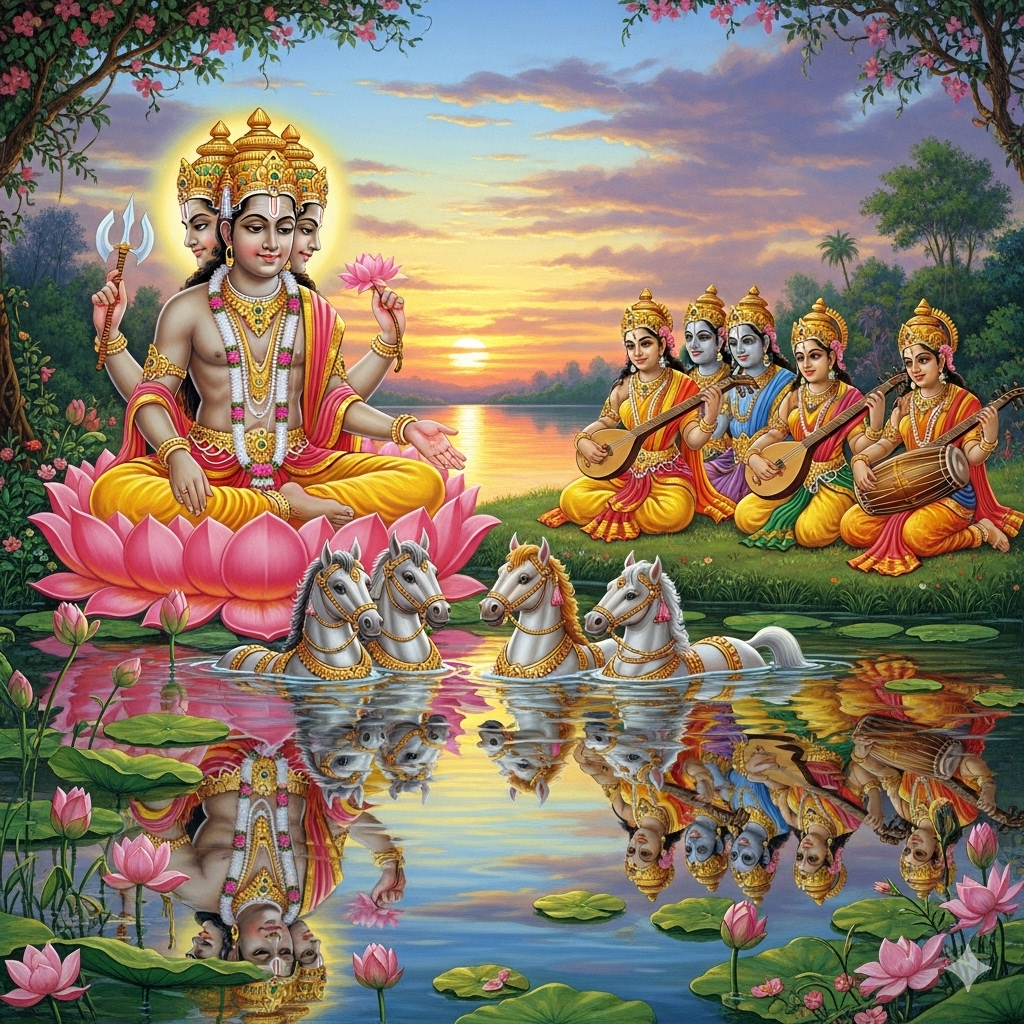
45. One day Brahmā, the creator of beings, beheld his own reflection in water and, admiring himself through that, evolved the Kiṃpuruṣas as well as Kinnaras out of that very reflection.
- They took possession of that (shadowy) form, which was left by Brahmā. That is why they sing his praises by recounting his praises at daybreak (every morning) with their spouses.
- Once Brahmā lay with his body stretched at full length, much concerned over the fact that the work of creation had not proceeded apace, and in a sullen mood shed that body too.
- The hair that dropped from that body (as he apparently pulled them in a fit of excitement) were transformed into snakes, dear Vidura; while, even as the body crawled along with its hands and feet contracted, there sprang from it ferocious serpents and Nāgas with their necks dilated in the form of hood.
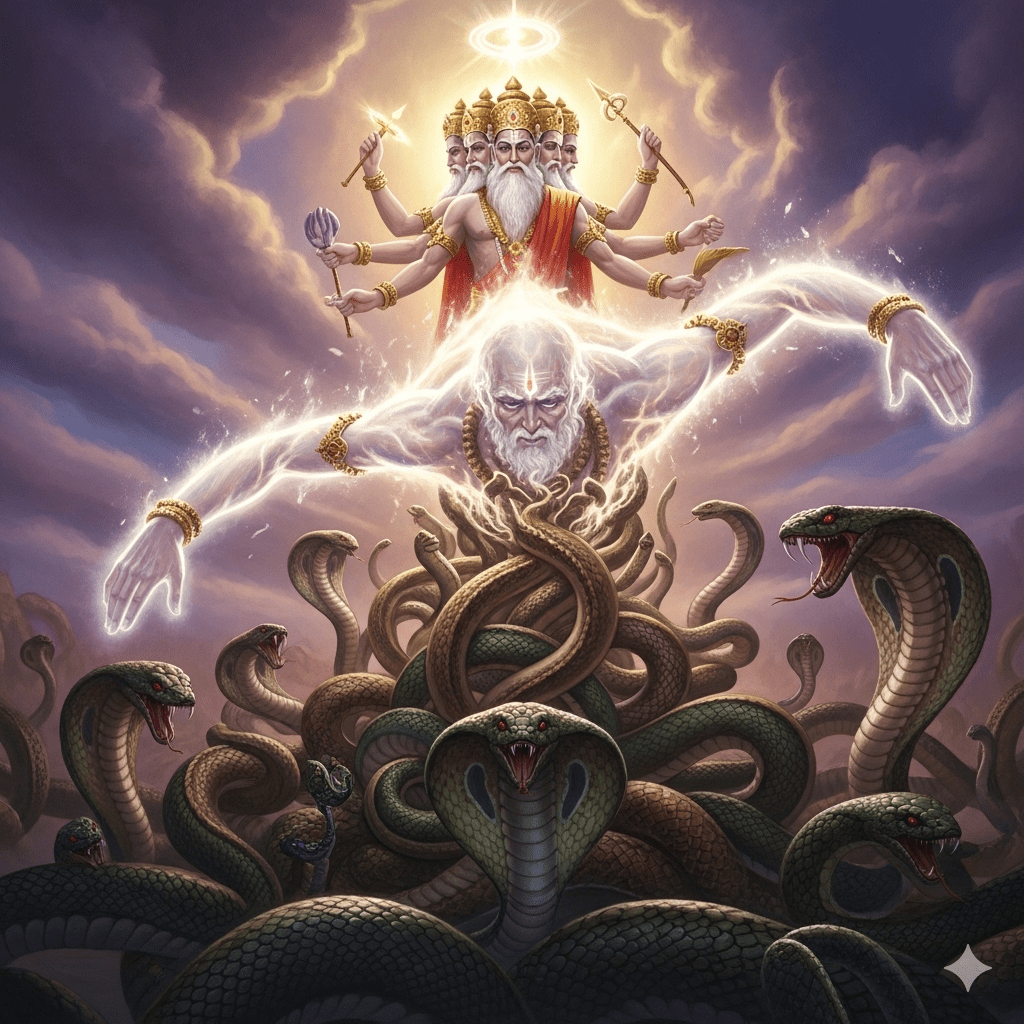
- One day, Brahmā (the self-born creator) felt as if the object of his life had been accomplished; at that time he evolved out of his mind, last of all, the Manus ( progenitors of humankind), who promote the welfare of the world.
- To them the self-possessed creator gave his own human form. On seeing them, the Manus, those who had been created earlier viz., the gods, the Gandharvas and so on applauded Brahmā, the lord of created beings.
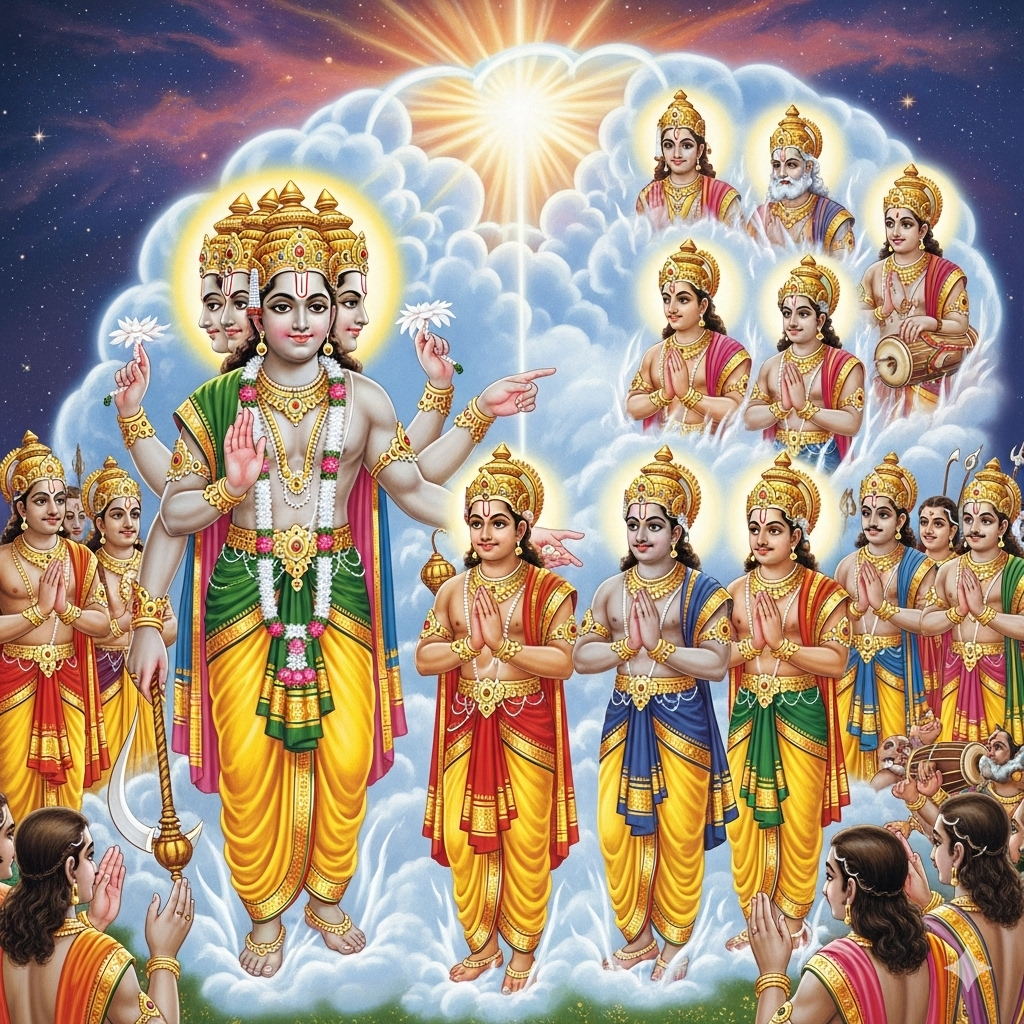
51. They exclaimed: “Oh, creator of the universe, we are glad what you have produced is well done. Since all ritual acts, such as pouring oblations into the sacred fire, have been placed on a sound footing in this human form, we shall all share the sacrificial oblations with it.”
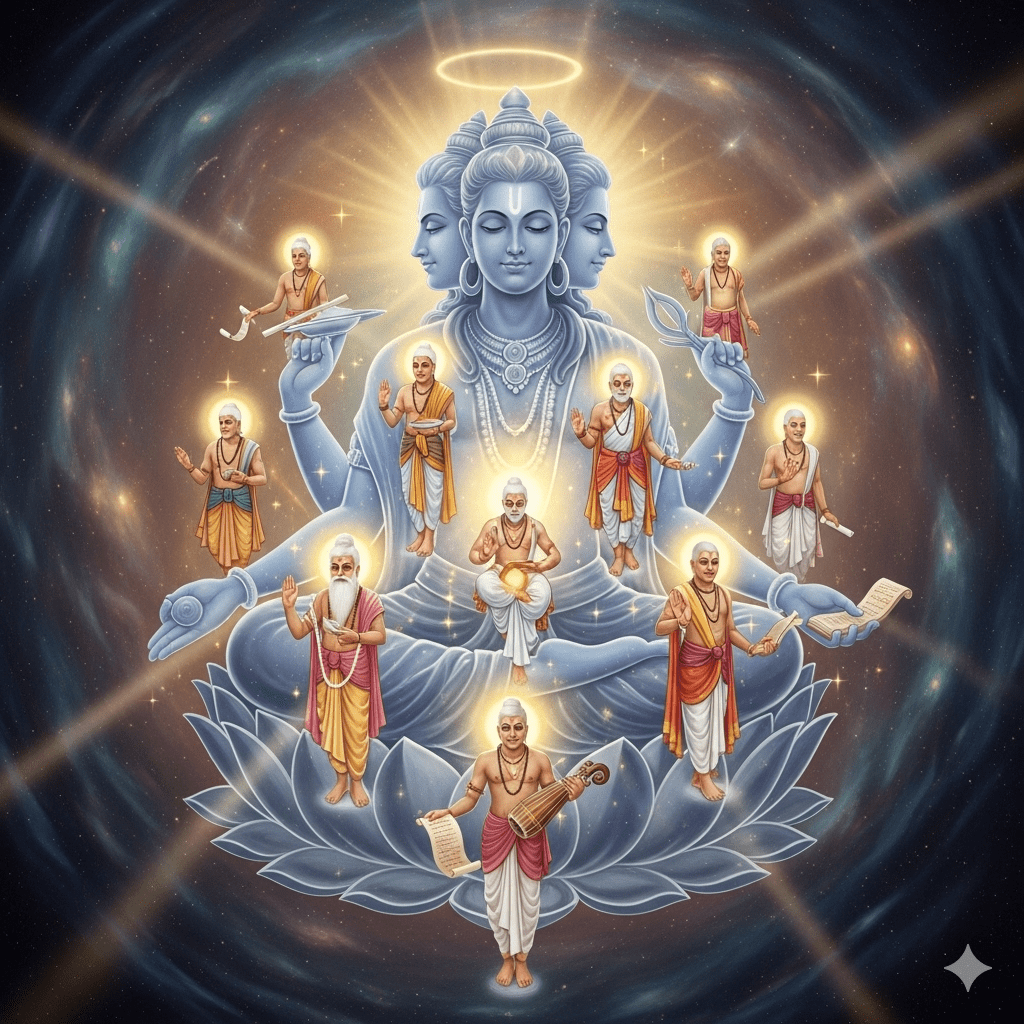
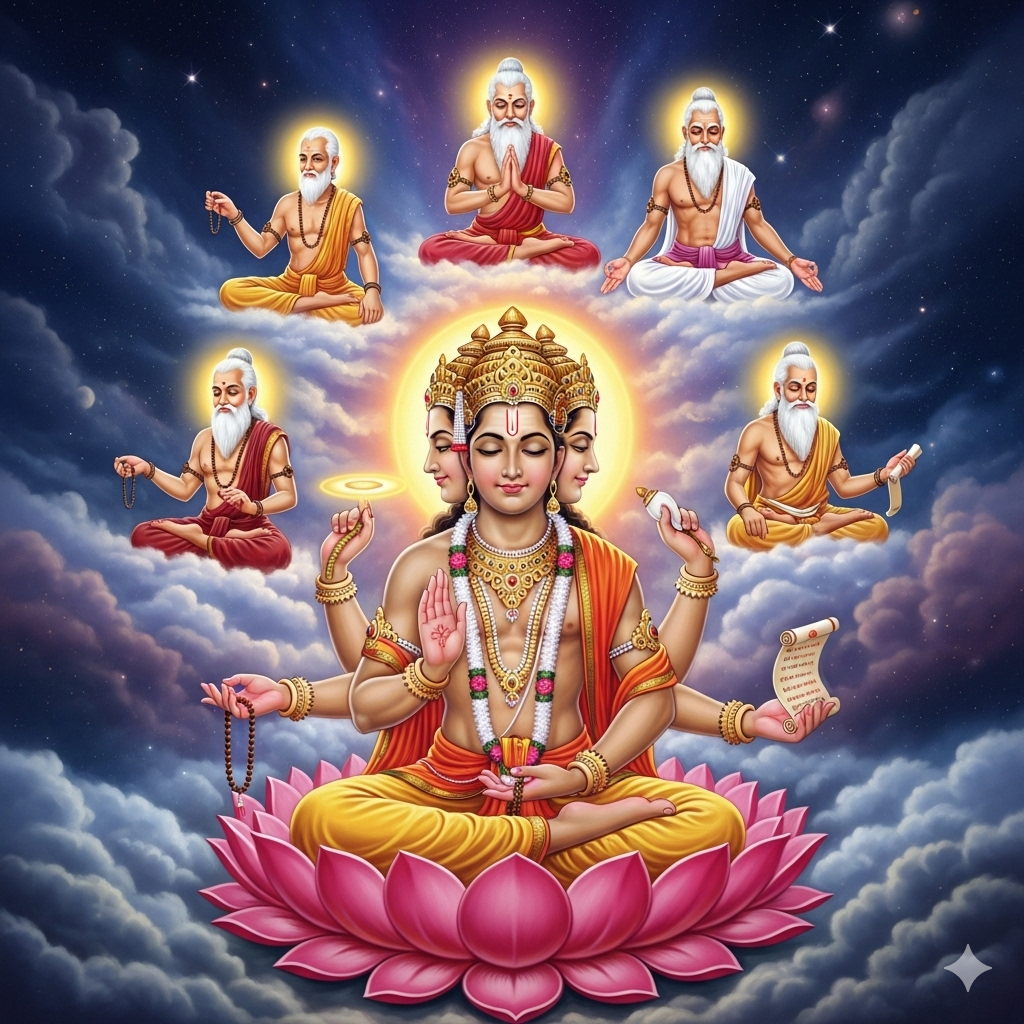
- Having equipped himself with austere penance, adoration, Yoga (concentration of mind) and Samādhi (deep meditation) accompanied by dispassion etc., and having controlled his senses, Brahmā (the first seer) evolved the Ṛṣi’s, his beloved children.
- To each one of these the unborn creator gave a part of his own body, which was characterized by deep meditation, concentration of mind, supernatural power, austerity, adoration and dispassion.
Thus ends the twentieth discourse entitled “Various Creations of Brahmā”, in Book Three of the great and glorious Bhāgavata Purāṇa, otherwise known as the Paramahaṁsa-Saṁhitā (the book of the God-realized Souls).
