Chapter 18 – Hiraṇyākṣa’s Fight with Varāha
Maitreya said:
- Ignoring the sober counsel of Varuṇa, the proud and furious Hiraṇyākṣa hardened his heart. Hearing from Nārada that the Supreme Bhagavān Śrī Hari had appeared, he rushed swiftly into Rasātala, O Vidura, eager for confrontation.
- There he beheld Śrī Hari in His wondrous form as the Divine Boar, lifting the Earth tenderly upon the tip of His tusks. His radiant eyes, glowing reddish with compassion, outshone the Asura’s splendor. Yet the demon, blinded by arrogance, laughed and mocked, saying, “Ah! What is this? A mere amphibious beast!”
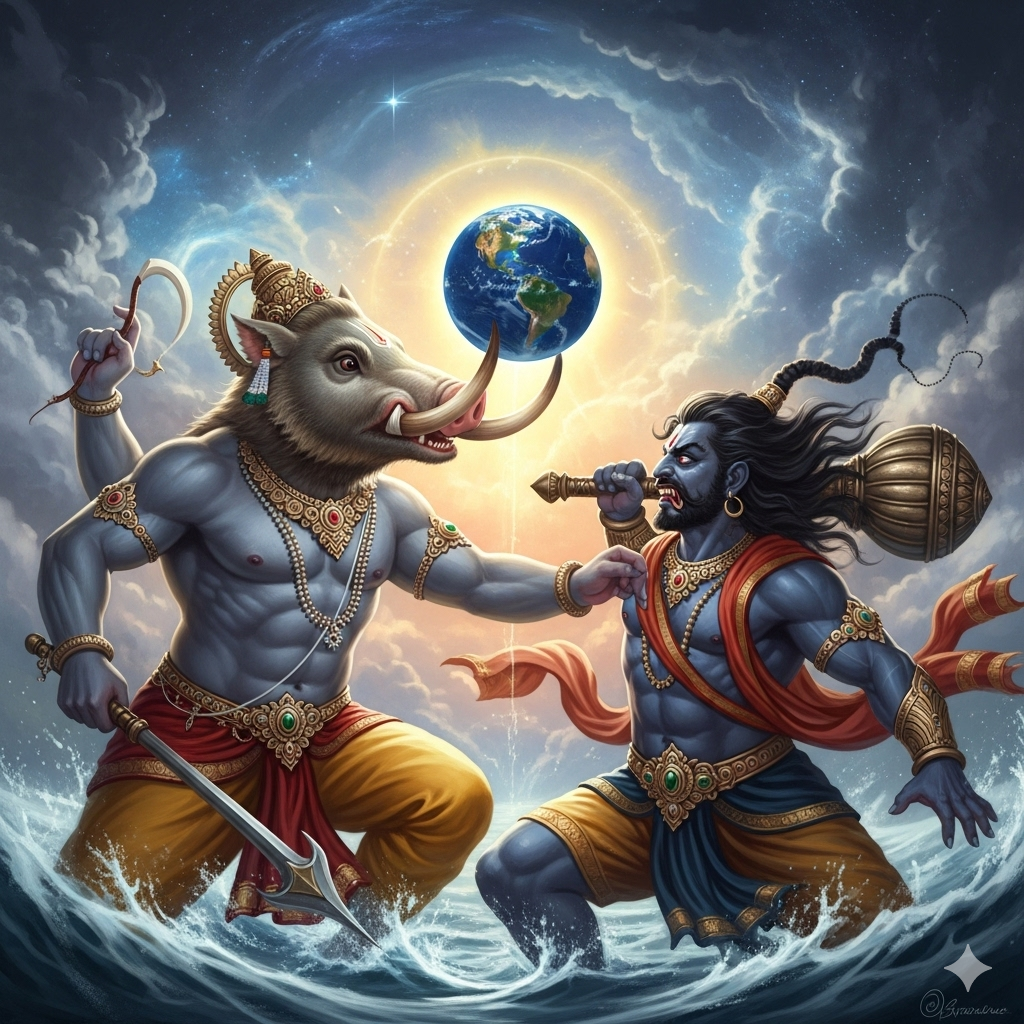
- He bellowed at Bhagavān, “Come here, O foolish one! Leave the Earth at once. This realm belongs to us, the lords of Rasātala, for why else would the Creator have allowed her here? You, who have stooped to the form of a boar, cannot carry her away before my eyes!”
- “Have the gods sent you to destroy us? You defeat Asuras only by deceit, never by valor. But today I will end your trickery. I shall rid my friends of sorrow by killing you, a coward hiding behind yoga-māyā!”
- “When your head lies shattered beneath my mace, the gods and sages who now worship you with offerings will be cast down and uprooted forever.”
- Though pierced by the sharp, mocking words of the demon, the compassionate Bhagavān bore the insult. Seeing that Mother Earth trembled upon His tusks, He rose swiftly from the waters like a mighty elephant rising with his beloved mate from a crocodile’s grip.
- As a crocodile pursues an elephant emerging from a river, so too did the golden-haired demon, with terrible tusks and thunderous voice, chased after Bhagavān. Roaring, he cried, “Is there any shame too low for such a shameless enemy?”
- Unmoved, Bhagavān Varāha gently placed the Earth upon the cosmic waters, infusing her with His divine potency so she could again bear mountains and forests. As He did so, the devas and Brahmā praised Him with hymns, showering down flowers, while the demon watched helplessly.
- Then Bhagavān, feigning wrath, laughed aloud and addressed the demon, who, with golden ornaments and shining armor, pursued Him fiercely with a mace and cutting words.
Śrī Bhagavān said:
- “Yes, Hiraṇyākṣa, we are indeed wild beasts of the jungle! And I am seeking out arrogant lions like you. O vile one, do you not know? True warriors pay no heed to the empty boasts of those already bound by the noose of death.”
- “Here we stand—shameless usurpers of the treasures of Rasātala, forced to face your mace! Though weak before your boasting, we remain in the battlefield, for where else can we go after provoking enmity with the mighty?”
- “You are the chief of warriors—come then, without delay! Fulfill your vow! Dry the tears of your kin by defeating us. One who breaks his word has no place in the company of heroes.”
Maitreya said:
- Thus mocked by Bhagavān, the demon boiled with rage, like a serpent forced out of its hole.
- Breathing heavily, his senses inflamed, the Daitya rushed forward and struck at Hari with his mighty mace.
- But Bhagavān, as effortlessly as a yogī evades death itself, moved aside and parried the blow aimed at His chest.
- Burning with wrath, Hari then advanced, while the Asura lifted his mace once more, biting his lip in fury.
- Then, O gentle Vidura, Bhagavān struck Hiraṇyākṣa upon his brow with His own mace. But the demon, skilled in the art of battle, returned the blow with equal force.
- Thus the enraged Bhagavān and the arrogant Asura clashed again and again, their heavy maces resounding like thunder.
- Blow after blow rang out, blood flowed from their wounds, and the smell of it inflamed their fury still further. The battle raged like two bulls locked in combat over a cow, each striving for supremacy.
- O Vidura, Brahmā himself, surrounded by sages, arrived to witness this fierce contest—between the arrogant Daitya, desiring to seize the Earth, and the Supreme Bhagavān, who in His playful līlā had assumed the form of a boar, His very limbs being sacrificial offerings.
- Seeing the Asura’s relentless pride and unstoppable strength, Brahmā, chief of the sages, addressed Bhagavān, the Primeval Boar, Śrī Nārāyaṇa.
Brahmā said:
22-23. “O Supreme Bhagavān, this demon is a source of terror, oppressing gods, Brāhmaṇas, the wish-fulfilling cows, and all innocent beings who take refuge at Your lotus feet. Empowered by boons from me, he wanders the worlds unchecked, finding no worthy opponent.”
- “O Bhagavān, do not play with him as a child toys with an enraged serpent. He is full of deceit, arrogance, and wickedness. Destroy him before his asuric māyā becomes invincible.”
- “O Acyuta, before the time of evening—when the powers of darkness grow unconquerable—please slay this terrible foe.”
- “O Soul of all, the dreaded twilight, destructive to the world, is drawing near. For the sake of the gods, bring about victory before then.”
- “Now has come the blessed time of Abhijit, lasting for two muhūrtas. O Protector of the worlds, quickly destroy this unconquerable demon for the welfare of Your devotees.”
Special Note :
The Abhijit Muhūrta (अभिजित् मुहूर्त) is a very special and auspicious period of time in Vedic timekeeping.
What is a Muhūrta?
A day (from sunrise to next sunrise) is divided into 30 muhūrtas. Each muhūrta is about 48 minutes. Below is a table for sunrise at 6:00 AM. If sunrise shifts (e.g., 5:45 AM, 6:20 AM), all muhūrta times shift accordingly.
Daytime Muhūrtas (6:00 AM – 6:00 PM)
| Muhūrta No. | Name (Deity) | Time (Clock) | Duration |
|---|---|---|---|
| 1 | Rudra | 6:00 – 6:48 AM | 48 min |
| 2 | Ahi | 6:48 – 7:36 AM | 48 min |
| 3 | Mitra | 7:36 – 8:24 AM | 48 min |
| 4 | Pitṛ | 8:24 – 9:12 AM | 48 min |
| 5 | Vasu | 9:12 – 10:00 AM | 48 min |
| 6 | Varuṇa | 10:00 – 10:48 AM | 48 min |
| 7 | Vahni (Agni) | 10:48 – 11:36 AM | 48 min |
| 8 | Yama | 11:36 – 12:24 PM | 48 min |
| 9 | Sūrya | 12:24 – 1:12 PM | 48 min |
| 10 | Viṣṇu | 1:12 – 2:00 PM | 48 min |
| 11 | Indra | 2:00 – 2:48 PM | 48 min |
| 12 | Indrāgni | 2:48 – 3:36 PM | 48 min |
| 13 | Mitra–Varuṇa | 3:36 – 4:24 PM | 48 min |
| 14 | Āpah (Waters) | 4:24 – 5:12 PM | 48 min |
| 15 | Viśvedevāḥ | 5:12 – 6:00 PM | 48 min |
Nighttime Muhūrtas (6:00 PM – 6:00 AM)
| Muhūrta No. | Name (Deity) | Time (Clock) | Duration |
|---|---|---|---|
| 16 | Prajāpati | 6:00 – 6:48 PM | 48 min |
| 17 | Āśvinī | 6:48 – 7:36 PM | 48 min |
| 18 | Yama | 7:36 – 8:24 PM | 48 min |
| 19 | Agni | 8:24 – 9:12 PM | 48 min |
| 20 | Pitṛ | 9:12 – 10:00 PM | 48 min |
| 21 | Vasu | 10:00 – 10:48 PM | 48 min |
| 22 | Varuṇa | 10:48 – 11:36 PM | 48 min |
| 23 | Vahni (Agni) | 11:36 – 12:24 AM | 48 min |
| 24 | Sūrya | 12:24 – 1:12 AM | 48 min |
| 25 | Viṣṇu | 1:12 – 2:00 AM | 48 min |
| 26 | Indra | 2:00 – 2:48 AM | 48 min |
| 27 | Indrāgni | 2:48 – 3:36 AM | 48 min |
| 28 | Mitra–Varuṇa | 3:36 – 4:24 AM | 48 min |
| 29 | Āpah (Waters) | 4:24 – 5:12 AM | 48 min |
| 30 | Viśvedevāḥ | 5:12 – 6:00 AM | 48 min |
Abhijit Muhūrta :
- The Abhijit Muhūrta falls in the middle of the day, around 12:00 noon (solar time).
- Typically overlaps the 8th or 9th daytime muhūrta (depending on sunrise time).
- It starts 24 minutes before local solar noon and ends 24 minutes after solar noon.
- Thus it lasts about 48 minutes.
- Considered most auspicious for victory, success, and divine blessings.
- In the Mahābhārata, Shree Kṛṣṇa tells Yudhiṣṭhira: “Of the muhūrtas, I am Abhijit.”
- “How fortunate that he himself has come here today, rushing to the death already ordained for him! O Bhagavān of all, slay him heroically in battle, and restore peace and joy to Your people.”
Thus ends the eighteenth discourse entitled “Hiraṇyākṣa’s Fight with Varāha”, in Book Three of the great and glorious Bhāgavata Purāṇa, otherwise known as the Paramahaṁsa-Saṁhitā (the book of the God-realized Souls).
Summarization Of The Entire Chapter :
When the arrogant Hiraṇyākṣa, swollen with pride, ignored the wise counsel of Varuṇa, he rushed into Rasātala upon hearing from Nārada that the Supreme Bhagavān Śrī Hari had descended. There, before his eyes, shone the most wondrous sight: Bhagavān Varāha, in His majestic form as the Divine Boar, tenderly lifting Bhū-devī, the Earth goddess, upon the tips of His tusks. His eyes, reddish with compassion, radiated an effulgence that eclipsed all the might of the demon. But blinded by arrogance, Hiraṇyākṣa mocked Him as an animal, failing to recognize the all-merciful Lord who had come to rescue the world.
With harsh words full of contempt, the Asura derided the Lord, calling Him deceitful and unworthy of combat, vowing that he would end His mission and free his fellow Asuras from sorrow by killing Him. Though insulted, Śrī Hari, out of His infinite patience and compassion, bore the Asura’s taunts in silence. For the trembling Earth rested upon His tusks, and like a mighty elephant rescuing his mate from danger, He rose swiftly out of the waters, securing her safety. As He placed Bhū-devī gently upon the cosmic waters and infused her with His divine energy so she could once again bear forests and mountains, the devas and sages showered Him with flowers and hymns, their hearts overflowing with devotion.
The golden-haired demon, furious at being ignored, roared and gave chase, brandishing his mighty mace. At last, Śrī Varāha, feigning anger in His līlā, spoke words sharp with playful mockery: He called out Hiraṇyākṣa’s empty boasting, inviting him to fulfill his vow and prove himself a warrior. He revealed the truth—that those bound by death’s noose boast the loudest, and that true strength lies not in pride but in surrender at the lotus feet of Bhagavān. Thus, in the mood of divine play, the Lord prepared for battle, His every movement a sacrifice, His form a living yajña for the protection of the world.
Enraged by these words, the Asura hurled himself at Bhagavān. Their maces clashed with thunderous force, each strike resounding across the universe like crashing storms. Blow after blow, they exchanged strikes, their bodies bleeding, their fury mounting like two enraged bulls locked in combat over a cow. Yet Bhagavān, effortless as a yogī evading death, parried the demon’s fiercest assaults. His every gesture displayed divine majesty, even in the disguise of combat.
At this moment, Brahmā and the sages arrived, beholding the supreme wonder: the arrogant Daitya battling the Supreme Bhagavān in His form as Varāha, who for the sake of His devotees had descended into this world. Brahmā, anxious for the welfare of the gods and the world, prayed to Bhagavān with deep urgency. He reminded the Lord that Hiraṇyākṣa, puffed with Brahmā’s own boon, had tormented devas, sages, cows, and all the innocent. He begged the Lord not to delay the inevitable, for the time of dusk—when demonic powers wax strong—was near. He pleaded, “O Acyuta, O Soul of all beings, before darkness grows unconquerable, slay this demon and restore peace to the worlds. Now is the auspicious hour of Abhijit—please bring victory for the sake of Your devotees.”
Thus, the stage was set: the proud Asura, blinded by his own might, stood before the all-compassionate Lord, who bore the Earth upon His tusks and the universe within His heart. The devas, sages, and all beings waited in hope, for they knew that in this divine battle, arrogance would fall, and only the glory of Bhagavān’s love would triumph.
Short Questions & Answers :
Q.1. Who narrated the story of Hiraṇyākṣa’s fight with Bhagavān Varāha?
A.1. Sage Maitreya narrated it to Vidura.
Q.2. Whose counsel did Hiraṇyākṣa reject before the battle?
A.2. He ignored the wise advice of Varuṇa, who had advised him not to confront the Supreme.
Q.3. How did Hiraṇyākṣa learn about the appearance of Bhagavān?
A.3. Nārada informed him that Bhagavān Śrī Hari had incarnated.
Q.4. Where did Hiraṇyākṣa rush to find Bhagavān?
A.4. He rushed into Rasātala, the lower region.
Q.5. What form had Bhagavān assumed there?
A.5. He had assumed the wondrous form of Varāha, the Divine Boar, lifting the Earth upon His tusks.
Q.6. How did Bhagavān Varāha appear at that time?
A.6. His eyes shone reddish with compassion, His form was radiant and majestic, outshining the Asura’s splendor.
Q.7. How did Hiraṇyākṣa react on seeing Him?
A.7. Blinded by arrogance, he mocked Bhagavān as a mere amphibious beast.
Q.8. What accusation did Hiraṇyākṣa make against Bhagavān?
A.8. He accused Him of deceit, claiming that the gods could only defeat Asuras by trickery and not by valor.
Q.9. How did Hiraṇyākṣa threaten Bhagavān?
A.9. He declared he would shatter Bhagavān’s head with his mace and thus uproot the gods and sages who worship Him.
Q.10. How did Bhagavān respond to the insults?
A.10. Out of compassion, He bore the insults silently, thinking of Mother Earth trembling upon His tusks.
Q.11. What did Bhagavān do next with the Earth?
A.11. He swiftly rose from the waters, like an elephant lifting its mate, and placed the Earth gently upon the cosmic waters, empowering her to bear mountains and forests.
Q.12. How did the devas react to this act?
A.12. They, along with Brahmā, praised Him with hymns and showered flowers upon Him.
Q.13. How did Hiraṇyākṣa pursue Bhagavān?
A.13. Like a crocodile chasing an elephant, roaring fiercely, he ran after Bhagavān with mace in hand.
Q.14. What did Bhagavān say to the demon?
A.14. Bhagavān mocked him, saying: “Yes, I am a beast seeking arrogant lions like you. True warriors care not for empty boasts. Come now, fulfill your vow and fight!”
Q.15. How did the demon react to these words?
A.15. Enraged like a serpent driven from its hole, he attacked Bhagavān with his mace.
Q.16. How did Bhagavān deal with the blow?
A.16. Effortlessly, like a yogī evading death, Bhagavān moved aside and parried the attack.
Q.17. What followed then?
A.17. A furious mace-battle ensued, with both striking powerful blows, their weapons resounding like thunder.
Q.18. How was the intensity of the battle described?
A.18. They fought like two enraged bulls contending over a cow, blood flowing and fury increasing.
Q.19. Who arrived to witness this battle?
A.19. Brahmā, surrounded by sages, came to see the fierce contest.
Q.20. How did Brahmā describe Hiraṇyākṣa to Bhagavān?
A.20. He described him as a terror to gods, Brāhmaṇas, cows, and the innocent, roaming unchecked due to the boons granted by Brahmā himself.
Q.21. What warning did Brahmā give Bhagavān?
A.21. He warned not to play with the demon like a child with a serpent, as Hiraṇyākṣa was deceitful and dangerous.
Q.22. Why did Brahmā urge haste?
A.22. Because evening was approaching, when powers of darkness would become strong and difficult to overcome.
Q.23. What auspicious time did Brahmā mention?
A.23. The blessed period of Abhijit Muhūrta, lasting two muhūrtas, which was ideal for slaying the demon.
Q.24. How did Brahmā conclude his request?
A.24. He said that since Hiraṇyākṣa had himself rushed to the death ordained for him, Bhagavān should now slay him and restore peace and joy to the world.
