Chapter 15 – Sanaka and Others curse Jaya and Vijaya
Maitreya said:
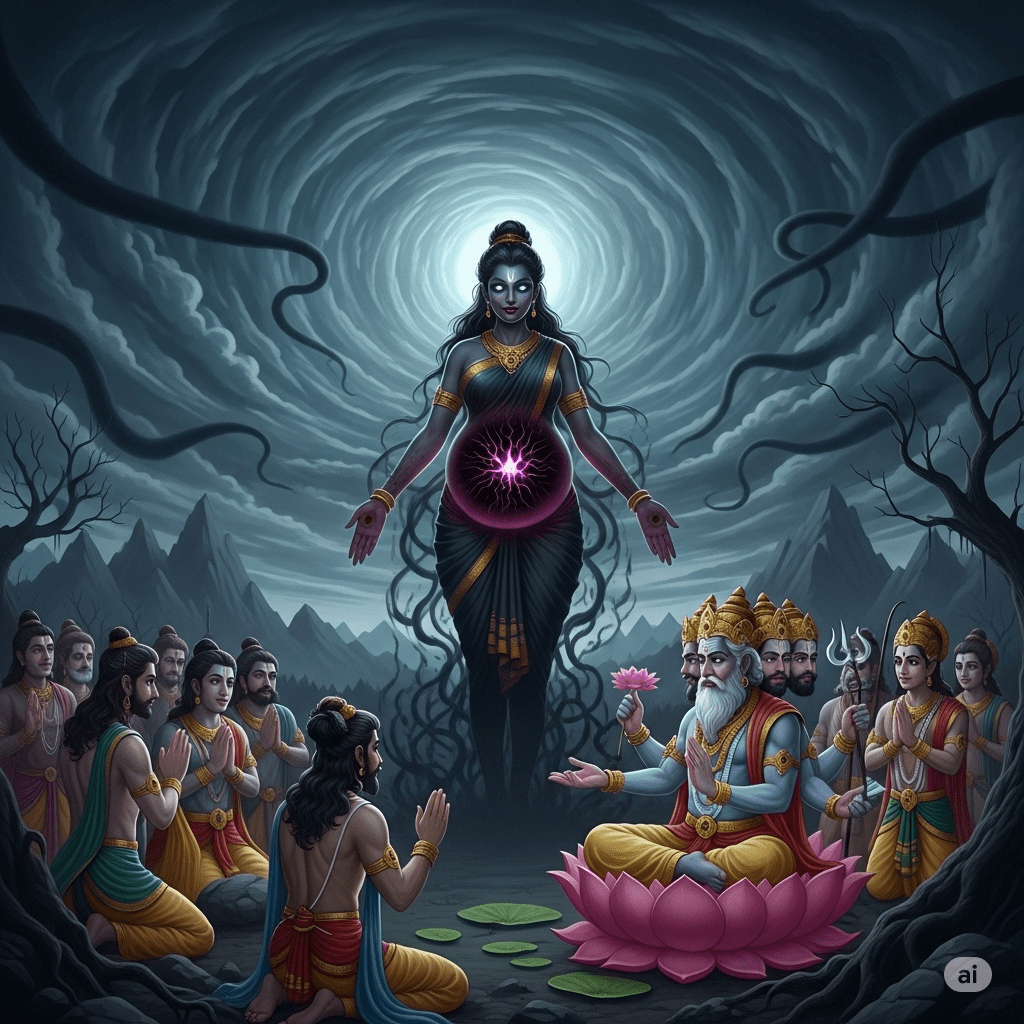
1. Being afraid of the destruction of her sons by Hari, Diti bore (in her womb) the luster (semen) of Prajāpati Kaśyapa for a hundred years—the lustre that subdued the lustre of others.
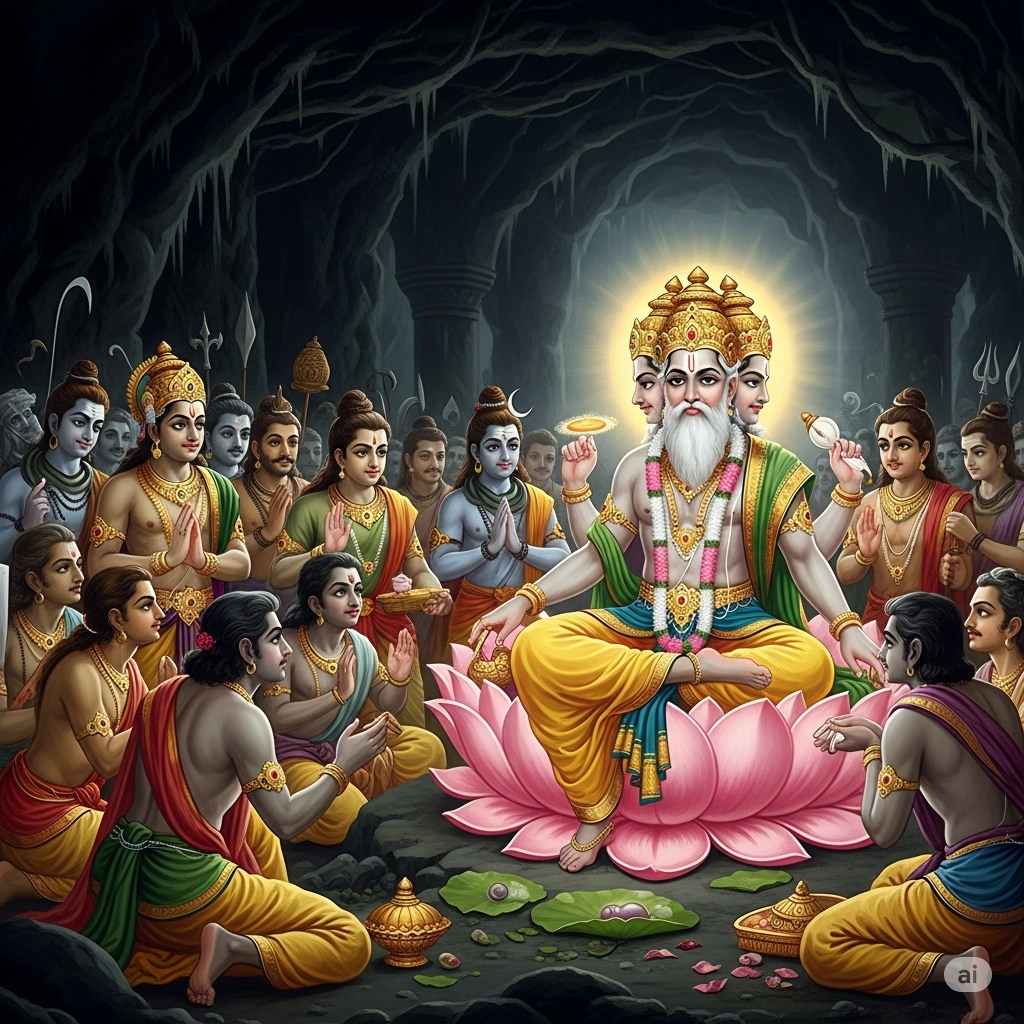
2. When by the power of the foetus, the world became void of light (due to the diminished light of the Sun etc.) and the gods in charge of protection of quarters were devoid of their power, they reported to Brahmā (the creator of the universe, the trouble due to) the spread of darkness in all directions.
Gods said:
3. Oh Lord, you know this darkness whereby we have been deeply agitated, because there is nothing unmanifested to you whose path (range of knowledge) is unaffected by Time.
4. Oh God of gods, the creator of the world, the crest- jewel of the protectors of the world, you know the mind of beings both superior and inferior to us.
5. We salute to you whose power is his special knowledge and who has assumed the body (as Brahmā) through Māyā and accepted rajas as a special attribute. We bow to you, the cause of the manifest-world (whose cause—the Supreme Soul—is unmanifested).
6-7. There is no defeat from anyone to those whose yoga is quite perfect (ripe) and who have conquered their breath, sense-organs and the mind and have been favoured by your grace and who, with unswerving devotion meditate upon you, the highest (God), the creator of all beings, whose form is composed of the causal relation, i.e. of cause and effect, and in whom the world is woven.
8. We bow to you the chief controller (or the chief vital breath) to whom all beings offer worship. Just as cows are bound down by cords, they (people) are restricted by his. (your) word (i.e. Vedic injunctions).
9. Oh mighty one you who are of this nature, bring about good to us whose (routine) performance of activities is stopped due to darkness. You should look with extreme mercy upon us who are distressed.
10.Oh god, this is the semen of Kāśyapa which is deposited in Diti’s womb as embryo which grows enveloping all directions in darkness, like fire consuming fuel.
Maitreya said:
11.Oh long-armed Vidura, the venerable son of the Supreme Soul (Brahmā) who was the object of the words of entreaty by gods, laughed loudly and replied to gods in sweet words.
Brahmā said:
12. Sanaka and others, my mind-born sons before your creation are free from all worldly desires and they wander over the worlds through the sky.
13. Once upon a time, they went to Vaikuṇṭha, the region of Lord Viṣṇu of pure Soul, Vaikuṇṭha which is respected by all.
14. All persons who dwell there have the form like Viṣṇu. They propitiate Hari by the righteous path without any ulterior motive to accomplish.
15. There dwells the venerable First Puruṣa who can be known only through word (i.e. Vedānta). He assumes pure Sāttvic form. The foremost one showers his grace on us, his devotees, to make us happy.
16. There is a park called the Final Beatitude which by its wish-yielding trees and by its beautiful blossoms of flowers etc. throughout all seasons, shines like veritable Mokṣa (Final Liberation) itself.
17. Where (in the Vaikuṇṭha region) devotees of Viṣṇu along with their beautiful wives in the aerial cars, disregard the fragrant wind even though their minds are distracted by the fragrance of the blossoming, honey-dripping flowers of creepers in the spring near water and sing of the deeds of the Lord which purify the sins of the world.
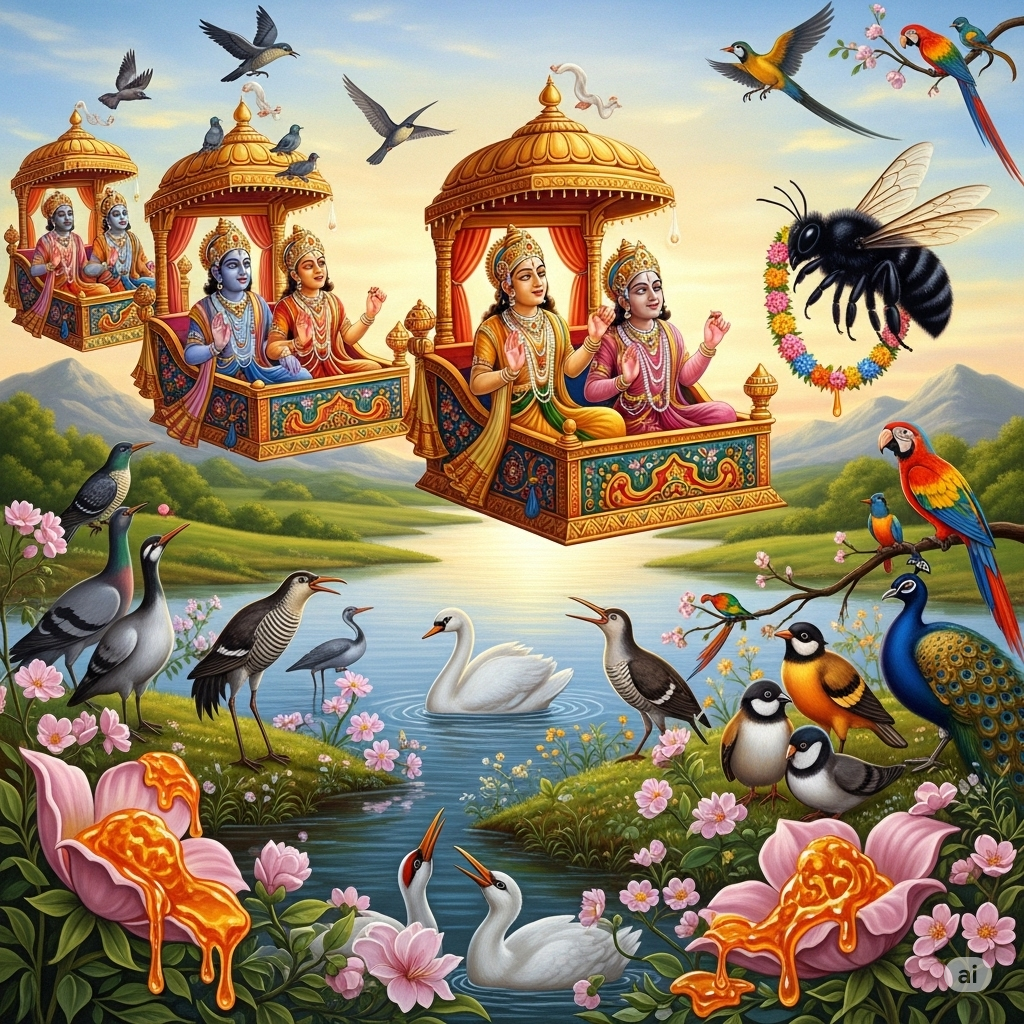
18. There the loud confusing cries of birds like pigeons, cuckoos, cranes, cakravāka, (the ruddy goose), cātakas, swans, parrots, tittiris and peacocks stop for a while when the chief black-bee (in Viṣṇu’s vanamālā) hums loudly as if singing the story of Hari.
19. There when the fragrance of Tulasī is appreciated by Viṣṇu by wearing (as an ornament) the garland of Tulasī, even flowering plants like the Mandara, the Kunda, the Kurava, the night-lotus, the Arṇa, the Punnāga, the Nāgakesara, the Bakula, the lotus and the Pārijāta, in their goodness of heart, paid respects to the penance of Tulasī.
20. It (the Vaikuṇṭha) is crowded with aerial cars (made) of (jewels like) Vaidūrya (Lapis lazuli), emerald (and of) gold which can be seen only by those that bow to Hari’s feet. Here, damsels of big hips and beautifully smiling faces cannot, with their beguiling smiles and other allurements, excite passion in those devotees whose minds are fixed on Kṛṣṇa.
21. The goddess of Wealth (Lakṣmī) of beautiful form, for whose favour others are striving, stays (permanently) in Hari’s residence giving up her noxious quality (of fickleness). With her lotus-like feet jingling with anklets and arms freely dangling with a lotus in hand in a sportive manner, she (i.e. her reflection) in the crystal walls chased with gold, appears as if dusting (the house with lotus).
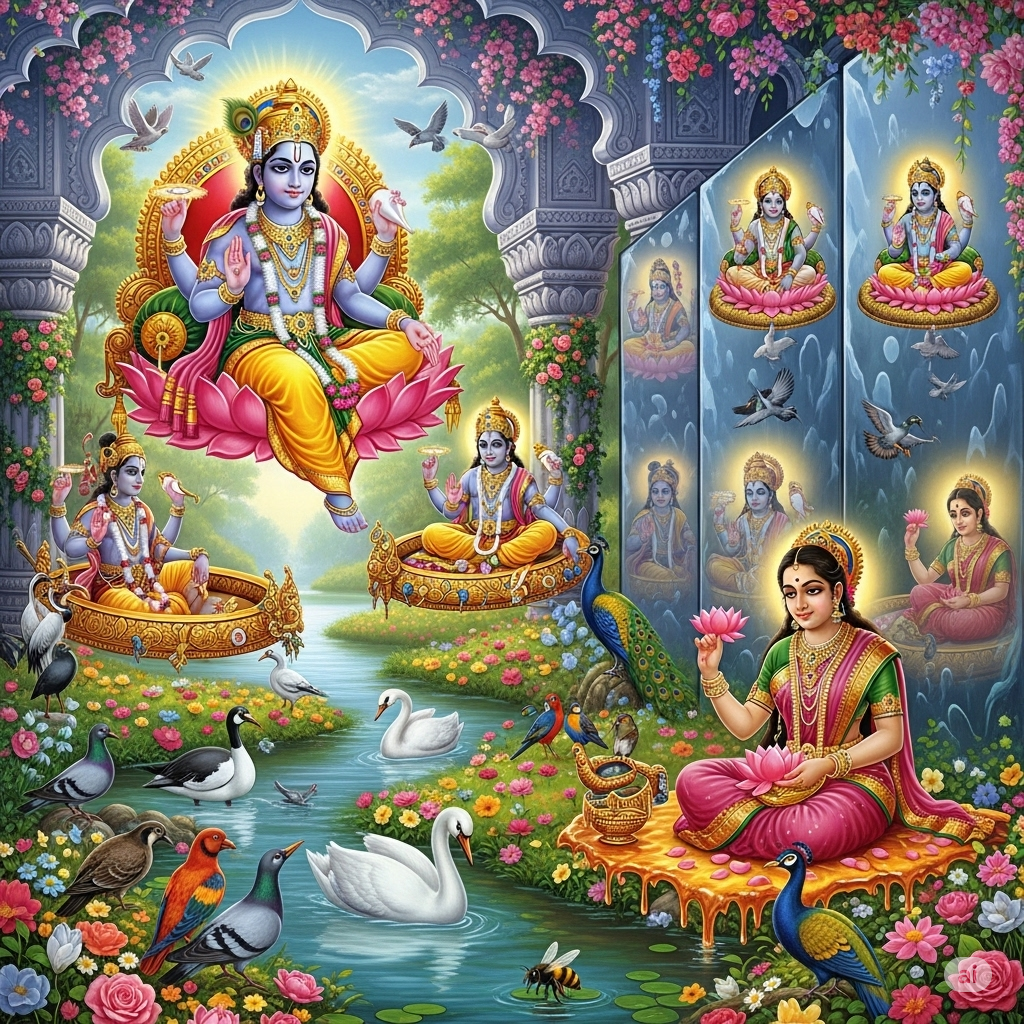
22. Oh gods, where (in Vaikuṇṭha), in her own garden, the goddess Lakṣmī attended upon by her maid-servants, was worshipping the Lord with Tulasī petals, saw her face with beautiful locks of hair and prominent nose reflected in the ponds of pure nectarlike waters and with sloping bank (ghāṭs) of corals, felt that it was kissed by her Supreme Lord.
23. To which (Vaikuṇṭha) do not reach those who listen to the mind-spoiling evil stories pertaining to topics other than the deeds of creation etc. of Hari, the destroyer of sins. Alas! These stories (on subjects concerning Artha and Kāma) when heard by unfortunate people, deprive (the hearers) of all good merits and throw them in dark hells from which there is no relief.
24. Birth in the human species is aspired after even by us (as) it is possible to gain the knowledge (i.e. realization of Brahman or the Truth along with the performance of Dharma, in it. Those who (having thus got birth as a man) do not propitiate the venerable Lord, are alas, deluded by your Māyā of very wide expanse.
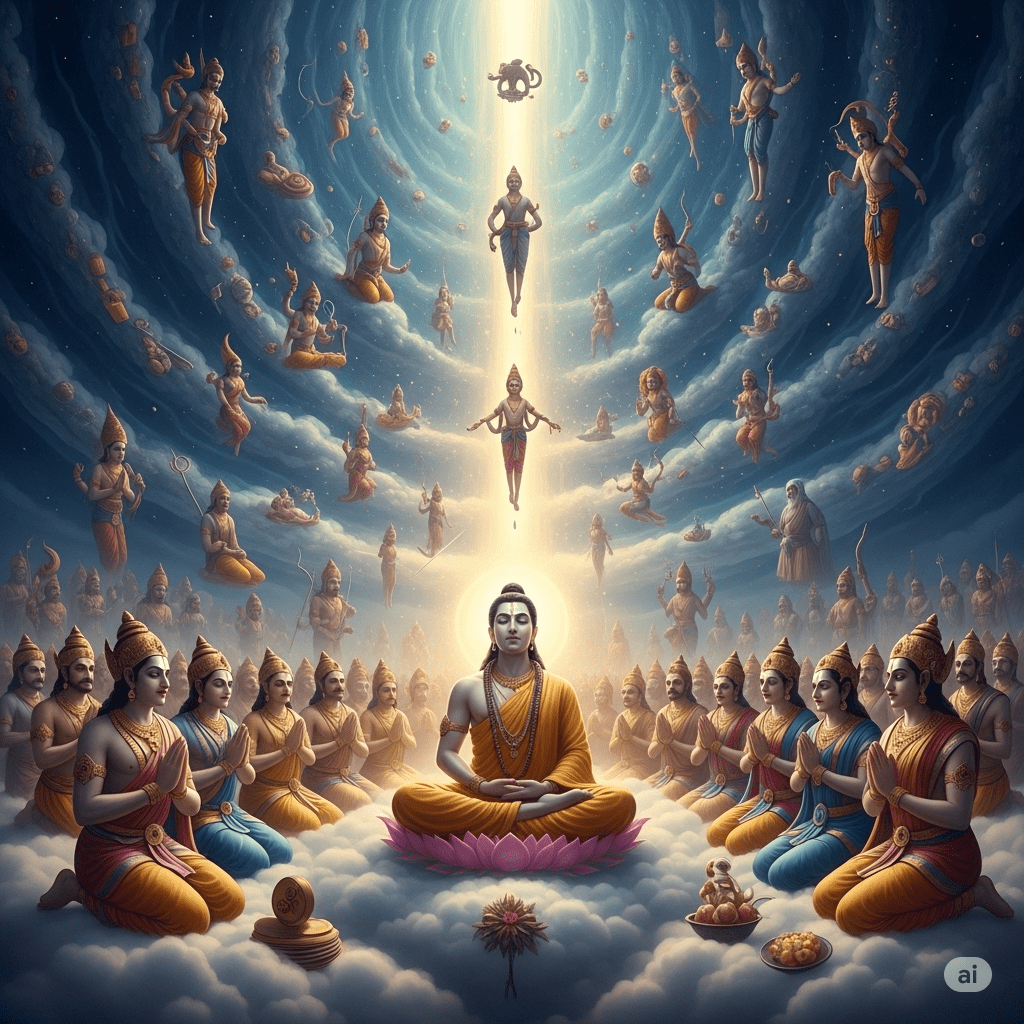
25. There (to Vaikuṇṭha, above our region) go these (men) who by the service of the greatest among gods, have kept off Yama, the god of death, (or who are above the discipline of Yama, Niyama etc.) and who being of enviable character are (spiritually) above us. While mutually discussing about the supremely glorious Lord, their mind, being overwhelmed with intense love and devotion, the hair stand on end on their bodies and tears flow from their eyes.
26. The sages were greatly overjoyed when, by their power of eightfold Yoga, they reached Vaikuṇṭha which they had not seen before, and which, being presided over by the Lord of the universe, was adorable to all the worlds, and which was shining with the lustre of various heavenly cars of great gods.
27. Having crossed the six enclosures without being prevented or attracted by the wonderful sights thereof, the sages saw, at the seventh, a pair of gods of the same age, each armed with a mace gorgeously dressed and wearing extremely valuable armlets, ear-rings and diadems.
28. Each of them wore around his neck and between their four bluish arms, a garland of forest-flowers (Vanamālā) about which swarmed the intoxicated bees, and whose face with best brows, wide nostrils and red eyes, appeared excited (angry).
29. While these two were looking on, the sages entered without asking for permission, the (seventh) gate as (they did) through the (previous) gates the panels of which were made of diamonds chased with gold. They go everywhere without any obstruction as they are free from fear due to their equality of outlook to all (or due to their sight being fixed on the Soul or the Lord).
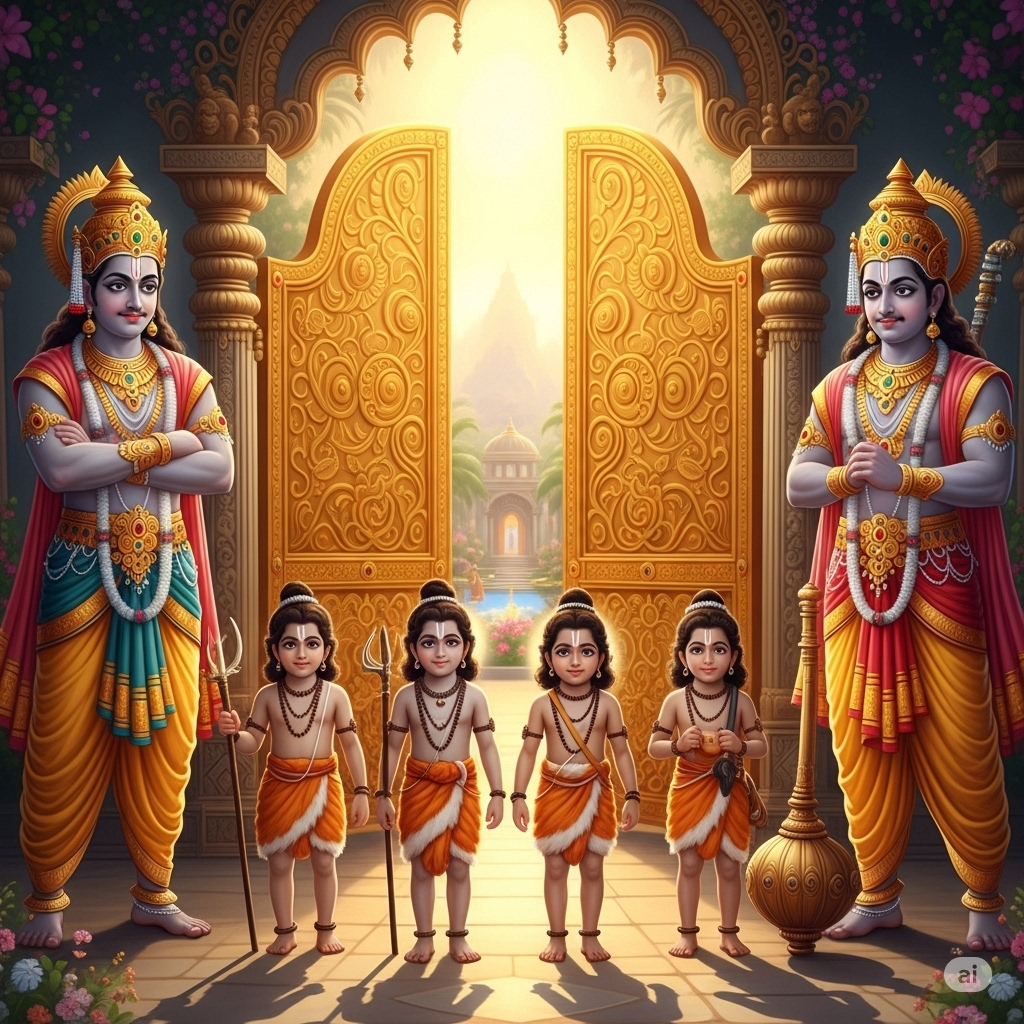
30. The two (gods) whose nature was contrary to that of the Lord, looked at those four nude boy-sages who, despite their age, looked five years old and had realized the real nature of the Soul. Laughing (disrespectfully) at their prowess, they prevented (the sages) both by their cane (and command) even though the sages should not have been treated so.
31. When the most venerable sages were disallowed by Hari’s door-keepers, while the gods were looking on, they (sages) whose eyes were suddenly overwhelmed with some anger due to their disappointment of seeing their most beloved God, spoke (as follows):
The sages said:
32. “What a partial nature of you both who dwell here among persons who attain to this region by rendering the highest service to God and who possess the same qualities (e.g. impartiality) as of the Lord! Is there any suspicious character here resembling you in crookedness of mind (and hence worth apprehending) by you, when the Supreme Man is so very tranquil and free from all hostilities.
33. For learned men do not see any difference here in the Lord (Viṣṇu) in whose belly lies the whole (universe). They see the (individual) Soul in the Supreme Soul like the space (in a pot) in (the bigger space of) the sky. You possess the characteristics of gods. What (cause) has arisen which makes you suspect such a stomach-tearing fear to Hari?
34. So we consider what can be done for the great welfare of you two stupid servants of the Supreme Lord of Vaikuṇṭha for this impropriety of making differences and discriminations even here. You go from this place (Vaikuṇṭha) to those sinful worlds where the three enemies (Lust, Anger and Avarice) dominate.”
35. Having understood the terrible (implication of their) utterance and realizing the impossibility of protection from the Brāhmaṇa’s punishment with the help of missiles, the two servants of Hari immediately prostrated themselves before them touching their feet as (they knew that even) Hari entertains great awe for them (Brāhmaṇas).
36. “May the punishment inflicted upon us, sinners, by your Venerable Selves be implemented. It will absolve us completely of our violence of even God’s order. But we pray by the slight repentance awakened in us by your favour, may not the delusion erasing the memory of the Lord affect us who may go down to lower births for this offence.”
37. At that time, knowing the offence given to the saints this way by his servants, Lord Padmanābha (Viṣṇu), the delight of the noble ones, along with Lakṣmī went there on foot which are sought after by Paramahaṃsas and great sages.
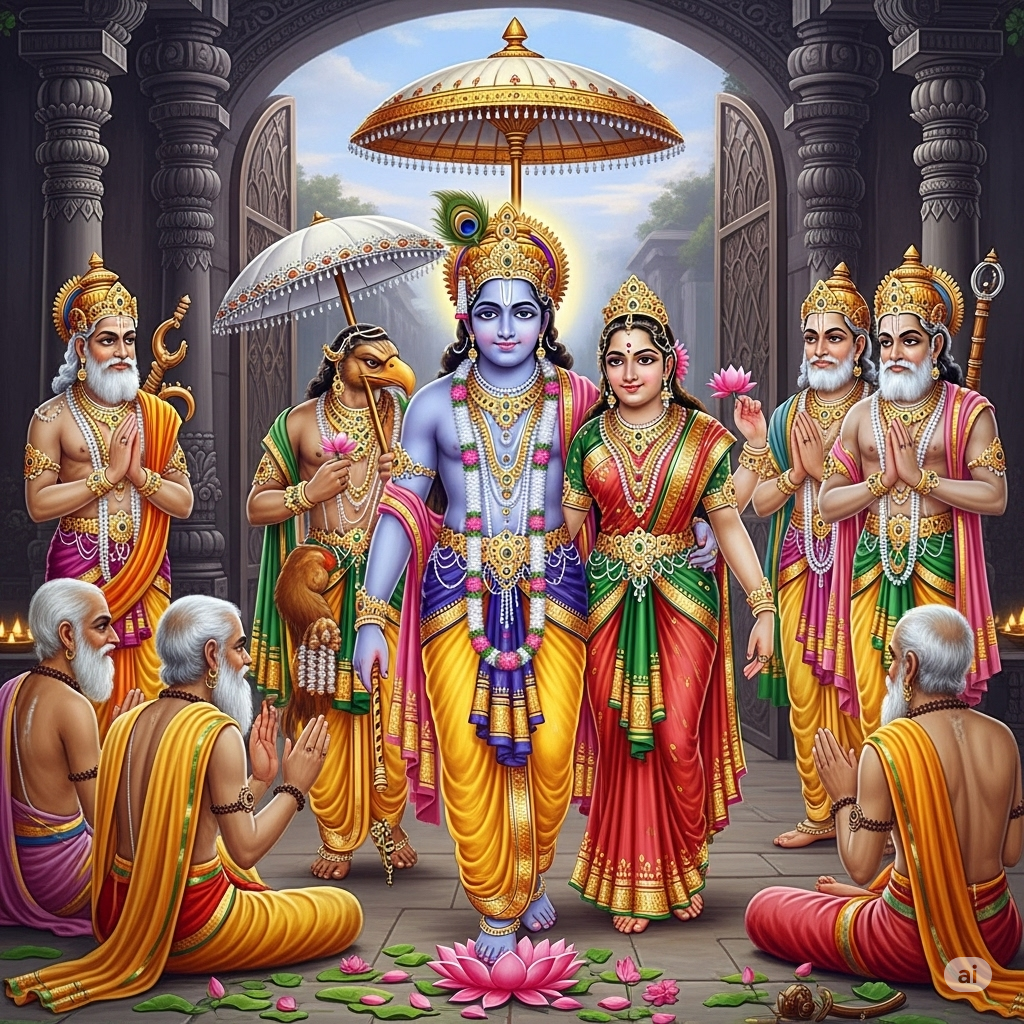
38. They saw him who was the ultimate object—the Brahman—to be realized in meditation, coming within the range of their sight. His men (attendants) promptly brought to him the usual articles (e.g. the umbrella, Chowries, at the time of going). From the pearl-fringes of his moonlike white umbrella were dripping drops of water as they (the hanging pearl-laces) were gently moving in the enjoyable breeze caused by the two Chowries (cāmaras) which were beautiful like swans.
39. (They saw him) whose extremely beautiful face was showing grace to all (the sages and the door-keepers); who is the home of (all) desirable qualities; who was (as if) touching the interior of hearts by his affectionate glances and who with the resplendent Lakṣmī on his blue broad chest was heightening the beauty of his abode (Vaikuṇṭha) situated above the heavens like a crest-jewel.
40. (They saw him) wearing a shining girdle round the yellow garment covering his big hips, and with his Vanamālā (hovered round) by humming black-bees, and who wore beautiful bracelets on his wrists, and who rested one hand on Garuḍa’s shoulder and who was sportively waving a lotus with another hand.
41. (They saw him) whose face was beautiful due to his prominent nose, and cheeks suitable to grace the ear-rings shaped like Makaras, surpassing the lightning in brilliance; whose diadem was set with jewels and who was wearing round his neck the Kaustubha jewel and an attractive and precious necklace hanging between his big arms.
42. His devotees, with their intelligence, judged that the pride of Lakṣmī about her being possessed of the highest beauty was subdued in the presence of the Lord. Having seen the Supreme Lord assuming bodily form for me, Śiva and you (Sanatkumāras), they bowed to him with their heads but their eyes were never satisfied by gazing at him.
43. When they breathed, the air fragrant with the Tulasī and the filaments of the lotus of the feet of the lotus-eyed Lord entered through their nostrils, and caused excitement in the minds and bodies of the sages who have experienced the permanent—everlasting—bliss (of Brahman).
44. Seeing his face charming like the interior of a blue lotus and his flower-like smile on his very beautiful lips, they felt that their desires were fulfilled. Again, when they saw his pair of feet with ruby-like nails, they meditated upon him.
45. They eulogised Viṣṇu who is the object of meditation for men who seek liberation by the Yoga-process in this world, and who showed the most venerable Puruṣa-form giving delight to the eyes and who is possessed of his inherent eight siddhis which are not accessible to others.
Kumāras said:
46. Oh Infinite One, you, though present in hearts of the sinners (non-devotees), are unmanifested to them, but not so to us. But it is just today that you are visible to our eyes. You entered our hearts by the way of the ears when your mystery was explained to us by our father who is born of you.
47. Oh venerable Lord, we recognize you to be that Supreme Paramātman who every moment generate (inspire) love in these devotees by means of the attribute Sattva—Paramātman whom passionless sages, whose knot of I-ness (ahaṃkāra) is severed, know in their hearts by intense Bhakti- yoga (and who are) understood by them through your grace.
48. Oh Lord! Those blessed ones who have resorted to your feet and have tasted the flavour of episodes about you whose glory is highly praiseworthy and purifying, do not count (attach much value to) Mokṣa, your maximum grace. Will they attach any value to other attainments (such as Indra- hood) which are affected with terror at the bent of your brows?
49. May we at will be born even in hells by our sins, if our hearts sincerely rejoice at your feet like black bees (in lotus), and if our words, like Tulasī, get their charm (beauty) from your feet, and if our ears (passage in the ear) is filled with (the description) of your (host of innumerable) attributes.
50. Oh Lord of immense glory! Our eyes have to our best satisfaction obtained the bliss of looking at this form which you manifested. You who are never visible to persons with uncontrolled senses have appeared to us this way. Oh glorious Lord, we pay obeisance to you (who are of this nature.)
Thus ends the fifteenth discourse entitled “Sanaka and Others curse Jaya and Vijaya”, in Book Three of the great and glorious Bhāgavata Purāṇa, otherwise known as the Paramahaṁsa-Saṁhitā (the book of the God-realized Souls).
Summarization Of The Entire Chapter :
In this chapter, the grandeur of Bhagavān’s leela is revealed through the devotion and insight of the mind-born sons of Brahmā—Sanaka, Sanandana, Sanātana, and Sanatkumāra. Maitreya recounts that the sons, upon witnessing the inauspicious effect of Diti’s prolonged gestation of Hiraṇyākṣa and Hiraṇyakaśipu, were moved by the cosmic imbalance created in the worlds. The very light of the Sun and other luminaries was dimmed, and the protective gods were unable to maintain order. Overcome by concern, they approached Brahmā, who is the cause and guide of the universe, to seek remedy and understanding. Their devotion and anxiety reveal the tender relationship between the cosmic order and divine will, highlighting how the sages’ love for Bhagavān and dharma transcends all fear.
The chapter then takes the devotees into the resplendent realm of Vaikuṇṭha, the eternal abode of Hari, where all beings exist in pure, unsullied bliss. The sages observe the perfection of this divine realm, where the fragrant groves, wish-yielding trees, and ever-blooming flowers fill the atmosphere with nectarean beauty. Even the bees, birds, and other creatures participate in celebrating the glory of Bhagavān. Lakṣmī, the goddess of fortune, remains ever devoted, attending to Hari with unwavering love, showing that true devotion is free from vanity and attachment. Here, the chapter conveys that even celestial beings are humbled by the majesty of the Lord, and that all forms of beauty, wealth, and power are nothing in comparison to the bliss of pure bhakti.
However, not all in Vaikuṇṭha are equally wise or respectful. Jaya and Vijaya, the door-keepers of Hari, act with arrogance and prevent the sages from entering freely, failing to recognize the supremacy of devotion over their own positions. The mind-born sons of Brahmā, although young in form, possess divine insight and spiritual authority. Seeing the misconduct of the gatekeepers, they curse Jaya and Vijaya to be born in the mortal worlds, ensuring that even divine servants are reminded of the supremacy of devotion and the importance of humility before the Lord. This act demonstrates that the protection of dharma and the honor of pure devotees is paramount, even in the abode of the Lord.
When Bhagavān himself manifests before the sages, accompanied by the graceful Lakṣmī, they behold his sublime form—resplendent, compassionate, and full of divine majesty. Every detail of his form, from the Kaustubha jewel on his chest to the delicate fragrance of Tulasī adorning his feet, fills their hearts with uncontainable bliss. They offer obeisances with deep love, recognizing that the Supreme Lord is both immanent in all beings and yet supremely transcendental. Their eyes, minds, and senses are enthralled, and through this vision, the sages experience the highest prema—the purest love for Bhagavān, which transcends fear, desire, and worldly attachments.
The chapter beautifully emphasizes that pure devotion is the ultimate path to liberation and eternal bliss. The sages’ love for Bhagavān, their reverence for dharma, and their insight into cosmic order reveal the harmonious interplay of divine will, karma, and bhakti. It also teaches that the grace of the Lord is all-pervading, that the vision of the Supreme can purify even the highest beings, and that true devotion is marked by humility, surrender, and delight in the Lord’s glory. The story of the curse of Jaya and Vijaya thus becomes a reminder that bhakti surpasses all forms of hierarchy, power, and even cosmic privilege, for the love of the Lord is the highest law.
Thus ends the fifteenth discourse, revealing the eternal leelas of Hari, the devotion of the sages, and the transcendental beauty of Vaikuṇṭha, teaching all devotees the path of prema-bhakti as the ultimate means to union with Bhagavān.
Short Questions & Answers :
Q1. Who were the sages that witnessed the cosmic imbalance caused by Diti’s sons?
A1. The sages were the mind-born sons of Brahmā—Sanaka, Sanandana, Sanātana, and Sanatkumāra.
Q2. Why did the sages approach Brahmā?
A2. They approached Brahmā because the prolonged gestation of Diti’s sons Hiraṇyākṣa and Hiraṇyakaśipu caused darkness in the world and weakened the gods in charge of the quarters, disturbing cosmic balance.
Q3. How did the gods describe the darkness to Brahmā?
A3. The gods explained that the semen of Kāśyapa deposited in Diti’s womb grew so powerful that it enveloped all directions in darkness, like fire consuming fuel, and requested Brahmā to remedy the situation.
Q4. What is Vaikuṇṭha and what did the sages see there?
A4. Vaikuṇṭha is the eternal abode of Lord Viṣṇu. The sages saw wish-yielding trees, fragrant flowers, aerial cars, devotees singing Hari’s deeds, and Lakṣmī attending Bhagavān with devotion. Everything reflected perfect bliss and devotion, untouched by lust or material desire.
Q5. What lesson is conveyed by Lakṣmī’s behavior in Vaikuṇṭha?
A5. Lakṣmī demonstrates unwavering devotion and humility. She remains absorbed in serving Bhagavān, showing that true bhakti is free from vanity, attachment, or jealousy.
Q6. Who were Jaya and Vijaya and what mistake did they make?
A6. Jaya and Vijaya were the door-keepers of Vaikuṇṭha. They acted arrogantly and prevented the sages from entering freely, failing to respect the supremacy of devotion and spiritual insight.
Q7. What did the sages do in response to Jaya and Vijaya’s behavior?
A7. The sages, though young in form, cursed Jaya and Vijaya to be born in mortal worlds as a result of their arrogance, teaching that even divine servants must respect devotion and dharma.
Q8. How did Bhagavān respond to the sages?
A8. Bhagavān manifested before the sages, accompanied by Lakṣmī. His divine form, adorned with Kaustubha, yellow garments, a Vanamālā, and lotus-like features, filled their hearts with uncontainable bliss, demonstrating the supremacy of divine grace.
Q9. What was the reaction of the sages upon seeing Bhagavān?
A9. The sages were overwhelmed with prema-bhakti, offering obeisances, meditating on his lotus-like feet, inhaling the fragrance of Tulasī, and rejoicing in the sight of the Supreme Lord’s beauty, realizing the highest bliss and liberation.
Q10. What spiritual lesson does this chapter convey?
A10. The chapter emphasizes the supreme importance of devotion (prema-bhakti) over hierarchy, power, or cosmic privilege. Even the gates of Vaikuṇṭha recognize the authority of pure devotees. True bhakti purifies the heart, pleases Bhagavān, and grants eternal bliss beyond all material attainments.
Q11. How does the curse of Jaya and Vijaya connect to the leelas of Hari?
A11. The curse sets the stage for their future births in the mortal world, where they will be vanquished by incarnations of Bhagavān, demonstrating that even apparent misfortune serves the divine leela and reinforces the supremacy of devotion.
Q12. What does Vaikuṇṭha signify for devotees in this chapter?
A12. Vaikuṇṭha represents the perfect realm of purity, bliss, and devotion, where all beings live in service to Bhagavān, untainted by lust, ego, or desire, and it is accessible only through sincere bhakti.
