Chapter 14 – Diti’s Conception
Śrī Śuka said:
1. Having listened to the story of Hari in his Boar- incarnation (for the purpose of the lift-up of the earth) as narrated by Maitreya, Vidura who had taken the vow (of hearing the episodes of Hari) was not much satisfied. Folding up his hands (in bowing), he asked again.
Vidura said:
2. “Oh great sage, we have heard it reported that the first daitya (demon) Hiraṇyākṣa was killed by the same Hari who (in the boar-form) was the embodiment of sacrifice (Yajña).
3. Oh Brahman, for what purpose was there a confrontation between the demon-king (Hiraṇyākṣa) and him (Hari) who was lifting the earth up with the tip of his tusk.”

Maitreya said:
4. Oh warrior (Vidura), yours is a good query as the story about Hari’s incarnation that you ask, cuts asunder the noose of death in the case of mortal beings.
5. By (hearing) which (story) as sung by the sage (Nārada), the male child of Uttānapāda (Dhruva) set his foot on the head of the god of Death and ascended to the place of Hari.
6. Even in this case (of the fight with Hiraṇyākṣa) I have heard this account related in ancient times by Brahmadeva, the god of gods, to the gods who enquired him (about it).
7-8. Oh Vidura, Diti, the daughter of Dakṣa, was desirous of a child and with her heart overcome with passion on one evening, desired (the company of) her husband Kaśyapa, the son of Marīci, who was seated in meditation in his fire-worship hall after offering oblations of milk to the Supreme Person, the protector of sacrifices, in the evening.
Diti said:
9. “Oh learned, this god of love with a bow in his hand torments me, a poor thing, for your sake just as an elephant attacking a plantain tree crushes it.
10. May you be prosperous! Please confer your favour on me who am burning at the (sight of the) prosperity of my co-wives who are blest with children.
11. The fame of women who are greatly respected by husbands, spreads over the world, and of those to whom the husband like you, is really born as a son.
12. Formerly our father, venerable Dakṣa, who was affectionate to us his daughters, asked us separately, “Oh daughters, whom do you select as your husband?”
13. Having understood the inclination of us, his daughters, he, the progenitor of the race, gave you thirteen daughters who liked your nature.
14. Oh lotus-eyed auspicious sage, now satisfy my desire. Oh plentiful one, an entreaty of the distressed to the great ones is never fruitless.”
15. Oh valiant one, Kaśyapa replied in consolatory words to her who, being over-whelmed with passion, has become pitiable and was persuading him with many arguments (words).
16. “Oh timid one, here I am ready to comply with whatever you desire. Who would not fulfil the desire of her who helps accomplishment of the three puruṣārthas (dharma, artha, and kāma) in life?
17. Just as the people cross the sea in ships, a married person giving shelter to persons of other āśramas, crosses the sea of misery.
18. Oh proud lady, they (the learned ones) call her (the wife) as the equal partner (lit. half the part) of the man who aspires after happiness. After entrusting the responsibility of his work to her, man can move about free from the fever of anxiety.
19. Depending on whom (the wife), we easily overcome the enemies in the form of senses which are difficult to be conquered by men of other (non-gṛhastha) āśramas, just as the lord of a fort (subdues) the enemies (due to his fortified position).
20. Oh mistress of the house, it is not possible for us to become so completely (obliging) like you, even (if we try) throughout our life (and in the next birth as well). Nor others who appreciate (your) virtues (can do so).
21. I shall, however, try to comply with your request (desire) for offspring. But please wait for a muhūrta so that they (the people) will not reproach me.
22. This is the most terrible of times when everything looks awful, as at this time goblins, the followers of Rudra wander about.
23. Oh pious lady it is in the evening that Lord Śiva, the creator of beings and the king of ghosts, moves about riding his bull and surrounded by his goblin-attendants.
24. Your brother-in-law god Rudra whose shining mass of hair (on head) became scattered and tawny by the dust raised by the whirl-wind in śmaśāna (the crematory ground) and whose pure gold-like body is smeared with ashes, witnesses (everything) with his three eyes (viz. the Sun, the Moon and the fire.) Hence there is no secrecy anywhere.
25. In this world there is no one who is his relative or non-relative. Nobody is specially respectable or censurable to him. By performance of various vows, we desire to have the (prosperity and greatness of) Māyā which he has enjoyed and spurned (lit. kicked).
26. Thoughtful people who wish to tear off the veil of Māyā praise his life which is spotless or unattached (to sensual pleasures). He has none equal or superior to him. He is the ultimate goal of the saintly people; yet he himself followed the vow of piśāca type of life.
27. The unfortunate sinners decorate with garments, garlands, ornaments and pigments their body, (which is nothing but) the food of dogs, as if it (the body) were their Soul. They do not understand the motive behind his (Rudra’s) behaviour and laugh at him who is absorbed in (the meditation of) the Soul.
28. God Brahmā and others obey the limits (laws) set by him. He is the cause of this universe. Māyā is his obedient servant. His behaviour is like a Piśāca. Oh (how) incomprehensible are the ways of the Almighty.
Maitreya said:
29. Though she was thus admonished by the husband, she whose senses were thoroughly overwhelmed with passion, caught hold of the garment of the Brāhmaṇa Sage.
30. Knowing his wife’s importunity to that prohibited act, he then bowed down to the dictates (of the providence) and sat down with her in a secluded place.
31. He then took bath, controlled his breath and meditating silently over the pure, eternal Light, repeated internally the Gāyatrī (or the syllable Om).
32. Oh Vidura, even Diti, feeling ashamed of that sinful act, approached the Brāhmaṇa-Sage and with her face cast down, addressed him.
Diti said:
33. ‘Oh Brahman! May not the Lord of goblins (bhūtas) kill the child in my womb. I have committed a fault against Rudra, the Lord of bhūtas (beings).
34. Obeisance to the great god Śiva who is the remover of miseries (Rudra), who is irresistible, giver of blessings (to those who cherish desire and the highest bliss to the desireless devotees). He, though weaponless, takes up arms against the wicked, and is anger incarnate (at the time of destruction or pralaya).
35. May the Lord of Satī, my sister’s husband, the great god with abundance of grace, be gracious unto us women who are treated as worthy of compassion even by ruthless hunters.
Maitreya said:
36. Prajāpati (Kaśyapa) who has completed his evening rituals spoke to his wife who was trembling (greatly with fear) and who was desirous of securing the good of her progeny both here and hereafter.
Kaśyapa said:
37-38. On account of your impure mind, inauspiciousness of the (evening) time, disobedience to my order and complete disrespect for gods (attending Śiva), Oh woman, you will beget two wicked sons the worst ever born from wombs. Oh wrathful one, they will frequently make the worlds and the protectors of the worlds, cry out (by their atrocious acts).
Special Note :
1. The nature of dusk (sandhyā-kāla)
- Dusk (pradoṣa-kāla or sāyam-sandhyā) is the transitional period between day and night.
- It is neither fully light nor fully dark, a liminal moment when sattva (purity) is not predominant, but rajas (passion) and tamas (inertia) tend to mix.
- Scriptures prescribe that this time is specially reserved for sandhyā-vandana (twilight prayers), meditation, and worship of Lord Viṣṇu or Śiva.
So, using that sacred moment for sense enjoyment (like sexual union) was considered a misplacement of energy and hence inauspicious.
2. Association with beings of tamas
- At dusk, yakṣas, rākṣasas, piśācas, and other lower entities become more active, as it is their natural time of movement.
- If one engages in indulgence at this time without protection of prayer, one is more vulnerable to their influence.
- Sage Kaśyapa warned Diti that union at such a time would produce children of a tāmasic and asuric nature.
- Because Diti insisted, the result was the birth of Hiraṇyākṣa and Hiraṇyakaśipu, powerful but demonic sons who opposed the devas and Viṣṇu.
Dusk is not “bad” in itself—it is a time of heightened subtle energy. - If used for worship → it becomes most auspicious.
- If used for indulgence → it intensifies passion and tamas, leading to inauspicious results.
39-40. When the poor and innocent beings will be massacred and women are seized per force and the great souleḍ ones are incensed, the venerable Lord of the universe, the creator of the world, will be enraged. He will come down as an incarnation and will kill them as Indra (the wielder of the Vajra) destroyed the mountains.
Diti said:
41. Oh Lord, I desire that both of my sons should meet death directly at the hands of the glorious Lord whose noble arms appear splendid by the disc (sudarśana). May not they be a victim of Brāhmaṇa wrath.
42. Not even the denizens of hell show favour to a person burnt by Brahmadaṇḍa (curse of a Brāhmaṇa) and the tormentor of beings, in whatever class of creatures he be born.
Kaśyapa said:
43-44. On account of the sorrow and repentance for your misdeed, and your present consideration of what is proper and improper, and due to your great respect to Lord Viṣṇu and regard for Śiva and myself one son out of your son’s son will be respected by saintly persons. They will sing of his pure fame which would be comparable to the glory of the venerable Lord.
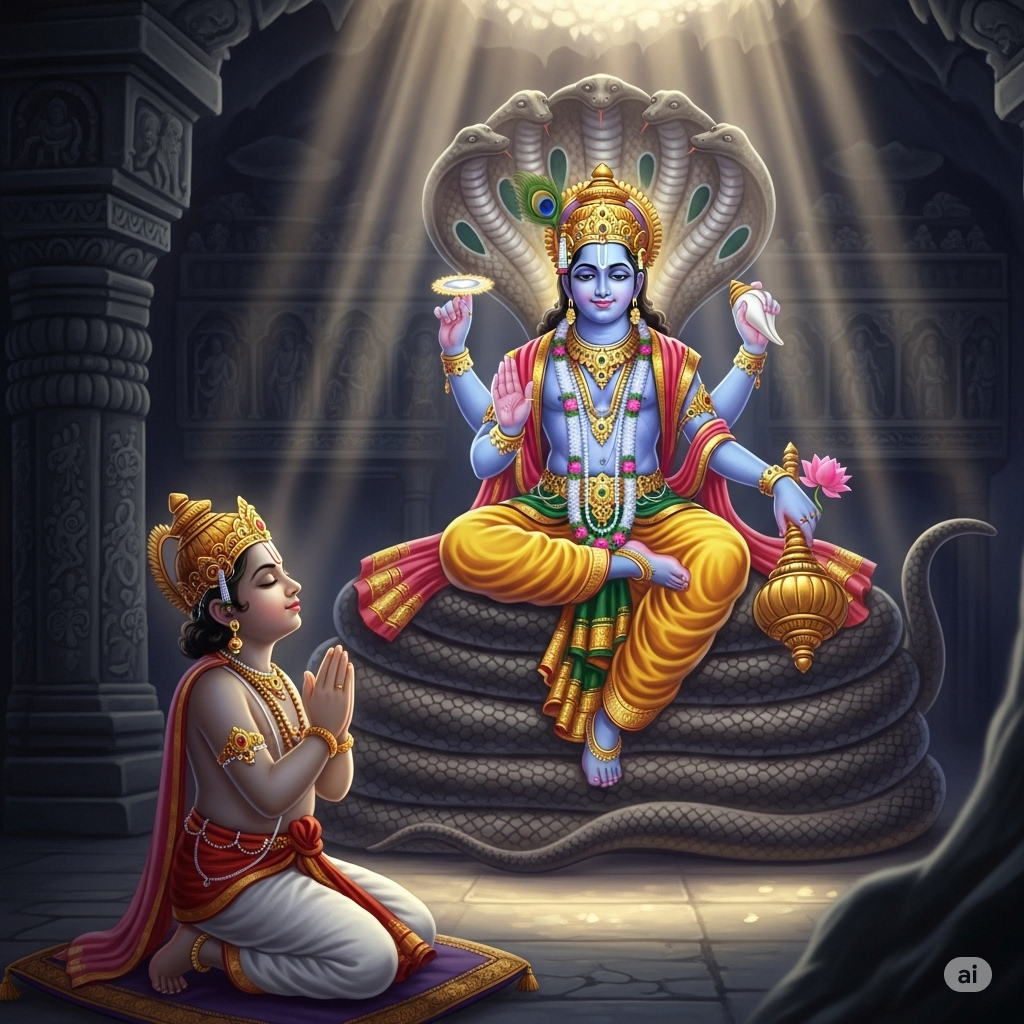
45. In order to emulate his pious nature, good persons will purify their hearts (by imbibing virtues) like non-enmity (friendliness to all) and others, just as they purify gold of inferior carat by purificatory processes.
46. By his intellect (or devotion) not directed to anyone else except the Lord, the venerable self-perceiving Lord by whose grace this universe becomes propitious, and who is the indweller of the universe, will be pleased with him.
47. Verily, he would be the greatest devotee of unlimited vision and of great prowess and the greatest of the great. For, by his deep devotion, he will establish Lord Viṣṇu in his heart, purified by devotion, and give up the ego about his body etc.
48. He will be devoid of desire for worldly pleasures, of good nature, a mine of excellent qualities, delighted at the prosperity of others and pained at the sufferings of the afflicted. With no enemy in the world, he will relieve the sorrows of the world, just as the Moon removes the summer heat.
49. Your grandson will see both in his mind and outside before him, Hari of excellent virtues, of lotus-like eyes, who assumes the form according to the desire of his votaries, and who is a grace to his consort Lakṣmī and his face adorned with refulgent ear-rings.”
Maitreya said:
50. Hearing that her grandson would be a votary of the Lord, Diti was greatly delighted. Knowing that both of her sons would meet death at the hands of Kṛṣṇa, her heart was elated.
Thus ends the fourteenth discourse entitled “Diti’s Conception”, in Book Three of the great and glorious Bhāgavata Purāṇa, otherwise known as the Paramahaṁsa-Saṁhitā (the book of the God-realized Souls).
Summarization Of The Entire Chapter :
After hearing about the glorious Boar incarnation of Bhagavān, lifting the earth from the depths of the ocean, King Vidura, devoted and ever absorbed in thoughts of Hari, remained eager to know more. With folded hands and a heart full of devotion, he inquired of Sage Maitreya about the encounter between the Lord and the mighty daitya Hiraṇyākṣa. He wished to understand the purpose of the demon’s birth and the reason why the Supreme Protector assumed his boar form to vanquish him. This question, born of sincere curiosity and reverence, opened the way for a deeper narration of divine lila that reveals the wondrous ways in which the Lord restores dharma and protects the worlds.
Maitreya began to narrate how the desire for progeny and the will of fate intertwine in the divine plan of the universe. Diti, the daughter of Dakṣa, overwhelmed by passion, approached her husband Kaśyapa with an earnest plea for children, inspired by the prosperity of her co-wives. Kaśyapa, wise and serene, reminded her of the sacredness of time, the laws of dharma, and the presence of Śiva, the Lord of spirits and ghosts, who observed all actions without partiality. Yet, moved by her entreaties, and understanding the cosmic plan, he consented to fulfill her desire for progeny, though he cautioned her about the inauspicious timing and potential consequences of her actions.
Despite the warnings, Diti’s determination led to the conception of two sons who would grow into the formidable daityas, Hiraṇyākṣa and Hiraṇyakaśipu, whose actions would challenge the devas and require the direct intervention of Bhagavān. Kaśyapa’s words, though stern, were filled with foresight and love; he foretold that the sorrow and impetuousness of Diti’s actions would bring temporary havoc, yet ultimately, the Lord Himself would intervene to protect the cosmic order and uphold dharma. In this way, the story exemplifies the delicate balance of human desire, divine will, and the inscrutable play of Māyā, demonstrating how even apparent missteps serve the greater purpose of the Lord’s lila.
Maitreya further revealed that, though the sons of Diti would bring suffering and challenge the worlds, her grandson would become a great devotee of Hari, wholly absorbed in loving service. This blessed descendant would embody the highest virtues: compassion for the afflicted, selflessness, devotion to the Lord, and delight in the prosperity of others. By his devotion, he would purify his heart and awaken the grace of Bhagavān, manifesting the supreme qualities of a saintly soul. Through this, the narrative emphasizes the transformative power of bhakti and the sublime workings of divine grace, wherein the Lord Himself ensures the triumph of righteousness and the ultimate welfare of all beings.
The chapter thus portrays the intertwining of divine providence, human longing, and the perfect plan of the Lord. Diti, though initially anxious and repentant, rejoices upon learning that the divine will favors her lineage through devotion to Hari. Maitreya closes the discourse highlighting the mercy and foresight of the Supreme Lord, whose pastimes, even when veiled by worldly events, ultimately lead to the protection of the universe and the awakening of love and devotion in the hearts of His devotees. The chapter leaves the reader immersed in prema-bhakti, recognizing that the Lord’s lila governs all creation with love, wisdom, and compassion.
Short Questions & Answers :
Q1: Who inquired about the purpose of the demon Hiraṇyākṣa’s confrontation with Bhagavān Varāha?
A1: Vidura, the devoted descendant of the Kuru dynasty, asked Sage Maitreya about the purpose of the confrontation between Hiraṇyākṣa and Bhagavān in his boar form.
Q2: Why did Diti approach her husband Kaśyapa?
A2: Diti, overwhelmed with desire for children and seeing her co-wives blessed with offspring, approached Kaśyapa requesting progeny to gain fame and happiness.
Q3: How did Kaśyapa respond to Diti’s request?
A3: Kaśyapa advised caution, highlighting the inauspicious timing (evening) and the presence of Rudra (Śiva), but he eventually consented to fulfill her desire, understanding her devotion and the cosmic plan.
Q4: What warning did Kaśyapa give about the children to be born?
A4: He warned that because of Diti’s impure mind, disobedience, and the inauspicious time, the children would be wicked, powerful, and cause suffering in the worlds. However, he also foretold that their descendants would have devotees of Hari who would follow dharma.
Q5: Who were the sons born to Diti as a result of this union?
A5: Hiraṇyākṣa and Hiraṇyakaśipu, two powerful daityas, were born. They were wicked and challenged the devas, necessitating the intervention of Bhagavān.
Q6: What was foretold about Diti’s grandson?
A6: Diti’s grandson would become a great devotee of Bhagavān, full of virtues, compassion, and devotion. He would establish Lord Viṣṇu in his heart, act selflessly, and inspire others to follow righteousness.
Q7: How does this chapter highlight the relationship between human desire and divine will?
A7: The chapter shows that even when human desire seems misguided, divine will (Māyā) ensures the ultimate good. Though Diti’s sons caused temporary havoc, the Lord’s lila ensures the preservation of dharma and the welfare of devotees.
Q8: What spiritual lesson is emphasized through this story?
A8: The story emphasizes that devotion to Bhagavān, respect for dharma, and understanding the cosmic plan lead to liberation and divine grace. Even challenging circumstances are part of the Lord’s loving plan.
Q9: Why did Diti feel delighted at the end of the chapter?
A9: She felt joy upon learning that, despite her sons’ eventual deaths at the hands of Bhagavān, her grandson would be a pure devotee of Hari, receiving divine blessings and establishing righteousness in the world.
Q10: How does this chapter reflect the theme of prema-bhakti?
A10: It demonstrates that sincere love and devotion to Bhagavān, even across generations, ultimately leads to divine favor. Devotion purifies the heart, attracts grace, and fulfills the soul’s highest purpose.
