Chapter 10 – Brahmā’s Penance and Ten-fold Creation
Vidura said:
1.) How many types of beings did Brahmā, the grandfather of the world and master of his senses procreate, both from his body and his mind, after the disappearance of the Lord Almighty from his view?
2.) Oh Lord, the foremost among the learned, please explain to me, one by one, whatever points I asked you, and solve all our doubts.
Sūta said:
3.) Thus requested by Vidura, O Śaunaka (scion of Bhṛgu), the sage Maitreya (son of Kauṣāru) felt highly pleased and proceeded to answer the queries (by Vidura), which he had borne in his mind.
Maitreya said:
4.) Brahmā (the Creator) practiced austere penance for a hundred celestial years (36,000 human years) with his mind fixed on Śrī Nārāyaṇa, as he had been told by the Lord, who is devoid of birth.
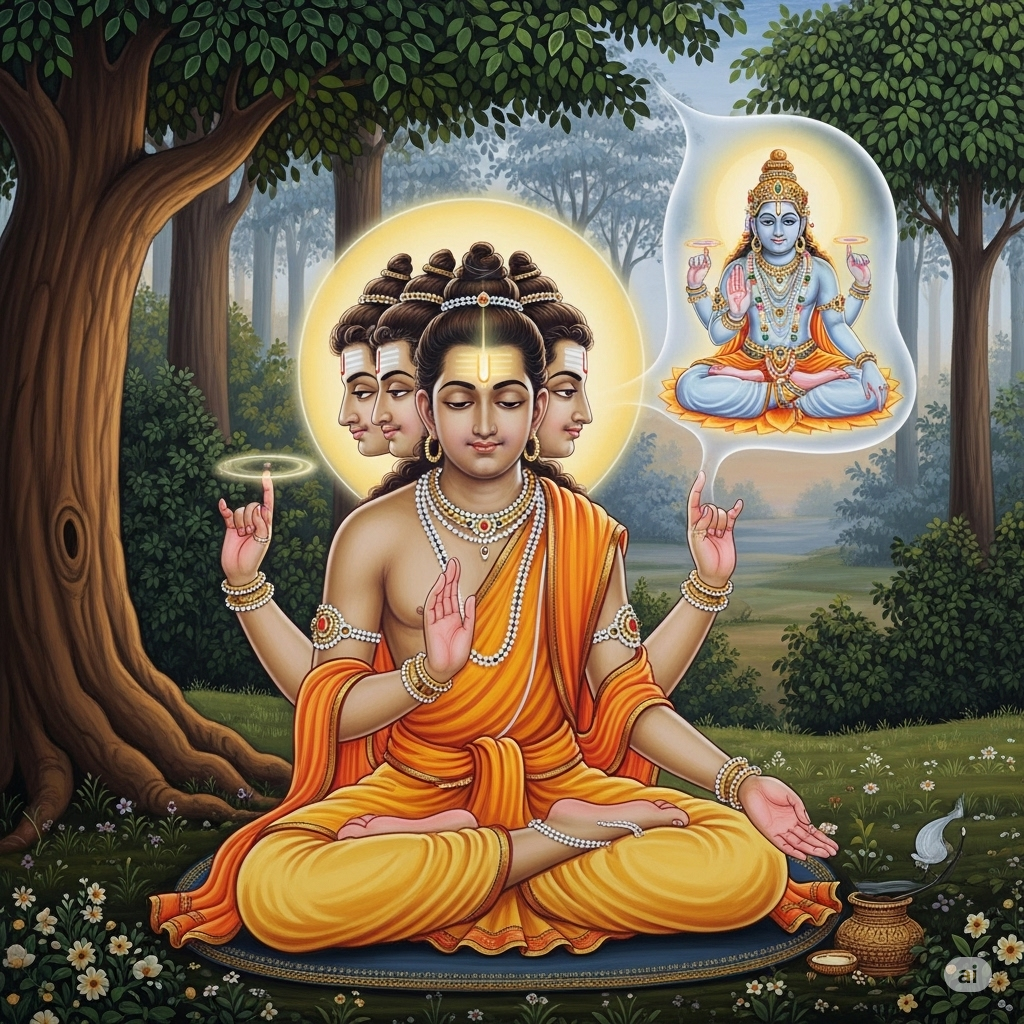
5.) The lotus-born god now saw the lotus on which he was perched, as well as the water all round, being tossed by the wind, whose fury had been intensified by the period of universal destruction.
6.) His knowledge (about creation) and creative power having been greatly enhanced by his ever-growing penance and worship through the Mantras sacred to the Lord, he drank up the wind along with the water.
7.) Having seen that the lotus, which was his seat, pervaded the whole of the space, he thought he should, by this lotus, create again the worlds which were formerly (at the time of the deluge during previous Kalpa) withdrawn.
8.) Directed by the Lord to carry on the work of creation, Brahmā entered the corolla of the lotus and split it up into three parts (viz., Bhūḥ, Bhuvaḥ and Swaḥ), although it was so big that it could be divided into fourteen or even more parts.
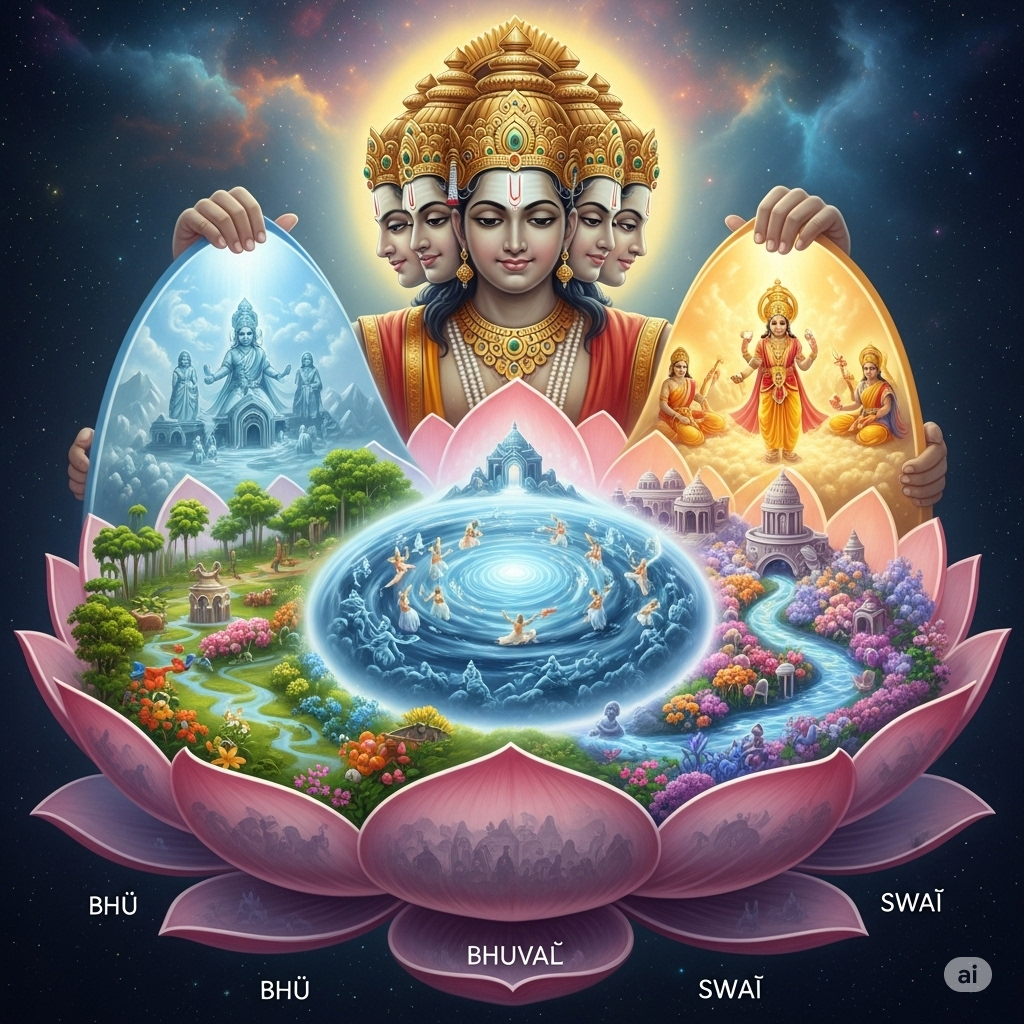
9.) It is these three worlds alone that have been declared (in the scriptures) as constituting the realm where the Jīvas (embodied souls) experience the fruit of their actions. As for Brahmā, i.e., his abode (the Satyaloka) and the three worlds immediately below it (viz., Maharloka, Janaloka and Tapoloka), they are the rewards of virtue practised without any selfish motive.
Special Note – This verse elaborates on the cosmic structure and the principle of karma, explaining where different types of souls experience the consequences of their actions and intentions.
1. “It is these three worlds alone that have been declared (in the scriptures) as constituting the realm where the Jīvas (embodied souls) experience the fruit of their actions.”
- “These three worlds alone”: This refers to the Bhūḥ, Bhuvaḥ, and Svaḥ lokas (earth, atmosphere/intermediate, and lower heaven) that were mentioned in the previous verse as being created by Brahmā.
- “Jīvas (embodied souls)”: These are individual souls, currently encased in material bodies, who are caught in the cycle of birth and death (saṃsāra).
- “experience the fruit of their actions”: This is the core concept of karma. Every action (physical, verbal, mental) performed by a jīva generates a reaction, either positive (puṇya) or negative (pāpa). These reactions ripen into “fruits” which the jīva must experience.
- Meaning: The verse asserts that the lower three planetary systems (earth, lower atmosphere, and lower heaven) are the primary arenas where jīvas reap the consequences of their actions. This means that if you perform good deeds with a desire for their phala (fruit), you might ascend to Svarloka (heaven) for a time to enjoy those fruits. Conversely, if you perform negative deeds, you might experience suffering on Earth or even in lower realms (though the verse doesn’t explicitly mention lower hellish realms, the implication is that karma dictates one’s birth and experiences within these three worlds). These realms are where material desires and their fulfillments or consequences play out.
2. “As for Brahmā, i.e., his abode (the Satyaloka) and the three worlds immediately below it (viz., Maharloka, Janaloka and Tapoloka), they are the rewards of virtue practised without any selfish motive.”
- “Brahmā, i.e., his abode (the Satyaloka)”: Satyaloka (also known as Brahmaloka) is the highest of the material planetary systems, the abode of Lord Brahmā himself.
- “and the three worlds immediately below it (viz., Maharloka, Janaloka and Tapoloka)”: These are the three higher celestial realms, above Svarloka (heaven), but still within the material universe.
- Maharloka: A realm of great sages and advanced beings.
- Janaloka: Inhabited by great yogis and ascetics.
- Tapoloka: The abode of highly austere beings who have performed severe penances.
- “they are the rewards of virtue practised without any selfish motive.”: This is the crucial distinction. While the lower three worlds are for those who act with desire for results (karma-phala), these higher realms are attained by those who perform virtuous actions without any selfish attachment to the outcomes. This is a principle known as Niṣkāma Karma (action without desire for fruit) or Akarma (action that does not bind). Such selfless actions, performed as a duty or for the pleasure of the Divine, purify the soul and elevate it to higher states of existence, eventually leading beyond even these higher material realms. Residing in Satyaloka or the realms just below it indicates a very high degree of spiritual advancement, purity, and detachment.
In essence, this verse explains the cosmic hierarchy based on the nature of one’s actions and motivations:
Higher four worlds (Maharloka, Janaloka, Tapoloka, Satyaloka): Realms attained by souls who have performed selfless, virtuous actions and are progressing towards liberation from the material world entirely. These are temporary abodes of great spiritual merit, but ultimately, even they are within the cycle of creation and dissolution. True liberation (mokṣa) lies beyond even Satyaloka.
Lower three worlds (Bhūḥ, Bhuvaḥ, Svaḥ): The realm of cause and effect, where jīvas experience the reactions of their selfishly motivated actions, leading to repeated births and deaths.
Vidura said:
10.) Tell me in detail, my lord, about the potency referred to by you under the name of “Time” of Śrī Hari of marvellous deeds, who appears as many (in the form of the universe).
Maitreya said:
11.) Time, which in itself is undifferentiated and has no beginning or end, appears in the form of metamorphosis of worldly phenomena (like sattva, rajas, etc.). Making it His instrument, the Lord (the Supreme Person) sportfully manifested Himself (in the form of the universe).
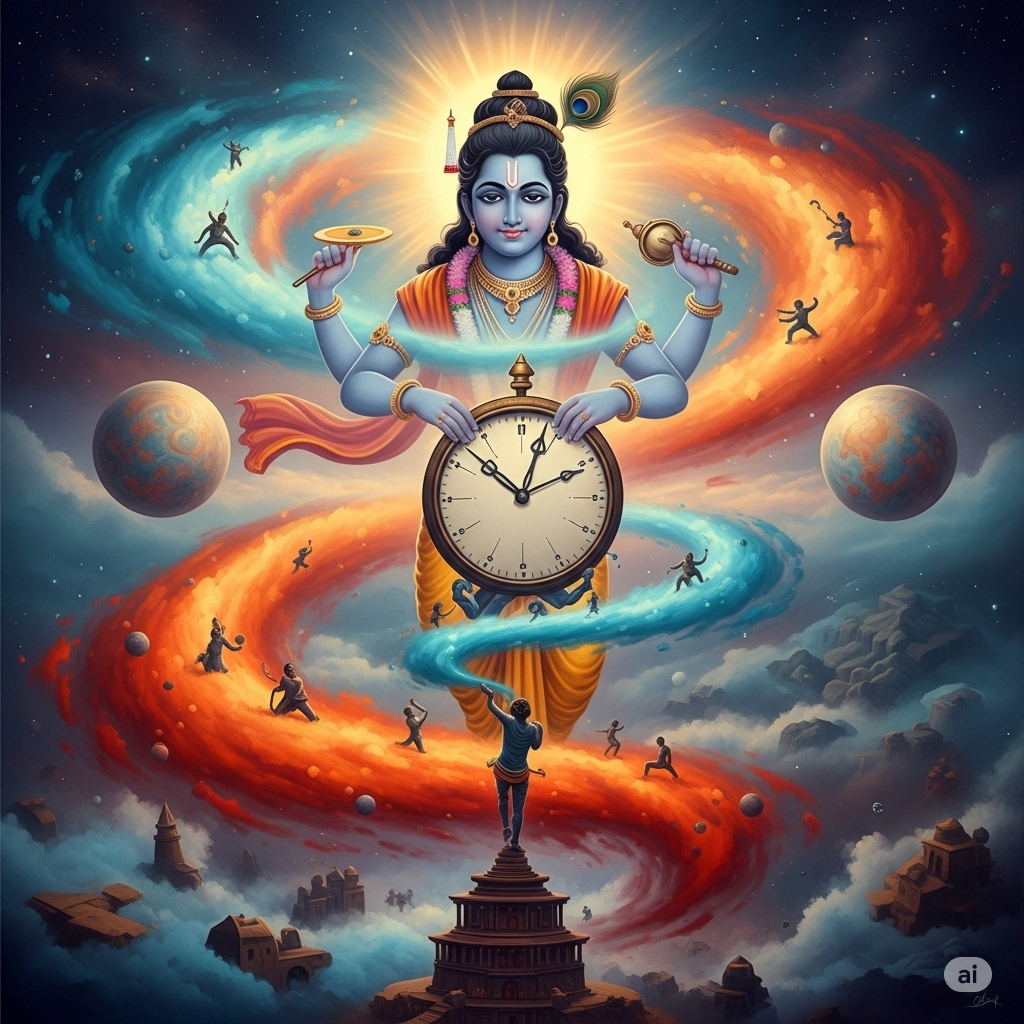
12.) Having been dissolved by the Māyā (wonderful potency) of Śrī Viṣṇu, this universe existed (during the period of universal destruction) as no other than Brahma (unmanifest consciousness). God, then evolved it as a distinct entity through the instrumentality of Time, which is undifferentiated in itself.
13.) As the universe exists today, so it was before and so it will continue to be hereafter. Ninefold (both material and elemental) is its creation, the one proceeding both from Prakṛti (God) and vikṛti (Brahmā) being the tenth.
14.) The reabsorption (dissolution) of the universe, again, is threefold, viz., through Time, elements and the Guṇas (modes of Prakṛti). (Now as regards the ninefold creation) the first in order of sequence is the creation of the Mahat-tattva, which takes place only when the equilibrium of the Gunas (Sattva, Rajas and Tamas) is disturbed by the will of God Himself.
15.) The second is the evolution of the ego (Ahaṁkāra), from which proceed the five gross elements, as well as the five senses of perception, and the five organs of action. The third is the evolution of the subtle elements (tanmātras), which in their turn evolve the gross elements (bhūtas).
16.) The fourth is the evolution of the Indriyas, i.e., the senses of perception and the organs of action; while the fifth is the evolution of the deities (presiding over the Indriyas / organs of senses), who are born of the Sāttvika ego (vaikārika ahaṅkāra), as well as of the mind, which is also a product of the Sāttvika ego.
17.) The sixth is the evolution of Tamas (the principle of nescience), which clouds the reason and distracts the mind of the Jīvas. These six varieties of creation proceed from Prakṛti (God, the Cause of Causes); now hear of those that proceed from Vikṛti (Brahmā, who sprang up from the Lord).
18.) (As a matter of fact) the creation proceeding from Brahmā too is a pastime of the Lord, the very thought of whom rids one of all sorrows and who assumes the quality of Rajas (in order to carry on the work of creation as Brahmā). The seventh is the sixfold creation of immobile creatures (plants and trees etc.), which is the first (in order of sequence of the three categories of creation proceeding from Brahmā, and which is subdivided into six varieties.
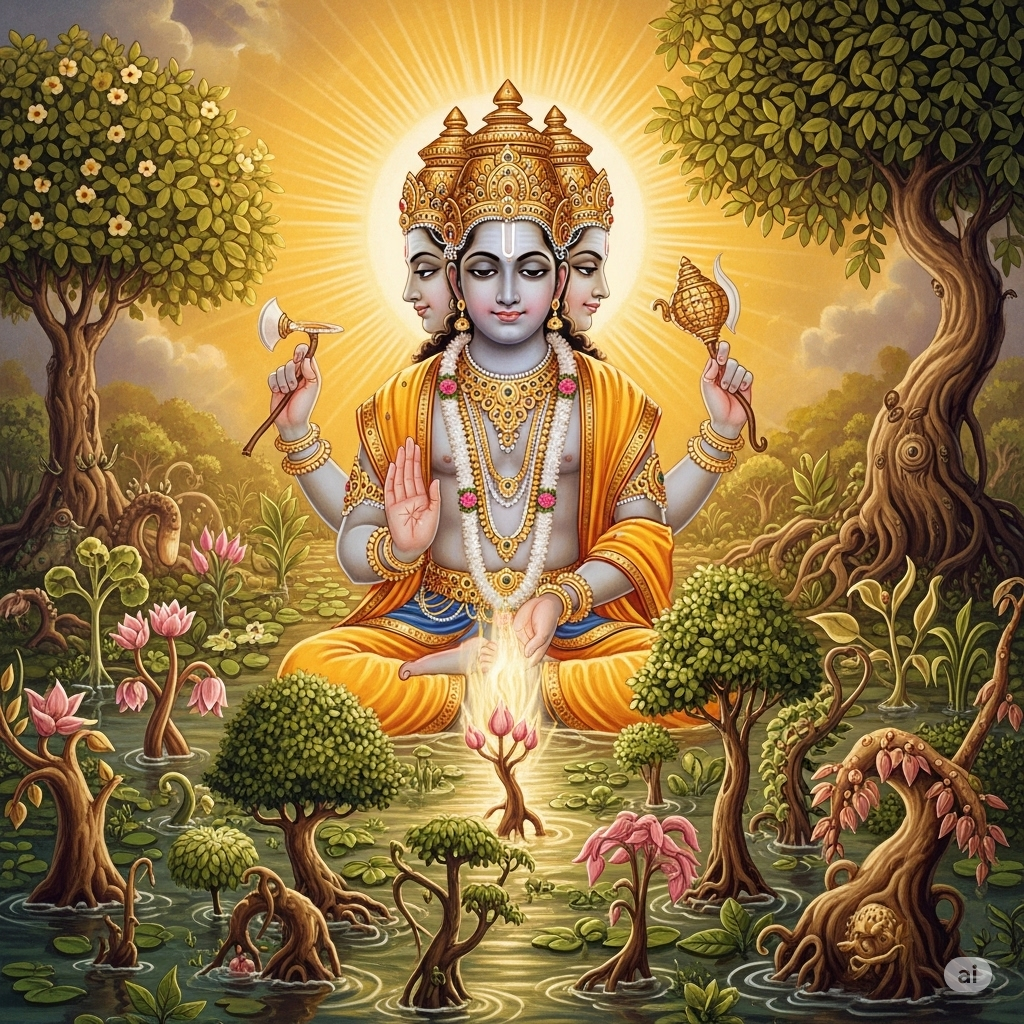
19.) These consist of (i) trees which bear fruit without flowering, (e.g., the banyan, the Peepul and so on), (ii) annual plants and herbs that die as soon as their fruit is ripe (such as the cereals), (iii) creepers that grow on the support of other trees or walls etc., (iv) plants which have a hard bark (such as the bamboo), (v) creepers that creep on the ground alone, being too stiff to climb upwards (such as the melon, the water-melon and so on) and (vi) trees which bear fruit after blossoming. All these draw their nutriment from below; they are almost wanting in sensibility, have an inward feeling of touch alone and possess some peculiarity of their own.
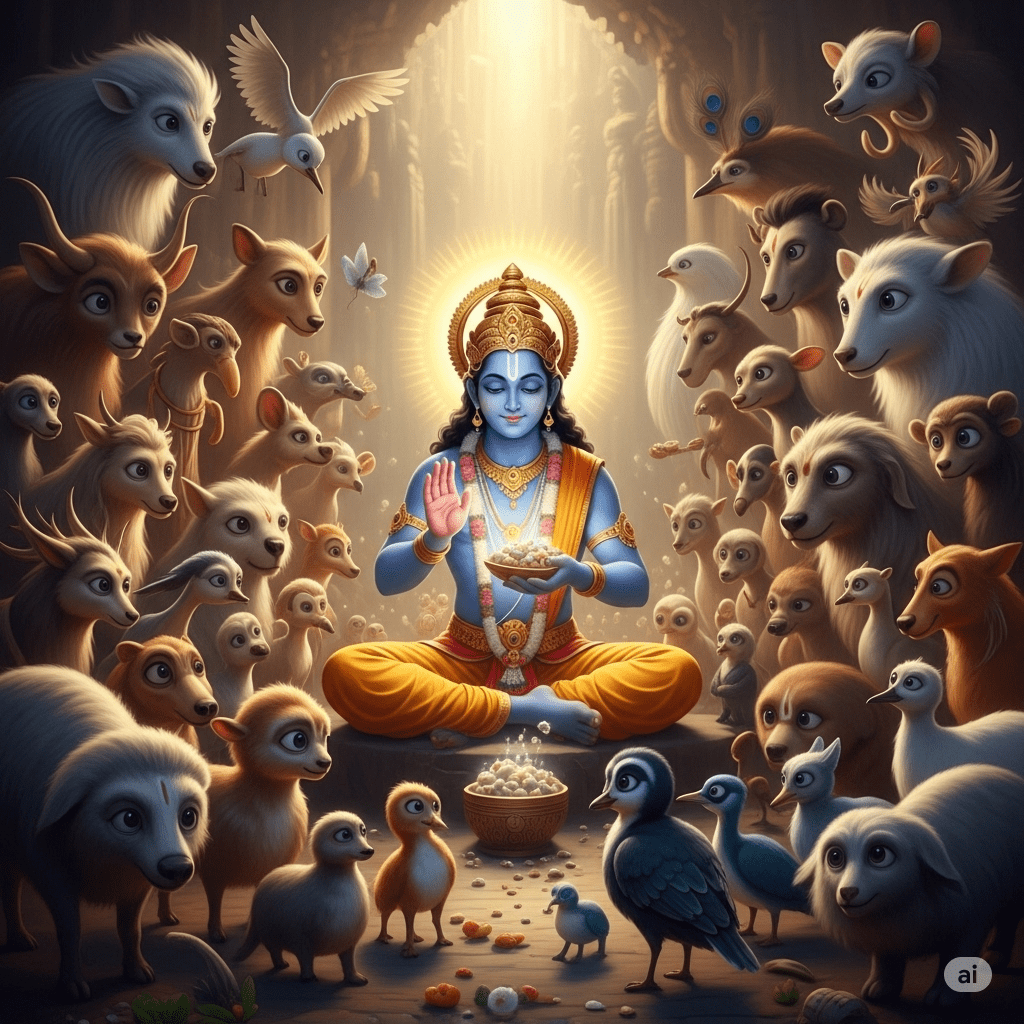
20.) The eighth creation is of animals and birds. It is said to have twenty eight varieties. (They are) devoid of knowledge (of tomorrow etc.), full of ignorance (except the knowledge of gratifying their appetite). They know by scent only and are of minds incapable of retaining knowledge for long.
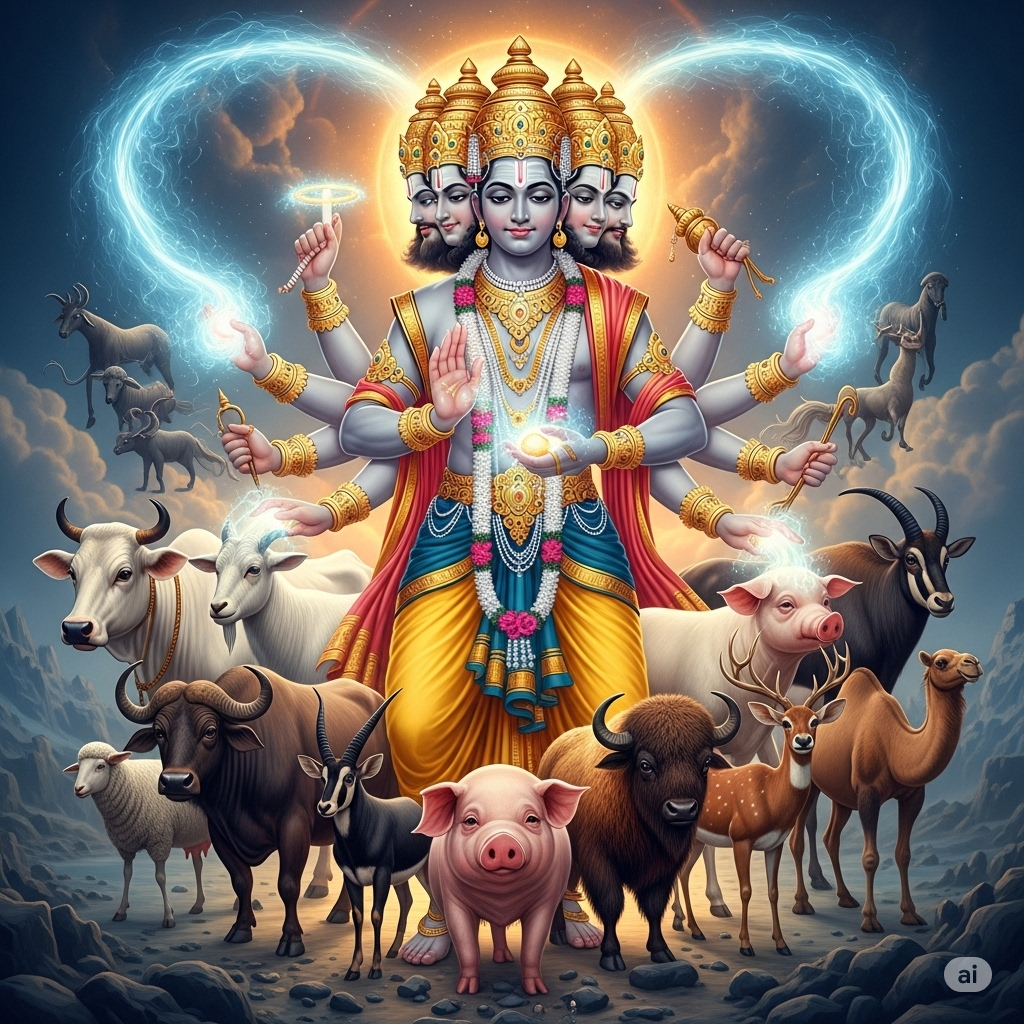
21.) Oh extremely pious Vidura, the cloven-hoofed beasts are the cow, the goat, the buffalo, the black-antelope, the pig, the bison, the ruru (a kind of deer), the sheep, the camel.
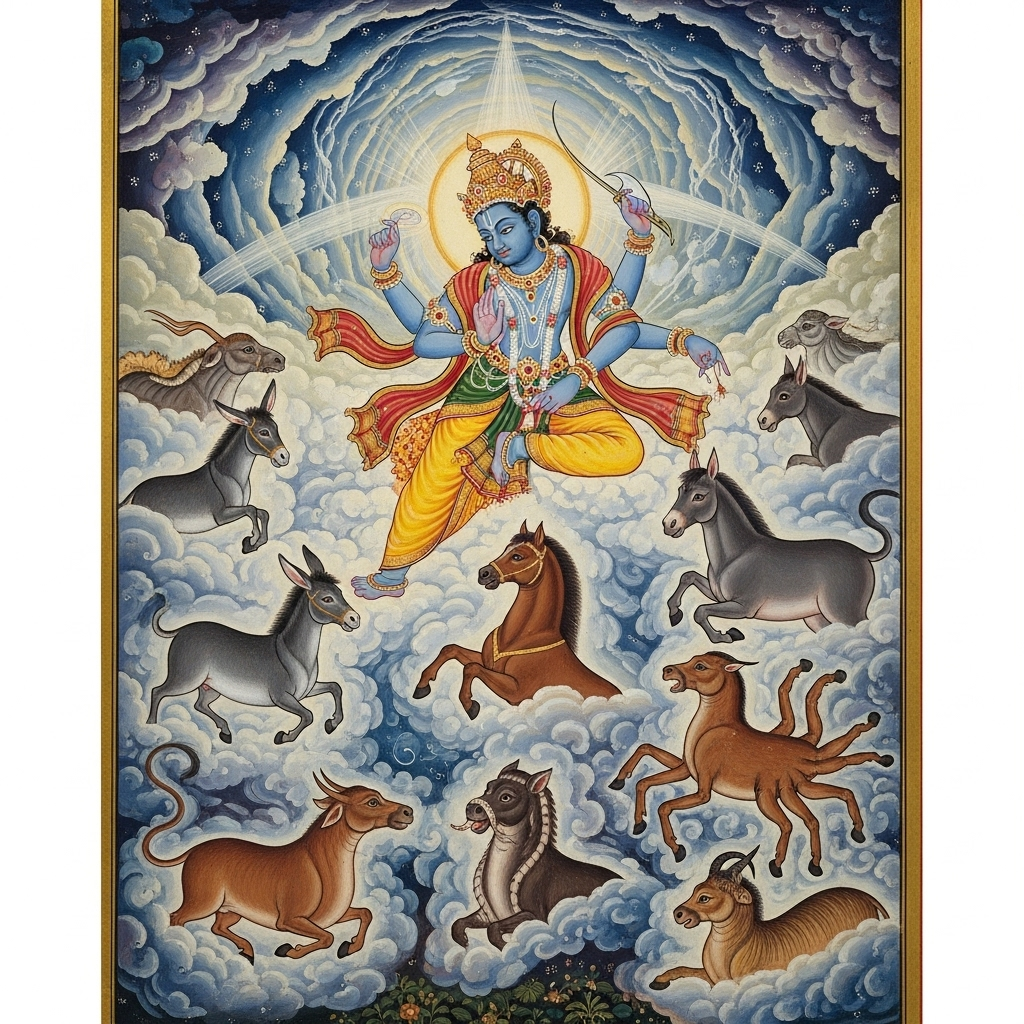
22.) Oh Vidura, the one (uncloven)-hoofed beasts are: the donkey, the horse, the mule, the guara [gaura?] (a cross of a horse and a female mule), the śarabha (a fictitious eight-legged animal who can kill lions) and the camara (from whose hair chowries are made). Please listen to beasts with five nails.
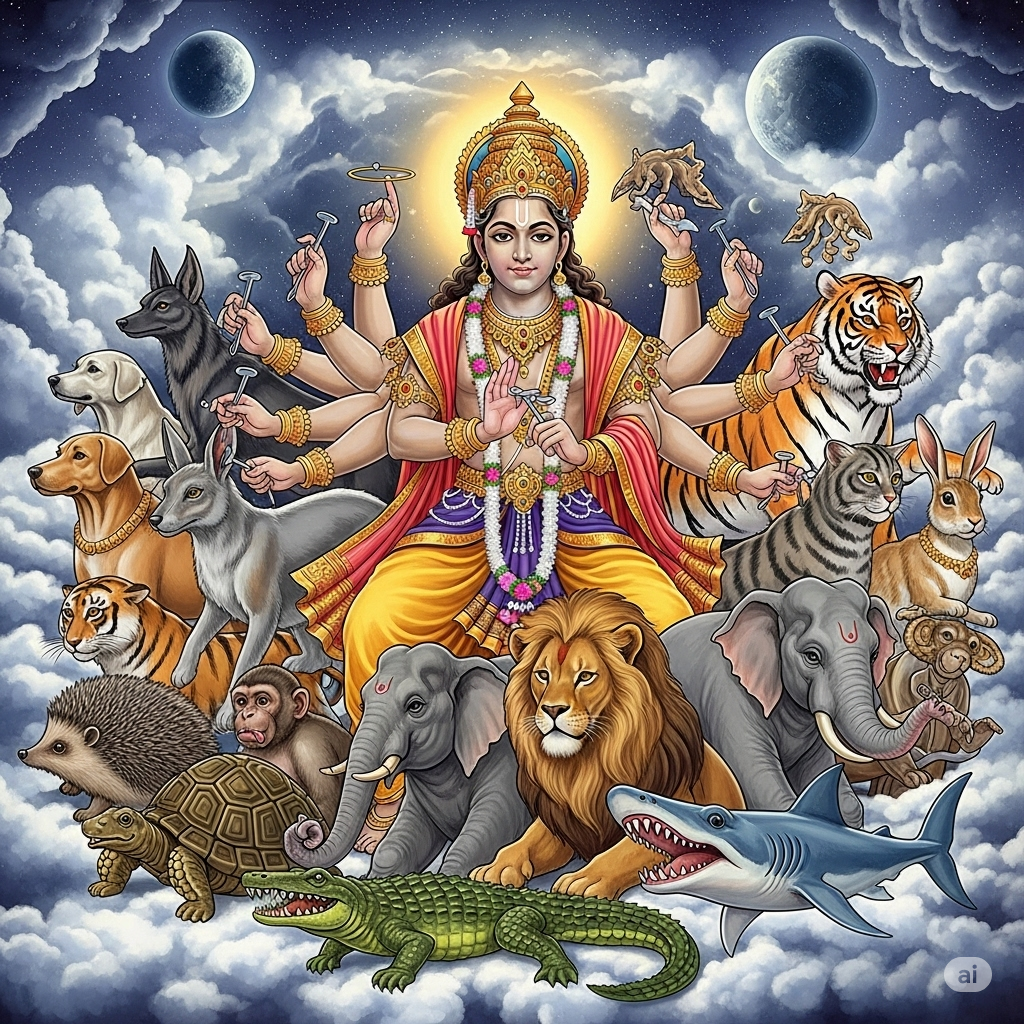
23.) (They are) the dog, the jackal, the tiger, the cat, the hare, the hedge-hog, the lion, the monkey, the elephant, the tortoise, the alligator, the shark and others.
24.) The birds are: the heron, the vulture, the bat, the hawk, the bhāsa (a vulture, acock), the bhallūka (a kind of owl or bear), the peacock, the swan, the crane (baka), the ruddy goose, the crow, the owl and others.
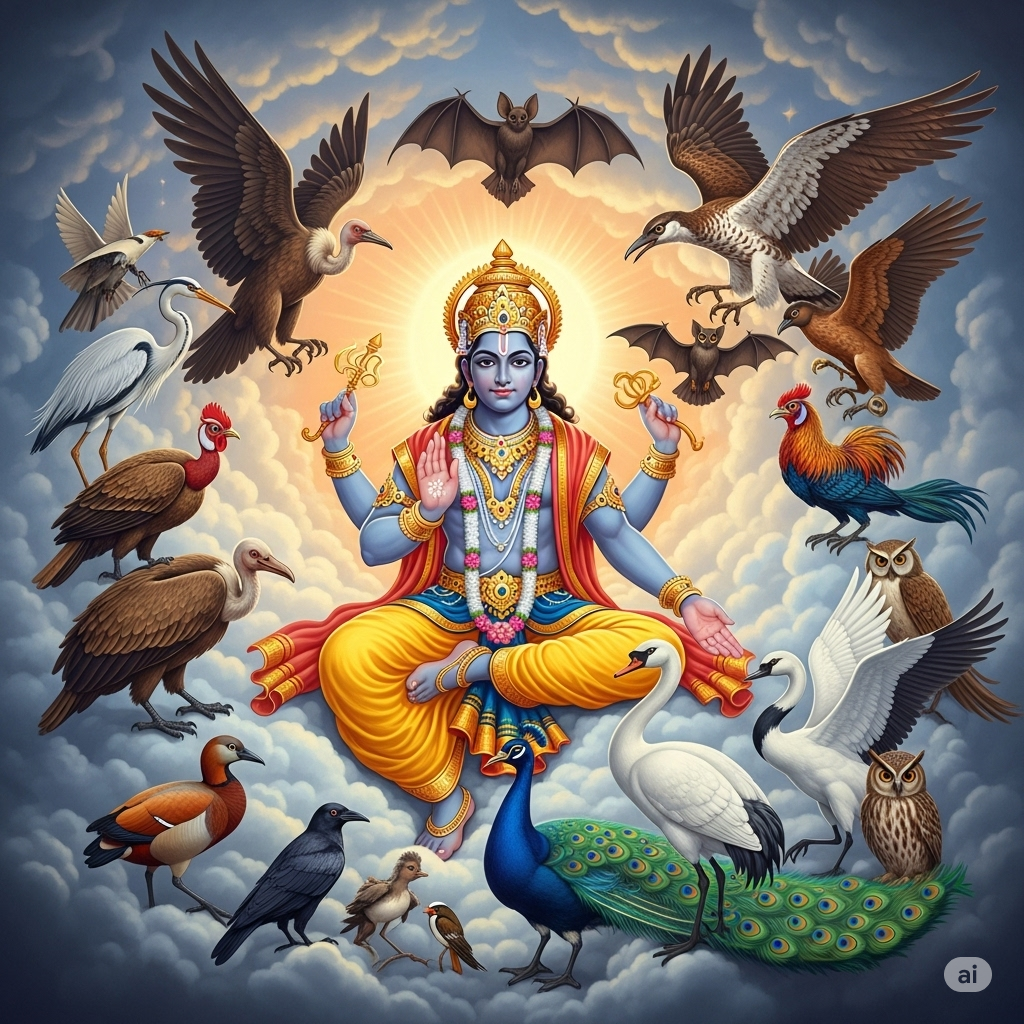
25.) The ninth is the creation of the human species, which, O Vidura. is only of one kind and whose current of nutriment tends downwards. Human beings have an abundance of Rajas (the principle of activity), are active by nature and take delight in the pleasures of sense, which are rooted in sorrow.

26.) All these three (viz., the immobile creation, the beasts and birds and the human species) as well as the creation of the gods (to be discussed hereafter), O noblest of men, are creations that have proceeded from Brahmā. As for the deities (presiding over the Indriyas and) born of the Sāttvika ego they have already been dealt with (in verse 16 above under the category of the creation proceeding from God); while the creation of the sages Sanaka and others is classed as proceeding from God and Brahmā both.
27-28.) The creation of heavenly beings consists of eight varieties, viz., the gods; the manes; the demons; the Gandharvas (celestial musicians) and the Apsarās (celestial dancing girls); the Yakṣas and the Rākṣasas; the Siddhas (a class of heavenly beings endowed with supernatural powers), the Cāraṇas (the celestial bards) and the Vidyādharas; the Bhūtas (ghosts), Pretas (spirits) and Piśācas (fiends); the Kinnaras, Kimpuruṣa’s and Aśwamukhas. I have thus told you, O Vidura, the ten creations evolved by the Lord personally as well as in the form of Brahmā (the Creator of the universe).

Special Note –
- The Gods (Devas):
- Benevolent celestial beings.
- Often associated with forces of nature and moral values.
- Reside in higher realms like Svarga (Indra’s heaven).
- Examples include Indra (king of gods), Saraswati (goddess of knowledge), etc.
- The Manes (Pitris):
- Spirits of deceased ancestors.
- Reside in a spiritual realm, often attained through righteous actions.
- Revered and honored through specific rituals and offerings.
- The Demons (Asuras):
- Powerful superhuman beings, often seen as antagonists to the gods.
- Can possess both good and bad qualities.
- Known for their immense strength, magical powers, and sometimes their ego and violence.
- The Gandharvas:
- Divine musicians, singers, and dancers.
- Often companions to Apsarās.
- Known for their enchanting artistic talents and sometimes their frivolous nature.
- They are skilled in music and warfare.
- The Apsarās:
- Celestial dancing girls and nymphs.
- Exceedingly beautiful and often employed by gods (like Indra) to distract sages and kings.
- Associated with pleasure, beauty, and the arts.
- The Yakṣas:
- Nature spirits, often associated with wealth and hidden treasures.
- Their lord is Kubera, the god of wealth.
- Can be benevolent and worshipped as tree-deities, granting boons.
- The Rākṣasas:
- Fierce, often malevolent demons.
- Known for their ability to change shape at will.
- They are flesh-eating and often disrupt rituals.
- Ravana, the antagonist of the Ramayana, is a famous Rakshasa.
- The Siddhas:
- A class of heavenly beings endowed with supernatural powers (siddhis).
- They have attained a state of spiritual perfection and can perform various mystical feats like levitation, invisibility, etc.
- Often reside in Siddhaloka.
- The Cāraṇas:
- Celestial bards or minstrels.
- Known for their musical abilities and their role in praising deities and heroes.
- Often travel in space.
- The Vidyādharas:
- “Knowledge-bearers” or “power-bearers.”
- Possess magical powers and knowledge, sometimes acquired through learning, mantras, or ritualistic means.
- Can also become invisible and create illusions.
- The Bhūtas:
- Ghosts or spirits, often originating from individuals who died violently or without proper funeral ceremonies.
- Can be unquiet and have malicious intentions.
- The Pretas:
- Spirits of malformed or crippled people, or those who died prematurely due to omission of ceremonies.
- They are often in a state of suffering due to their past karma.
- The Piśācas:
- Fiends or malevolent spirits.
- Formed from people who led immoral lives, were drunkards, liars, criminals, or died insane.
- Known for their roguish and frightening nature, sometimes haunting graveyards.
- The Kinnaras:
- Mythical beings, often depicted with a human body and a horse’s head, or vice versa.
- Associated with music, dance, and beauty.
- Attendants of Kubera, similar to Kimpuruṣas.
- The Kimpuruṣas:
- A race of beings described as having human bodies and lion heads (though sometimes used interchangeably with Kinnaras).
- Also associated with music and often attendants of Kubera.
- The Aśwamukhas:
- “Horse-faced” beings. The name directly describes their appearance. They are often mentioned alongside Kinnaras and Kimpuruṣas as various semi-divine or mythical races.

29.) After this I shall speak to you of the ruling dynasties as well as the periods presided over by the Manus, United with Rajas (the principle of activity) as the self-born Brahmā, the creator, none other than Śrī Hari of unfailing resolve, thus projects Himself (in the form of the universe) by Himself at the beginning of every Kalpa
Thus ends the tenth discourse entitled “Brahmā’s Penance and Ten-fold Creation”, in Book Three of the great and glorious Bhāgavata Purāṇa, otherwise known as the Paramahaṁsa-Saṁhitā (the book of the God-realized Souls).
Summarization Of The Entire Chapter :
After the disappearance of the Lord Almighty from his vision, Brahmā, the lotus-born Creator, contemplated the task of recreating the universe. Filled with reverence and devotion, he performed severe austerities for a hundred celestial years, with his mind absorbed in thoughts of Śrī Nārāyaṇa, the Supreme Being, whose glories surpass all material comprehension. By this penance, Brahmā’s knowledge and creative power were magnified, allowing him to perceive the entire cosmos as if resting upon the lotus from which he emerged. Witnessing the tumult of wind and water during the period of dissolution, he prepared to manifest creation once more, guided by the instructions of the Lord Himself. In this way, Brahmā’s actions, though vast and powerful, were an expression of divine grace, serving the ultimate purpose of sustaining souls and the cosmic order.
The creation of the universe, as Maitreya explained, is intimately connected with the potency of Time, a divine instrument of Śrī Hari. Though Time has no beginning or end, it manifests the transformations of the material world, enabling the Supreme Lord to appear in manifold forms and orchestrate His cosmic Līlā. During the period of dissolution, all creation merges back into the unmanifest consciousness of Brahmā, who, inspired by the Lord, evolves the universe anew. This creation is ninefold, with the first five elements, the senses, and their presiding deities arising from the interplay of Prakṛti’s three modes, and subsequent creations emerging from Brahmā’s own activities. Each stage of creation is a testament to Bhagavān’s marvelous potency, manifesting life in countless forms while maintaining the ultimate harmony of the cosmos.
The diversity of life is portrayed in exquisite detail. From immobile plants and trees, each with its own peculiarities, to animals, birds, and the human species, all creations exhibit the balance of knowledge, ignorance, and desire inherent in material existence. The Lord’s mercy pervades even these mundane forms, sustaining their lives and activities. Higher beings, such as the deities, sages, and celestial performers, exist through the interplay of divine energy and virtuous action. These creations are categorized according to the motive and purity of action, illustrating the subtle law of karma: those who act selflessly attain higher worlds, whereas those motivated by desire experience the fruits of their actions in the lower realms. In every form, whether humble or exalted, the presence of the Supreme is implicit, guiding, witnessing, and loving all creation.
Among the most wondrous of these are the heavenly beings: devas, manes, Gandharvas, Apsarās, Yakṣas, Rākṣasas, Siddhas, Cāraṇas, Vidyādharas, and other semi-divine entities. Each has its unique attributes, roles, and qualities, yet all exist as instruments of the Lord’s Līlā, expressing His glory in music, art, beauty, and valor. From the playful dancers of the Apsarās to the wise Siddhas, every being reflects some facet of divine consciousness, allowing devotees to perceive the Lord’s infinite creativity. Even the spirits and fiends—Bhūtas, Pretas, Piśācas—serve as reminders of karmic law and the path to spiritual purification. In this diversity, the Lord’s mercy shines most brightly, for all forms of life are sustained by His will and participate, knowingly or unknowingly, in His loving Līlā.
Finally, the narrative points to the supreme purpose behind Brahmā’s penance and the ten-fold creation: the Lord, as the self-born Brahmā, projects Himself in the universe at the beginning of each Kalpa, combining the principles of creation, preservation, and activity with perfect resolve. Every being, every action, and every element of creation is suffused with His presence, inviting the heart of the devotee to fix itself upon Him in love and surrender. By understanding this cosmic order, Vidura and all seekers are reminded that devotion to the Supreme Being—Śrī Hari—is the highest path, surpassing all intellectual knowledge or worldly accomplishment. The chapter concludes as a luminous exposition of divine grace, cosmic law, and the eternal relationship between the Lord and His beloved devotees.
Short Questions & Answers :
Q1: Oh Vidura, how many types of beings did Brahmā procreate, both from his body and mind, after the Lord disappeared from his view?
A1 (Maitreya): Brahmā, by the will of Śrī Hari, manifested ten creations:
- Immobile beings (plants and trees)
- Animals and birds
- Humans
- Deities presiding over the senses (born of the Sāttvika ego)
5–10. Various celestial beings including devas, manes, demons, Gandharvas, Apsarās, Yakṣas, Rākṣasas, Siddhas, Cāraṇas, Vidyādharas, Bhūtas, Pretas, Piśācas, Kinnaras, Kimpuruṣas, and Aśwamukhas.
Q2: Oh Lord, please explain all points I have asked, one by one, and solve our doubts.
A2 (Maitreya): Upon Vidura’s request, the sage Maitreya joyfully explained all the stages of Brahmā’s penance, the manifestation of Time, and the ten-fold creation in detail, answering each query with clarity and divine insight.
Q3: How did Brahmā perform penance and what was its result?
A3: Brahmā performed austere penance for 100 celestial years (36,000 human years), meditating on Śrī Nārāyaṇa. By this penance, his knowledge and creative power grew immensely, allowing him to create the universe and control the winds and waters during the period of dissolution.
Q4: How did Brahmā create the three worlds?
A4: The lotus on which Brahmā sat pervaded all space. By entering the corolla and splitting it into three parts—Bhūḥ, Bhuvaḥ, and Swaḥ—he created the three worlds where embodied souls experience the fruits of their karma. His own abode (Satyaloka) and the higher worlds (Maharloka, Janaloka, Tapoloka) were for those performing selfless virtuous actions.
Q5: What is the role of Time in creation?
A5: Time is undifferentiated, eternal, and serves as the instrument of Śrī Hari. Through Time, the Supreme manifests the universe, maintaining the cycles of creation, preservation, and dissolution. The Lord’s potency, combined with Time, produces the material world and all its forms.
Q6: How is creation structured from Prakṛti and Brahmā?
A6: The universe’s creation proceeds in two streams:
- From Prakṛti (material nature, the Cause of Causes):
- Mahat-tattva (intellect)
- Ego (Ahaṅkāra)
- Subtle elements (tanmātras)
- Senses (Indriyas)
- Deities presiding over senses (from Sāttvika ego)
- Principle of Tamas (nescience)
- From Brahmā (the material creator, born from the Lord):
7. Immobile beings (plants and trees)
8. Animals and birds
9. Humans
10. Celestial beings (devas, manes, demons, Gandharvas, Apsarās, Yakṣas, Rākṣasas, Siddhas, Cāraṇas, Vidyādharas, Bhūtas, Pretas, Piśācas, Kinnaras, Kimpuruṣas, Aśwamukhas).
Q7: Can you explain the immobile creation?
A7: Immobile creation includes six types of plants and trees:
- Trees bearing fruit without flowering (e.g., banyan, Peepul)
- Annual plants and herbs (like cereals)
- Creepers growing on supports
- Trees with hard bark (bamboo)
- Creepers that grow along the ground
- Trees bearing fruit after blossoming
They draw nutrition from below, have minimal sensibility, and display unique characteristics.
Q8: How are animals and birds classified?
A8: Animals and birds are ignorant of future events and mostly act on instinct:
- Cloven-hoofed beasts: cow, goat, buffalo, antelope, pig, bison, deer, sheep, camel.
- Uncloven-hoofed beasts: horse, donkey, mule, guara, śarabha, camara.
- Beasts with five nails: dog, tiger, cat, elephant, monkey, hare, lion, hedgehog, tortoise, alligator, shark, etc.
- Birds: heron, vulture, bat, hawk, peacock, swan, crane, crow, owl, ruddy goose, etc.
Q9: What is the nature of humans?
A9: Humans are of one species, nourished from the material world, full of Rajas (activity), and inclined toward sensory enjoyment, which is rooted in sorrow. Their actions and desires dictate their experiences across the three lower worlds.
Q10: How are celestial beings created?
A10: Celestial beings include:
- Devas (gods)
- Manes (Pitris)
- Demons (Asuras)
- Gandharvas and Apsarās
- Yakṣas and Rākṣasas
- Siddhas and Cāraṇas
- Vidyādharas
- Bhūtas, Pretas, Piśācas
- Kinnaras, Kimpuruṣas, Aśwamukhas
Each class has unique qualities and functions, expressing the Līlā of the Supreme Lord.
Q11: How does the chapter conclude regarding creation?
A11: Brahmā, united with Rajas and inspired by Śrī Hari, manifests creation at the beginning of every Kalpa. This ten-fold creation demonstrates the Lord’s divine potency and mercy, sustaining all beings and guiding them toward selfless action, devotion, and eventual liberation.
