Chapter 10 – The Ten Characteristics of the Bhāgavata Purāṇa
1.) Here (in the Bhāgavata Purāṇa) the (constituent) topics detailed are: (1) Subtle creation (sarga), (2) gross creation (visarga), (3) law and order (ensured by God) (sthāna), (4) protection—welfare of all (poṣaṇa), (5) material lust from Karmas (ūti), (6) the period of Manu and history thereof (Manvantara), (7) accounts of God’s deeds (īśānukathā), (8) physical annihilation (nirodha), (9) liberation (mukti) and (10) the last resort of the universe, the ultimate Reality (āśraya).
2.) In order to realize the true essence of the tenth subject—(āśraya) the Supreme Reality, the ultimate refuge of all existence—exalted souls expound the preceding nine topics, drawing directly from the Vedas through hymns and praises, and indirectly through profound narratives that reveal its deeper meaning.
3.) The process by which the gross and subtle elements, the senses of perception and action, the mind, ego, and the Mahat-tattva (the principle of cosmic intelligence) emerge—tracing back in reverse order from the manifest world—due to the agitation of the guṇas (modes of nature) from their state of equilibrium, under the sovereign will of the Supreme Person (unmanifest Nārāyaṇa / Śrī Viṣṇu), is known as Sarga, or primary creation. The subsequent creation of all living and non-living beings by Brahmā, who himself is born from the Cosmic Being (Garbhodakaśāyī Viṣṇu, who then later becomes the creation itself as Virāṭ Puruṣa), is referred to as Visarga, or secondary creation.
Special Note –
A. Sarga – The term Sarga, or primary creation, refers to the initial emanation of the fundamental principles that constitute the universe—not only its physical constituents but also the subtle building blocks of experience and consciousness. In this process, the gross elements (earth, water, fire, air, ether), the subtle sense objects (sound, touch, form, taste, and smell), the ten indriyas (five senses of perception and five organs of action), the mind, ahaṅkāra (ego or the sense of individuality), and the mahat-tattva (cosmic intelligence or the first evolute from prakṛti when activated by the Lord) all come into being. These arise through the disturbance of the equilibrium of the three guṇas—sattva (goodness), rajas (activity), and tamas (inertia)—which otherwise remain balanced in the state of unmanifest (Mūla) prakṛti. This disturbance is not arbitrary, but occurs under the sovereign will of the Supreme Person, the unmanifest Nārāyaṇa, whose glance alone sets the wheel of creation in motion. Thus, Sarga is divine causation—the Supreme Lord initiating the framework of existence, the subtle and gross realities that will form the canvas for all subsequent manifestations.
B. Visarga – Once these foundational elements are in place, the Lord empowers Brahmā, the first-born from His navel-lotus (emerging from Garbhodakaśāyī Viṣṇu, who Himself is the cosmic source resting in the ocean of causality). Brahmā, now infused with knowledge and potency by the Lord, proceeds to arrange and organize the various forms of life—gods, sages, humans, animals, plants, and all animate and inanimate beings. This is known as Visarga, or secondary creation. Though it appears as if Brahmā is the creator, he is in truth only an instrument in the divine hands of Nārāyaṇa, functioning within the design already seeded by the Lord. Importantly, Visarga unfolds within the structure provided by Sarga, and both are aspects of the Lord’s Līlā—the cosmic play of manifesting, sustaining, and eventually dissolving the universe.
In this vision, creation is not accidental nor merely material, but a sacred expression of divine will and intelligence. The entire cosmos becomes a living expression of the Lord—from the subtlest element to the universal form of the Virāṭ Puruṣa, in whom all beings reside and who Himself permeates all of creation.
4.) Sthiti is the glorious triumph of the Supreme Lord in upholding the divine order and cosmic harmony throughout creation. Poṣaṇa signifies His compassionate grace by which He lovingly sustains, protects, and nourishes all beings. The term Manvantara refers to the sacred eras governed by the Manus, who dutifully embody righteousness and diligently protect their subjects according to divine law. Meanwhile, ūti denotes the latent desires within living entities—impulses born of past karma that compel them toward action.
Special Note –
A. Sthiti, often translated as maintenance or preservation, represents the Supreme Lord’s victory in sustaining the cosmic order (dharma). It is through His all-pervading presence and sovereign will that the universe remains orderly and balanced. Every living being abides within its destined limits, the seasons follow their courses, and the laws of nature unfold harmoniously—this unbroken rhythm is the manifestation of Sthiti. The Lord’s maintenance is not merely a passive act but a dynamic, ongoing triumph of His divine will, ensuring the stability and continuity of all existence.
B. Poṣaṇa or nourishment, speaks of the Lord’s graceful protection and benevolent care extended toward all creation. It is by His mercy that beings receive sustenance, shelter, and welfare. Beyond physical nourishment, Poṣaṇa also encompasses spiritual sustenance—the Lord’s grace that nurtures the soul, uplifts the devotee, and protects from harm. It reveals His compassionate nature, ever ready to sustain His children with boundless love.
C. Manvantaras refers to the cosmic epochs or ages, each presided over by a Manu, the divine progenitor and lawgiver. The Manus embody the principle of righteous governance and dharma, overseeing the orderly progression of life and civilization during their respective eras. Each Manu’s righteous conduct serves as a model for human behavior and societal order, illustrating the eternal path of virtue. The narrative of Manvantaras thus reflects the Lord’s unfolding plan to maintain dharma throughout the cycles of time.
D. Ūti represents the latent desires and tendencies within beings—the subtle impressions born of accumulated karma that motivate actions. These desires often bind the soul in the cycle of birth and death by prompting attachment and selfish pursuits. Yet, even these impulses operate within the grand design of the Supreme, who allows such experiences for the soul’s eventual spiritual evolution. Understanding ūti helps in discerning the forces that drive human behavior and the means to transcend them through devotion and self-realization.
5.) The sacred narratives detailing the divine pastimes and incarnations of Śrī Hari, along with the lives of saintly devotees and complemented by various other sacred stories, are collectively known as Īśānukathā.
6.) Nirodha refers to the withdrawal or subsidence of the Jīva (Individual Soul), along with its associated qualifications or adjuncts (guṇas & karmas) are withdrawn back into the Supreme Person (Śrī Hari). This state corresponds to the Jīva (Individual Soul) merging with Śrī Viṣṇu during His cosmic rest or Yoga Nidra (which occurs during the end of each Kalpa) where all active functions are suspended. Mukti (or Mokṣa) signifies total liberation or emancipation, where the Jīva (Individual Soul) abandons all illusory forms and distinctions (of having a separate identity as a Jīva, or of being a doer, etc.) and establishes itself in its true nature (realization of it’s real svarūpa, which is Ātman). In this realization, the Jīva (Individual Soul) attains its eternal state of oneness with Brahma (the absolute / Ātman), and becomes free from all bondage and false identifications.
Special Note –
Nirodha – Nirodha primarily refers to the dissolution or winding up of the cosmic manifestation. It signifies the merging of the living entity (Jīva), along with its conditioned tendencies, back into the Supreme Being, Lord Vishnu (or Maha-Vishnu), at the time of cosmic dissolution.
It’s not a permanent or final liberation for most conditioned souls. Instead, it’s a temporary resting period during the cosmic annihilation (pralaya), after which the Jīvas are again manifested in the next creation according to their karma.
- What happens to the soul? The soul (Jīva) is eternal and indestructible. During nirodha (cosmic dissolution), the individual soul, along with its subtle body (containing its tendencies and karmic impressions), merges into the body of Maha-Vishnu. It doesn’t lose its individual identity, but its active manifestation ceases. It’s like putting things back into a dormant state, awaiting the next creation. The soul’s existence continues, but it’s not engaged in material activities or experiencing material reactions.
- Does it complete its journey? For a truly liberated soul (one who has attained Muktih – the ninth subject), the journey of transmigration is completed. Such a soul goes “back to the Divine” (Vaikuntha or the spiritual abode of the Lord) and does not return to the material world, even during cosmic dissolution.
However, for the majority of conditioned souls who have not attained genuine Muktih, Nirodha is a temporary cessation of their material journey, not its completion. They are simply held in abeyance during the dissolution and will be reactivated and given new bodies in the next creation cycle, continuing their journey until they achieve true liberation (Moksha) through devotion and knowledge of the Supreme Lord.
7.) That from which are known to proceed the creation, preservation and dissolution of the universe, is what is known as Āśraya (supreme refuge). This ultimate shelter is called the highest Brahma (Parabrahma) and the Supreme Self (Paramātman), the ultimate refuge and support of all existence. This Āśraya Himself depends on none, standing as the absolute foundation beyond all else.
8.) That Puruṣa (the Cosmic Being)—is verily in the form of the Ādhyātmika Puruṣa (Individual Soul in every being), which identifies itself with the senses of perception and objects (and becomes the Jīvātman). That very same Puruṣa (the Cosmic Being) is also known as the Ādhidaivika Puruṣa (in the form of devatās) aligned with the celestial powers who uphold the universal order & is the cosmic intelligence. But one who, due to delusion or attachment, perceives a separation between these two—Ādhyātmika Puruṣa and Ādhidaivika Puruṣa—such a being is termed as Ādhibhautika Puruṣa: one who is caught in the snare of material existence, identifying with the gross elements, the body, the senses, and the fleeting forms of the outer world.
Special Note – This verse is drawing a distinction between three aspects of a living being or puruṣa:
- Ādhyātmika – The inner self, the conscious experience within the body. This is the Puruṣa who has now become the jīva, the soul localized in a particular body.
- Ādhidaivika – The same puruṣa acting through or connected with divine intelligence, the cosmic intelligence that governs nature. This can refer to devas or presiding deities of the senses and natural elements.
- Ādhibhautika – When the connection to both the inner consciousness (adhyātmika) and the higher divine principle (adhidaivika) is lost, the being becomes material, entangled in matter alone—this is the gross physical view of life.
This verse subtly suggests that the puruṣa is fundamentally one, but due to perspective or conditioning of Māyā, he is perceived in three ways:
- As Ādhyātmika, he is the experiencing Soul within a body.
- As Ādhidaivika, he is identified with the divine power that regulates creation.
- As Ādhibhautika, estranged from both soul and God, he becomes absorbed in the material shell, functioning merely as a biological or mechanical entity.
The vicchedaḥ (disconnection) implies ignorance—when the Ātman forgets its own spiritual nature and divine origin, it is seen as a mere material body. This verse thus hints at illusion (māyā) and the fall of consciousness from its spiritual unity into material duality.
9.) Since the perception of one is not possible in the absence of the others—be it the Ādhyātmika (the individual self and its faculties, such as the eye needs not only the sense of sight, but also the presiding deva, Sūrya who is vision), the Ādhidaivika (the presiding deity for vision of the ādhyātmika Puruṣa), or the Ādhibhautika (the physical organ itself)—true knowledge does not arise unless all three are present. Being mutually dependent, they form an inseparable triad. Yet, he who realizes the nature of all three—their origin, function, and interrelation—is none other than the Ātman, the Self—independent, Self-luminous, and the eternal support of all that appears to support itself.
10.) When that Cosmic Being—the all-pure, divine Virāṭ Puruṣa—emerged from the golden, Cosmic egg-shaped universe (Brahmāṇḍa) and stood distinct from it, He sought a sacred foundation upon which to establish Himself. Desiring a resting ground for His divine manifestation, He, the taintless One, created the cosmic waters (Garbha-jala), pure and luminous, as the first expression of His will.
Special Note – Garbha-jala — the waters inside the brahmāṇḍa created by Garbhodakaśāyī Viṣṇu after He enters the universe in the form of the cosmic egg and lying within as the Virāṭ Puruṣa.
11.) Having evolved from the Supreme Person (also called ‘Nara’) these waters were known as ‘Nāra’ (that which proceeds from ‘Nara’); and since He lived on these waters of His own creation for a thousand (celestial) years, He became to be known as Nārāyaṇa (He who resides in the ‘Nāra’ or waters were his āyana place of abode).
12.) The gross elements (the foundational substances of the manifest universe), along with Karma (the cosmic karma as per sāṃkhya, & the destiny of all jīvas), the flow of Time (kāla), and the ever-shifting play of Matter and embodied souls (jīvas), all exist solely by His divine will and sustaining grace. The very moment the Supreme Person withdraws His glance or becomes indifferent, these phenomena lose their force and vanish into non-being, as shadows fade before the rising sun.
13-14.) Awakening from His Yoganidrā (the divine, transcendental trance), Lord Nārāyaṇa, who until then remained all alone in His infinite solitude (in this universe), willed to become many (multiplicity from His own energy). Through the wondrous power of His Māyā, that Supreme Being divided His radiant, effulgent seed-body into three aspects: Adhidaiva (the divine or celestial principle), Adhyātma (the indwelling Self), and Adhibhūta (the gross material manifestation). Listen now, O Parīkṣit, as I reveal how the undivided energy of the Lord, the One without a second, expressed itself as this sacred triad to facilitate the play of creation.
15.) When the Cosmic Being awakened from His transcendental repose (Yoganidrā), from the sacred space within His divine form emerged the brilliance of the senses, the unwavering power of will, and the strength of the body. From this sublime manifestation arose Prāṇa, the sovereign life force, the master of all vital airs that animate creation.
16.) Just as the devoted attendants faithfully follow the king’s every step, so too do the senses of all living beings awaken and function only in the presence of the active Prāṇa; and the moment this life-giving Prāṇa withdraws, the senses fall silent, ceasing their activities.
17.) By the activities of Prāṇa, hunger and thirst were aroused in the Lord (Virāṭ Puruṣa), When He desired to eat and drink, the mouth (face) first became separate (was formed) as a distinct organ of the body.
18.) From the divine mouth arose the sacred palate, the very seat where the exquisite sense of taste was born; from this holy foundation blossomed the manifold varieties of taste, each graced by its own presiding deity.
19.) When the Cosmic Being (Virāṭ Puruṣa) was moved by the impulse to speak, from His sacred mouth emanated Agni (the divine god of fire who presides over speech), along with the very organ of speech and the power of articulation that arises from their union. Until that moment, the Cosmic Being (Virāṭ Puruṣa) had remained submerged in the primordial waters, diligently controlling His breath in profound stillness for a long span of time.
20.) When His breath sought an outlet and pressed forward, a pair of nostrils gracefully unfolded within Him (Virāṭ Puruṣa). And as He felt inclined to perceive smell, the divine faculty of smell manifested in His nose, accompanied by Vāyu—the wind-god, the revered presiding deity and sacred bearer of the subtle sense of scent.
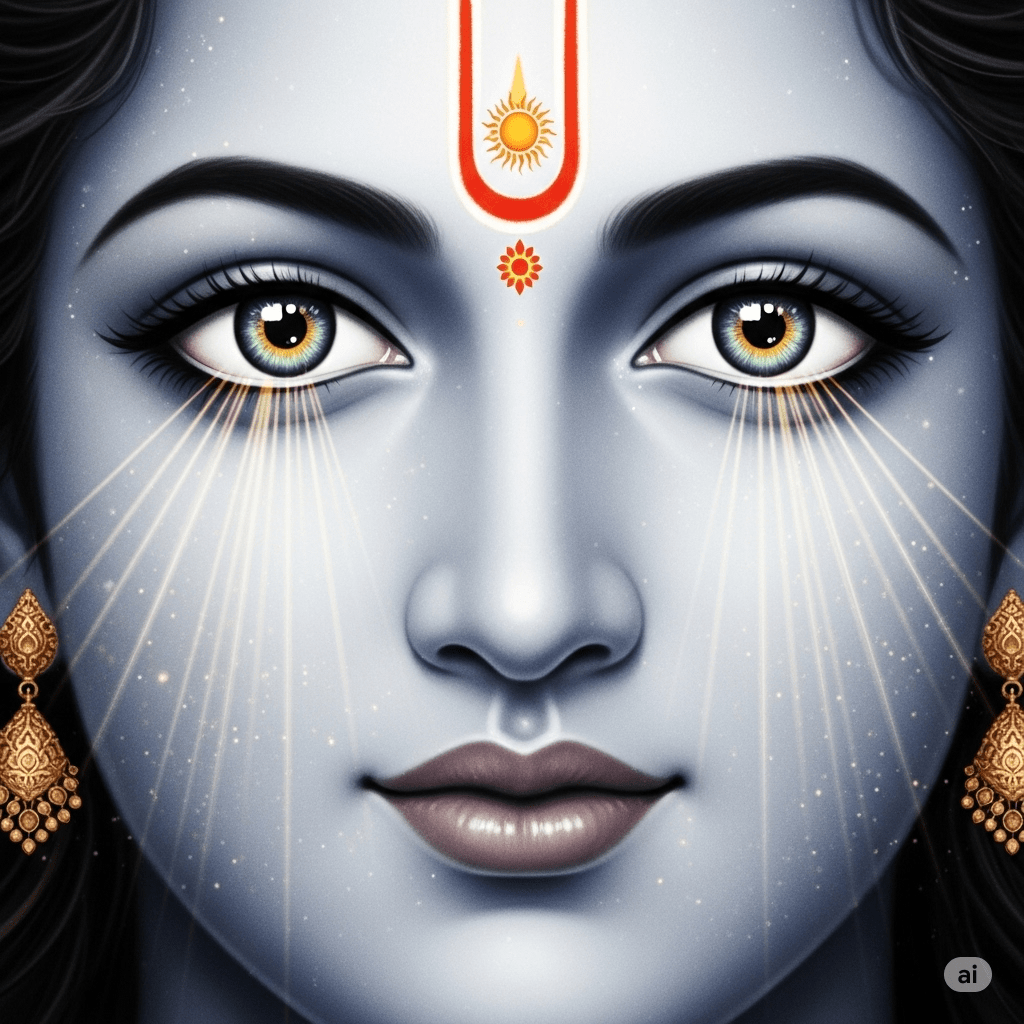
21.) Surrounded by profound darkness, when the Cosmic Being (Virāṭ Puruṣa) felt inclined to see, a pair of eyes manifested within Him, accompanied by the radiant sun-god—the divine presiding deity of sight—and the very sense of vision itself. From this sacred awakening arose the perception of colors, the resplendent objects of His divine gaze.
22.) When the Vedas, as embodiments of divine wisdom, approached the Cosmic Being with hymns of glorification to rouse His attention, He, the Cosmic Lord, out of compassion and grace, became inclined to listen. In response, there manifested upon His transcendental form a pair of ears—the seat of hearing—along with the Digdevatās, the deities who govern the four quarters and the faculty of sound. Thereby, through His divine will, the sense of hearing and the subtle perception of sound came into being.
Special Note – The Dasha Dikpālas / Digdevatās, also known as the Guardians of the Ten Directions, are deities in Vedic cosmology who are assigned to protect and govern the ten cardinal directions. These directions include the four cardinal (East, West, North, South), the four intercardinal (NE, SE, SW, NW), and the zenith (upward) and nadir (downward) directions.
These deities are often invoked in Vāstu Śāstra, temple architecture, and rituals, where directions hold deep spiritual and energetic significance. The concept of Dikpālas emphasizes that Divine protection surrounds the cosmos in every direction, reflecting an ordered and sacred universe.
- Indra: East (Pūrva)
- Agni: Southeast (Āgneya)
- Yama: South (Dakṣiṇa)
- Nirṛti (or sometimes Rakṣasa): Southwest (Nairṛtya)
- Varuṇa: West (Paścima)
- Vayu: Northwest (Vāyavya)
- Kubera: North (Uttara)
- Īśāna (a form of Shiva): Northeast (Īśānya)
- Brahma: Upward (Ūrdhva)
- Viṣṇu (or sometimes Ananta Shesha/Nāga): Downward (Adho / Pātāla)
23.) When the Cosmic Being, in His divine play, willed to experience the sensations of touch—the softness and roughness, lightness and heaviness, warmth and coolness of objects—there spontaneously manifested upon His infinite form the skin, the sacred seat of the sense of touch. Upon this skin arose fine hairs, sensitive to tactile perception and subtle stirrings, accompanied by the presence of the trees (who preside as deities over the hair), and Vāyu – the wind-god (the divine controller of the tactile sense). Enveloped both internally and externally by this sense of touch, He became pervaded by the experience of sparśa—tactile perception—thus manifesting yet another facet of sensory reality through His sovereign will.
24.) As soon as the Cosmic Being became inclined to engage in action and divine activity, a pair of hands emerged from His transcendent form. Within these hands manifested the sacred power of grasping and holding, along with Indra, the mighty sovereign of the senses, who presides over this dynamic faculty of grasping. Thus arose the act of grasping itself—born of both the divine potency inherent in the limbs and the grace of the presiding deity—unfolding through His cosmic intent.
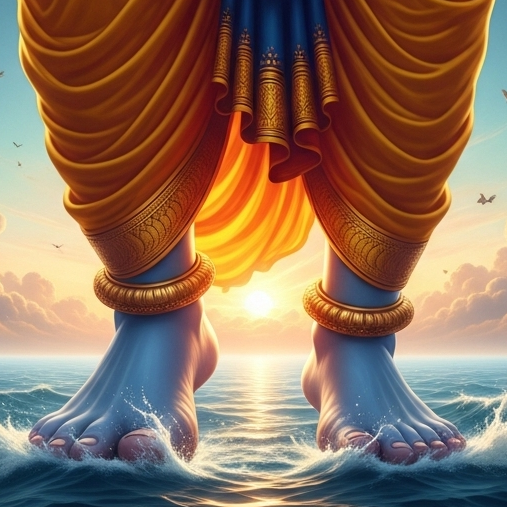
25.) As the Cosmic Being, moved by His own divine will, desired to walk and traverse the worlds, a pair of feet manifested from His infinite form. Along with them appeared Śrī Viṣṇu, the supreme deity who presides over the power of movement (and feet). Thus arose the sacred faculty of locomotion, by which beings move about and procure the essential offerings for sacrifice—acts which sustain the order of dharma and uphold the cosmic yajña.
26.) When the Cosmic Being willed to propagate creation, to partake in the joy of union, and to establish the path toward heavenly immortality through righteous household life, there emerged from Him the generative organ. Along with it appeared the sacred faculty of procreation, the deity Prajāpati—the lord of progeny who presides over this divine function—and the pleasure inherent in the sacred act of union. This pleasure, arising from the harmony between the faculty and its presiding deity, was sanctified as a means to uphold dharma, sustain lineage, and perpetuate the divine order of creation.
27.) When the Cosmic Being, in the course of manifesting the functions of the body, felt the urge to eliminate waste and thus maintain internal purity, there emerged from Him the organ of evacuation (Anus). With it arose the faculty of excretion, along with Mitra, the presiding deity of this vital function. Thereby, the act of elimination—essential to the balance and cleansing of the body—came into being, governed by both the faculty itself and the divine power that sustains its order.
28.) When the Cosmic Being willed to transition from one body to another—renouncing the former for the fulfillment of divine purpose—there manifested from His divine form the navel, the subtle center of transformation. From this arose the vital air known as Apāna, which governs downward movement and release. Along with it appeared Yama, the Lord of Death, who presides as the deity over the Apāna vāyu. Thus came into being the sacred moment of departure—the severance of Prāṇa from Apāna—the process of death itself, which unfolds through the interplay of this vital current and its presiding deity, as ordained in the divine rhythm of life and dissolution.

Special Note –
Yama is the Lord of Death and Justice: He is the presiding deity over the Apāna vāyu, which governs downward movement and release – essentially, the process of decay, expulsion, and ultimately, death.
- Symbol of Dissolution: His appearance in the image signifies the manifestation of the principle of dissolution and the end of a life cycle. When the Cosmic Being wills to transition from one body, it involves the process of “death,” and Yama is the divine orchestrator of this process.
- Role in the “Severance of Prāṇa from Apāna”: The verse specifically mentions “the sacred moment of departure—the severance of Prāṇa from Apāna—the process of death itself.” Yama is the deity who presides over this crucial separation, ensuring the divine rhythm of life and dissolution.
Visually, Yama might be represented as a more stern or imposing figure, often associated with the color black or green, riding a buffalo, and carrying a noose or mace. In the abstract representation of the Cosmic Being’s internal processes, he is the force that facilitates the “release” or “departure” aspect.
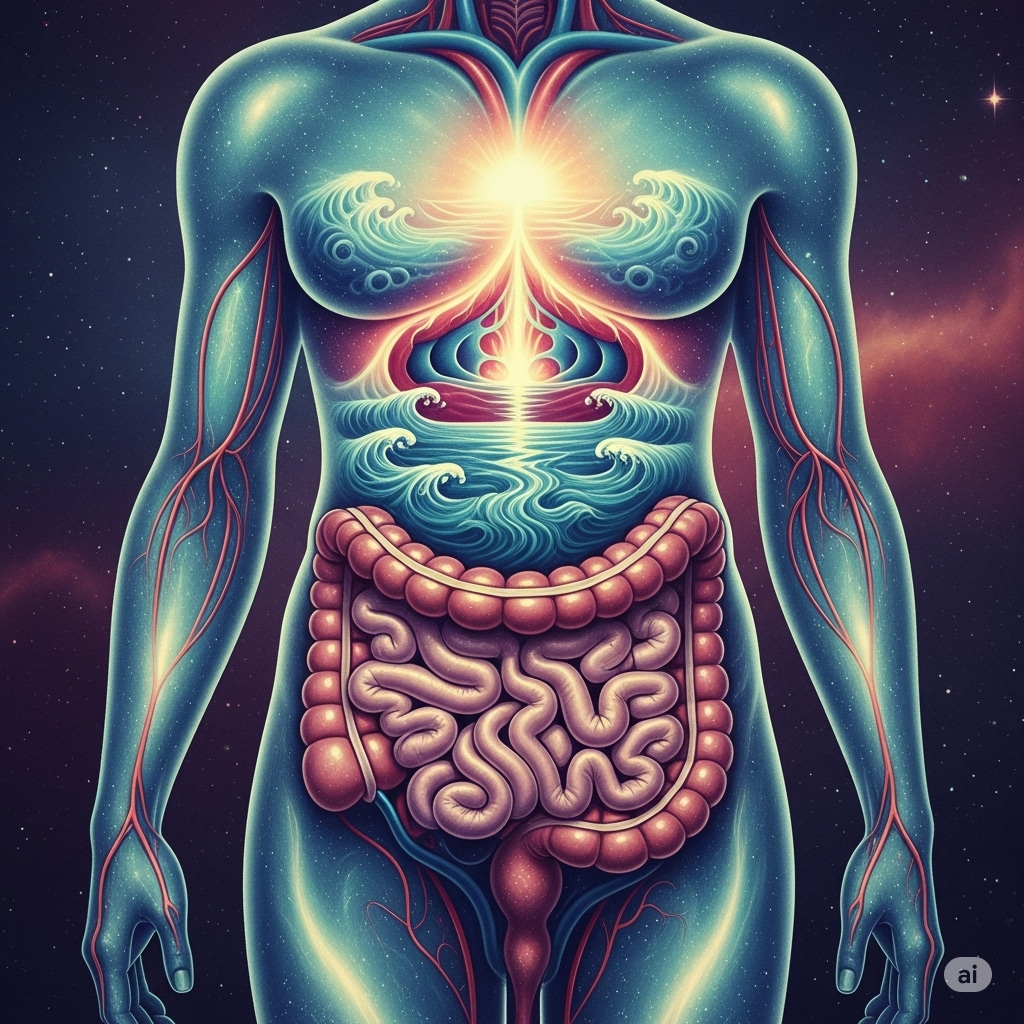
29.) When the Cosmic Being, stirred by the desire to partake of nourishment and sustenance, manifested within Himself the sacred cavity of the abdomen, along with the intestines and the vast network of veins and arteries. In union with these arose the divine rivers and the mighty seas, each presiding over as their guardian deities. Thus came forth satisfaction—born of the intestines and the seas—and nourishment, flowing through the veins and arteries like sacred rivers, sustaining the cosmic form through their ordained functions, upheld by divine grace.
30.) When the Cosmic Being, moved by the impulse to meditate upon His own wondrous Māyā, there manifested within Him the sacred heart, the seat of divine consciousness. From this arose the mind, subtle and profound, accompanied by the luminous Moon, the presiding deity who governs the mind’s tranquil sway. Last to emerge were volition (will) and desire—the twin faculties of the mind—guiding the will and stirring the heart’s deepest longings, all woven by His cosmic will.
31.) From the sacred elements of earth, water, and fire were formed the seven bodily constituents of the Cosmic Being: the thick outer skin, the subtle inner membrane, the flesh, the flowing blood, the nourishing fat, the essence of marrow, and the supporting bones. In like manner, from ether, water, and air arose His vital breath—prāṇa—the subtle life-force that pervades and animates His divine form, sustaining the movement of all living beings through His cosmic presence.
32.) The senses of perception ever flow outward, drawn toward their respective objects, which themselves arise from the Ego—the subtle source from which the elements are born. The mind, being the seat of turbulence and dualities, becomes the dwelling place of restless emotions and afflictive thoughts. Yet it is the intellect (buddhi) that illumines the truth of things, revealing the deeper reality behind appearances, when guided by clarity and divine insight.
33.) Thus have I revealed to you the manifest, gross form of the Lord—His cosmic body, which is veiled externally by eight encompassing sheaths: earth, water, fire, air, and ether; followed by the ego (ahaṅkāra), the Mahat-tattva—the great principle of cosmic intelligence—and finally, Prakṛti, the primordial substratum of all creation. These layers, though seemingly diverse, are but expressions of His infinite energy, through which He conceals and reveals Himself in the vast play of existence.
34.) Beyond this gross manifestation lies the Lord’s most subtle and transcendent form—unmanifest, formless, and free from all attributes. He is without beginning, middle, or end; eternal, imperishable, and untouched by the flow of time. This supreme reality dwells beyond the grasp of the mind and the reach of speech—beyond all thought and language—realized only through pure devotion and the grace of divine revelation.
35.) These two forms of the Lord, gross and subtle, which I have elucidated for your understanding, are indeed products woven by His wondrous Māyā. Yet, those who are truly wise and discerning do not cling to either, for they perceive the Lord’s transcendental nature beyond all material manifestations.
Special Note – The Cosmic Being, the ultimate reality, manifests in countless forms throughout creation. These manifestations, whether as diverse deities, divine incarnations, or the universal form encompassing all, are brought forth by His inherent, wondrous energy known as Māyā. Māyā isn’t mere illusion; it’s the divine power that veils the Supreme’s true nature, making the temporary material world appear tangible and distinct. It is through this potent energy that the Cosmic Being engages in His cosmic play, allowing for the rich tapestry of existence to unfold.
However, the truly wise individuals possess a profound spiritual discernment. They are not deceived by the alluring yet fleeting appearances generated by Māyā. Instead, they recognize that the Cosmic Being’s ultimate nature is transcendental—eternal, unchanging, and beyond all material qualities and limitations. While appreciating the divine presence in all forms, their wisdom allows them to look past the temporary manifestations and fix their understanding on the Supreme’s unconditioned essence. This profound insight ensures they remain untouched by the illusion and constantly connected to the absolute reality of the Cosmic Being.
36.) The Lord is, in truth, ever actionless—untouched by change or attributes. Yet, by the play of His own Māyā, He appears to become active. Assuming the form of Brahmā, He manifests as both the sacred word and that which it signifies, unfolding countless names, forms, and activities. Though He seems to participate in this creation, He remains ever untouched—truly the non-doer. Transcending both action and inaction, form and formlessness, He stands beyond all dualities—ever free, ever self-luminous.
37-39.) The Lord, though ever beyond name and form, assumes countless manifestations through His divine Māyā (which are filled with names, forms and actions). He appears as the Prajāpatis and Manus, as gods and sages, as the revered Pitṛs (manes), as perfected beings (Siddhas), and semi-divine entities such as the Cāraṇas, Gandharvas, and Vidyādharas. He takes form among Asuras, Yakṣas, and Kinnaras, among celestial damsels and Nāgas, as well as serpents and Kimpuruṣas. He dwells among humans, Mātṛkās (like Brāhmī, Māheśvarī, etc.), and even appears among malevolent beings—demons, Pretas, Piśācas, Bhūtas, Vināyakas, and mischievous spirits such as Kūṣmāṇḍas and Unmādas like Kālakarṇa, as well as Vetālas and Yātudhānas. He is present in the forms of planets, birds, deer, beasts, trees, mountains, and reptiles—pervading all levels of existence, from the celestial to the terrestrial, from the noble to the fearsome—enacting His līlā in infinite ways, while remaining untouched, ever-transcendent.
Special Note –
Divine and Celestial Beings:
- Prajāpatis – Progenitors of creation, the “lords of beings” appointed by the Lord to populate the universe. Prominent among them are Dakṣa, Marīci, Atri, etc.
- Manus – The rulers of manvantara epochs; each Manu governs a specific age and helps establish dharma. The current Manu is Vaivasvata.
- Gods (Devas) – Celestial beings who govern natural elements and uphold cosmic order. Includes Indra, Agni, Varuṇa, Vāyu, and others.
- Sages (Ṛṣis or Munis) – Spiritually advanced beings who possess divine wisdom and are often seers of the Vedas, like Vyāsa, Nārada, and Vasiṣṭha.
- Pitṛs (Manes) – Ancestors who dwell in subtle realms and are recipients of offerings (śrāddha). They help guide lineage and protect familial dharma.
- Siddhas – Perfected or enlightened beings who have attained supernatural powers (siddhis) and are often immortal or liberated.
- Cāraṇas – Celestial bards or singers who accompany the gods, often singing in praise of the divine and recounting sacred lore.
- Gandharvas – Divine musicians and celestial beings associated with music, dance, and art in heavenly realms.
- Vidyādharas – Semi-divine beings known for their knowledge (vidyā) and mystical powers; they inhabit higher planes and sometimes serve gods.
Demonic, Mischievous, or Fearsome Beings:
- Asuras – Powerful beings opposed to the Devas; often ambitious and prideful, yet not inherently evil. Some are later redeemed by divine grace.
- Yakṣas – Nature spirits or guardians of wealth and treasures, associated with Kubera. Some are benevolent, others mischievous.
- Kinnaras – Semi-divine beings with human-animal features (often horse or bird), known for their musical and poetic abilities.
- Apsarās (Celestial damsels) – Heavenly nymphs of great beauty, often involved in testing sages or entertaining gods.
- Nāgas – Serpent-like semi-divine beings dwelling in the netherworlds; both benevolent (like Śeṣa and Vāsuki) and fearsome types exist.
- Serpents (Sarpa) – While similar to Nāgas, this refers more broadly to snakes, symbolic of kundalinī energy or fearsome vitality.
- Kimpuruṣas – Mythical beings, sometimes described as lion-headed humans or monkey-like beings; dwell in remote or mythical regions.
Humans and Divine Mothers:
- Humans (Manuṣyas) – The earthly beings subject to karma, dharma, and liberation; among whom the Lord descends as avatāras.
- Mātṛkās – Fierce mother goddesses like Brāhmī, Māheśvarī, Kaumārī, Vaiṣṇavī, etc., representing shakti (divine energy) and often accompanying Devī in battle.
Malevolent Spirits and Mischievous Entities:
- Demons (Rākṣasas, Dānavas, etc.) – Malignant beings who often terrorize the world but are eventually subdued or purified by divine intervention.
- Pretas – Restless spirits of the departed who have not attained peace, often depicted as hungry ghosts.
- Piśācas – Flesh-eating ghouls or night-wandering spirits associated with darkness and impurity.
- Bhūtas – Spirits or ghosts, sometimes benevolent, sometimes disturbing; they can haunt places or people.
- Vināyakas – Obstructing spirits; in contrast, the divine Vināyaka (Gaṇeśa) removes obstacles—this term here refers to mischievous variants.
- Kūṣmāṇḍas – Minor demonic entities believed to inhabit food, dark spaces, or the inner organs—symbolic of subtle afflictions.
- Unmādas (like Kālakarṇa) – Spirits causing insanity or derangement. Kālakarṇa is a specific example of such an entity, associated with madness or delusion.
- Vetālas – Vampiric spirits often haunting cremation grounds; featured in stories like “Vetālapañcaviṃśati.”
- Yātudhānas – Sorcerer-like demons, often deceptive and powerful, involved in black magic or illusion.
Non-Human and Natural Forms:
- Planets (Grahas) – Celestial bodies with influence over human fate and events, often personified as deities like Śani (Saturn), Budha (Mercury), etc.
- Birds (Pakṣi) – Symbolic of swiftness, freedom, or divine messengers; Garuḍa is a chief example.
- Deer (Mṛga) – Gentle forest animals often symbolizing beauty, gentleness, or the soul’s attraction to sense pleasures.
- Beasts (Paśu) – Refers to all types of animals; the Lord manifests in them too, such as in the Varāha (boar) or Narasiṃha (lion) incarnations.
- Trees (Vṛkṣa) – Living beings in plant form, often sanctified (like the aśvattha tree); the Lord resides even in immobile forms.
- Mountains (Parvata) – Massive embodiments of stability and strength; some mountains are personified and divine (like Himālaya, Meru).
- Reptiles (Kṛmi-sarpa) – Includes worms, insects, and small creeping creatures—indicating even the lowest forms are pervaded by divine presence.
Conclusion:
This verse glorifies the Lord’s infinite immanence—His willingness to enter into all forms of existence, noble or vile, subtle or gross, divine or demonic. Each of these beings is but a mask of the Supreme, a mode in His grand līlā. Though untouched by māyā, He enters it out of compassion, play, and for the upliftment of all.
40.) He creates all beings—both the moving and the unmoving. He brings forth life in its manifold forms: those born of the womb, from eggs, through moisture (sweat), and from seeds (soil). He manifests creatures that dwell upon the earth, glide through the air, and move within the waters. All these living forms are but the embodiments of karma—emerging as the fruits of past actions, whether meritorious, sinful, or a blend of both. Thus, through His divine will and the law of causation, the cosmos unfolds in endless variety, yet ever rests in Him, the one immutable Truth.
41.) It is the predominance of the three guṇas—Sattva (goodness), Rajas (passion), and Tamas (ignorance)—that determines the birth of a being: Sattva leads to birth among the gods, Rajas to life as a human, and Tamas results in embodiment in the hellish realms or sub-human species. Yet even these three primary destinies are further nuanced, as each guṇa may be overshadowed or influenced by the other two, giving rise to nine subtle gradations of existence. Thus, through the interplay of the guṇas, the Lord orchestrates the endless diversity of births, even while remaining ever beyond their sway—pure, infinite, and untouched by change.
Special Note –
What are the nine subtle gradations of existence?
The nine subtle gradations of existence arise from the permutations and combinations of the three guṇas—Sattva, Rajas, and Tamas—where one guṇa is predominant, and the others are either subordinate or eclipsed. This framework is rooted in classical Sāṅkhya and Vedāntic thought, and it’s also reflected in Purāṇic cosmology
Here’s how the nine-fold division comes about:
Three primary destinies based on dominant guṇa:
- Sattva-dominant → Deva-yoni (heavenly or divine birth)
- Rajas-dominant → Mānuṣya-yoni (human birth)
- Tamas-dominant → Tiryak-yoni or Naraka-yoni (animal, sub-human, or hellish birth)
Each of these can further manifest in three subtypes:
- Pure (dominant guṇa is unchallenged by others)
- Overpowered by one of the other two guṇas
- Balanced or mixed (where another guṇa is significantly present)
So, we get:
| Predominant Guṇa | Subtype (based on interaction with other guṇas) | Resulting Nature |
| Sattva | Pure Sattva | High Devas, sages, those inclined to jñāna and bhakti |
| Sattva mixed with Rajas | Devas with active roles, ritualistic seekers | |
| Sattva mixed with Tamas | Lower celestials, less spiritually inclined | |
| Rajas | Pure Rajas | Ambitious, action-driven humans |
| Rajas mixed with Sattva | Noble rulers, dharmic householder types | |
| Rajas mixed with Tamas | Greedy, power-seeking, aggressive beings | |
| Tamas | Pure Tamas | Animals, demons, hellish beings |
| Tamas mixed with Sattva | Gentle animals, instinctive but harmless beings | |
| Tamas mixed with Rajas | Fierce animals, violent or harmful tendencies |
These nine grades represent subtle psychological and spiritual states resulting from the dynamic play of the guṇas, which determine not only one’s birth but also tendencies, behavior, and spiritual potential.
42.) Having assumed the form of Śrī Viṣṇu, the embodiment of all virtue and auspiciousness, the Supreme Being upholds and nourishes the universe. Taking on various divine manifestations—whether as animals, humans, or celestial gods—He manifests again and again, solely for the protection of dharma and the preservation of the cosmic order.
43.) And when the appointed time of dissolution arrives, the same Lord manifests as Rudra (the divine force of destruction), emerging from the blazing fire of cosmic annihilation. He withdraws the universe that He Himself once brought forth—just as a mighty wind scatters a mass of clouds—reducing all into silence and stillness, awaiting the next cycle of creation.
44.) The Lord, endowed with inconceivable and infinite power (acintya-śakti), has been spoken of as the Creator, Preserver, and Destroyer of the universe. Yet the wise do not confine Him to these cosmic functions alone—for He is far beyond all such descriptions, transcending cause and effect, form and function, manifest and unmanifest.
45.) The Supreme (Para Brahman) remains ever untouched by doership in the acts of creation, preservation, or dissolution of the universe. Though the Śruti appears to attribute these functions to Him, it does so only to ultimately transcend them—for such activity is merely a projection of Māyā, superimposed upon His transcendental, actionless nature. In truth, He ever abides as the silent witness—beyond all causality, pure, and self-luminous.
46.) I have thus described to you about the great Kalpa (cycle), marked by the manifestation of Brahmā, along with the various minor Kalpas (vikalpas) that follow. In essence, the process of creation remains the same across all Kalpas. The distinction lies in this: during a Mahākalpa—the cosmic cycle that follows a Mahāpralaya (the Final Dissolution)—creation begins afresh in its entirety. Even Prakṛti undergoes transformation, starting from the emergence of Mahat-tattva (the principle of cosmic intelligence) down to the condensation of the five gross elements. In the Kalpas that follow the nightly slumber of Brahmā, however, it is only the external forms—the bodies of sentient and insentient beings—that are newly formed, while the foundational elements remain intact.
47.) I shall later expound in full detail the measures of time—both gross and subtle—the vast duration of a Kalpa, and its manifold divisions. But now, lend your ears to the sacred narration of the Pādma Kalpa, the lotus-born cycle of creation.
Śaunaka said:
48.) O Sūta, you have narrated how Vidura, the foremost among the Lord’s devoted servants, relinquished his beloved kith and kin—so hard to sever ties with—and embarked on a humble pilgrimage, journeying on foot to all the sacred abodes scattered across the earth.
49.) Where did Vidura meet with the venerable sage Maitreya (the son of Kuṣāru), to engage in profound spiritual discourse? And what sublime truths did the exalted sage reveal to Vidura in response to his earnest inquiries?
50.) Please narrate to us the entire sacred story of Vidura—the circumstances that compelled him to renounce his beloved kinsmen, the hardships he endured, and the divine reasons that ultimately led to his return.
Sūta said:
51.) King Parīkṣit himself posed this very question, and now I shall faithfully recount to you the profound discourse that the great sage Śuka delivered in response to the king’s earnest inquiries.
Thus ends the tenth discourse entitled “The Ten Characteristics of the Bhāgavata Purāṇa”, in Book Two of the great and glorious Bhāgavata Purāṇa, otherwise known as the Paramahaṁsa-Saṁhitā (the book of the God-realized Souls).
Summarization Of The Entire Chapter :
This profound chapter offers a multi-layered spiritual revelation, meticulously outlining the very architecture of existence as a direct manifestation of the Supreme Reality, Āśraya. It’s not merely a cosmological account; it’s a profound spiritual blueprint designed to lead the seeker towards the ultimate truth, revealing how every facet of creation, sustenance, and dissolution is orchestrated by the divine will and ultimately dissolves back into its singular source. The opening enumeration of the ten fundamental topics serves as a divine syllabus, each point a progressively deeper insight into the Absolute. From the subtle initial stirrings of creation (Sarga) to the final, complete liberation (Mukti), every cosmic process and individual experience is presented as a stepping stone on the path to understanding the Supreme. The emphasis on “profound narratives” (Īśānukathā)—the accounts of God’s deeds and His devotees—is a crucial spiritual insight, highlighting that ultimate truth is not just intellectually grasped but primarily revealed through divine play (līlā) and the intimate connection of devotion. These stories are the living scriptures, designed to awaken the heart and deepen one’s understanding of the Divine’s personal involvement in all affairs.
The spiritual exposition continues by unfolding the elaborate process of creation, presenting it not as a random act but as the conscious, deliberate emanation of the Supreme Person’s will. Sarga (primary creation) is described as a cosmic breath, the subtle agitation of the guṇas (modes of nature) from their equilibrium, leading to the emergence of gross and subtle elements from the unmanifest Lord. This is followed by Visarga (secondary creation), where Brahmā, himself born from the Cosmic Being, further diversifies the universe, populating it with all living and nonliving entities. The Lord’s divine attributes are then further magnified through Sthiti (upholding divine order), showcasing His glorious triumph in maintaining cosmic harmony, and Poṣaṇa (compassionate sustenance), signifying His loving grace in protecting and nourishing all beings. This portrays an infinitely benevolent and actively involved God, whose presence pervades and sustains every atom of existence. Even the concepts of Manvantara (sacred eras governed by Manus) and Ūti (latent desires from past karma) are seamlessly integrated into this grand design, demonstrating how the Lord’s universal plan accommodates the individual journeys of souls, offering them opportunities for karmic unfolding and spiritual progression within divinely ordained cycles.
A profoundly significant spiritual teaching emerges with Nirodha (withdrawal), which describes the process by which the individual soul (Jīva), along with its karmic impressions and material adjuncts, is drawn back into the Supreme Person during His cosmic rest (Yoga Nidra). This concept serves as a powerful precursor to Mukti (liberation), the ultimate goal of spiritual endeavor. Mukti is presented as a state of total emancipation, where the Jīva abandons all illusory forms and distinctions, recognizing its true nature and attaining its eternal state of oneness with Brahma (the absolute / Ātman). This is not an annihilation of identity but a sublime realization of the Jīva’s intrinsic unity with the Infinite, shedding the false identifications of being a separate doer or a limited individual. This liberation signifies freedom from all bondage and the relentless cycle of birth and death, a return to the soul’s original, pure, and boundless spiritual essence. Throughout these descriptions, Āśraya is continually reaffirmed as the ultimate, self-existent foundation—the Parabrahma, Paramātman—upon whom all existence depends, yet who depends on none, embodying the non-dual truth that all emanates from and returns to this singular, absolute reality.
The chapter then delves into a deeply insightful explanation of the triad of existence: Ādhyātmika (the individual self and its faculties), Ādhidaivika (the presiding celestial powers/deities), and Ādhibhautika (the gross physical organs and elements). The text highlights their inseparable and mutual dependence, illustrating that true knowledge arises only when one comprehends the intricate interrelation of these three. For instance, the eye’s ability to see isn’t merely a function of the physical organ, but also relies on the individual’s faculty of sight (Ādhyātmika) and the presiding deity of vision, Sūrya (Ādhidaivika). This profound understanding culminates in the realization of the Ātman, the Self—independent, self-luminous, and the eternal support underlying all apparent supports. This teaching compels us to look beyond mere material causality and perceive the divine orchestration within and around us, recognizing that our very bodies and senses are sacred extensions of the cosmic form of the Lord.
The subsequent, highly detailed description of the Virāṭ Puruṣa’s emergence from the golden cosmic egg and the spontaneous manifestation of His senses (mouth, nose, eyes, ears, skin, hands, feet, generative and excretory organs, navel, abdomen, and heart) is a powerful allegorical account of the universe’s emanation. Each sense and vital function is portrayed as emerging from a divine desire and purpose, accompanied by its respective presiding deity and the specific faculty. For example, when the Lord desired to speak, Agni (the fire-god) emerged with the organ and power of speech. This illustrates how the entire cosmos, with all its sensory experiences and functions, is a direct expression of the Cosmic Being’s will and consciousness. The formation of internal organs like the abdomen, intestines, and veins, connected to divine rivers and seas, symbolizes the cosmic nourishment and life-giving forces that sustain the universe, emphasizing that our physical existence is deeply intertwined with cosmic principles, all upheld by divine grace. Even the mind and intellect, with their faculties of volition and desire, originate from the heart of the Cosmic Being, governed by the luminous Moon, signifying the subtle, profound forces that shape our inner world.
The chapter concludes by illuminating the Lord’s two forms: the gross (Virāṭ Puruṣa), which is the manifest universe, and the subtle (unmanifest, formless, and attribute-less), which transcends all material qualities. Both are declared to be products woven by His wondrous Māyā (divine illusory energy). The profound spiritual instruction here is that the truly wise and discerning do not cling to either form, for they perceive the Lord’s transcendental nature beyond all material manifestations and conceptual limitations. Though He appears as the creator, preserver, and destroyer, the Lord is unequivocally declared to be ever actionless—untouched by change or attributes. His seeming involvement in cosmic functions is merely a projection of Māyā, superimposed upon His transcendental, actionless essence. In truth, He forever abides as the silent witness, beyond all causality, pure, and self-luminous.
The expansive enumeration of the Lord’s diverse manifestations across all species and realms—from gods and sages to animals, plants, and even malevolent spirits—serves not as a mere list, but as a profound testament to His omnipresence and infinite power. He assumes countless forms through His divine Māyā, enacting His līlā (divine play) and orchestrating the karmic unfolding of all beings. All creatures, born from various karmas and influenced by the interplay of the guṇas (Sattva, Rajas, Tamas), are ultimately embodiments of His will. The endless cycles of creation and dissolution (Kalpas and Vikalpas) are presented as eternal rhythms of His divine dance, yet through all these cosmic processes, He remains the Para Brahman, eternally beyond all distinctions, limitations, and the dualities inherent in manifest existence. This chapter, therefore, is an ultimate spiritual teaching, inviting us to look beyond the transient and embrace the eternal, to recognize the Divine in every facet of existence, and ultimately, to transcend the veils of Māyā and merge with the pure, unchanging, and infinitely blissful reality of the Supreme Refuge, Śrī Hari.
Short Questions & Answers :
Q1: The chapter introduces ten fundamental topics. Beyond their literal definitions, what is the overarching spiritual purpose of enumerating these topics in the Srimad Bhagavata?
A: The spiritual purpose of detailing the ten fundamental topics—Subtle Creation (Sarga), Gross Creation (Visarga), Law and Order (Sthāna), Protection/Welfare (Poṣaṇa), Material Lust from Karmas (Ūti), Period of Manu (Manvantara), Accounts of God’s Deeds (Īśānukathā), Physical Annihilation (Nirodha), Liberation (Mukti), and Ultimate Reality (Āśraya)—is to systematically guide the seeker towards the realization of Āśraya, the Supreme Reality and Ultimate Refuge of all existence. Each topic serves as a progressive spiritual lens through which to understand the Absolute. They are not merely academic classifications but divine principles that reveal the intricate workings of the Lord’s līlā (divine play) and His intimate involvement in every aspect of cosmic and individual existence. By understanding these facets, one gains a holistic perspective, moving from the manifest world back to its unmanifest source, thereby fostering devotion and spiritual insight. The emphasis on Īśānukathā (divine narratives) further spiritualizes this process, showing that profound truth is often revealed not just through intellectual discourse but through the heart, by immersing oneself in the Lord’s stories and those of His devotees, which awaken love and ultimately lead to liberation.
Q2: How does the chapter portray the Lord’s active involvement in creation and sustenance, moving beyond a simple concept of a ‘creator’ to a more intimate relationship with the universe?
A: The chapter portrays the Lord’s active involvement as far more intimate than a mere ‘creator’ who sets things in motion and then withdraws. It details Sarga (primary creation) as a direct emanation from His sovereign will and desire, a “cosmic breath” agitating the guṇas. This signifies a continuous, conscious presence at the very genesis of existence. Furthermore, His roles in Sthiti (upholding divine order) and Poṣaṇa (compassionate sustenance and protection) emphasize His ongoing, loving relationship with all beings. He doesn’t just create; He meticulously maintains cosmic harmony and lovingly nourishes every single entity. The inclusion of Manvantara (epochs of Manus) demonstrates His establishment of righteous governance and protection through His chosen representatives. Even the concept of Ūti (material desires from karma), though seemingly individual, is woven into His grand design, indicating that His will encompasses and orchestrates the karmic unfolding of all souls. This comprehensive depiction reveals a Lord who is perpetually engaged, pervading and sustaining every atom of existence, acting as both the grand architect and the benevolent caretaker of His creation.
Q3: Explain the spiritual significance of ‘Nirodha’ and ‘Mukti’ as described in the chapter, and how they relate to the individual soul’s journey.
A: Nirodha (withdrawal or subsidence) signifies a crucial stage in the individual soul’s spiritual journey, where the Jīva (individual soul), along with its associated qualifications, guṇas, and karmas, is temporarily withdrawn back into the Supreme Person during His cosmic rest (Yoga Nidra). Spiritually, this represents a phase of suspension of all active functions, a temporary merging where the individual consciousness awaits the next cycle of manifestation. It’s a precursor, an echo of the ultimate cessation of material entanglement.
Mukti (liberation), or Mokṣa, is the ultimate spiritual goal described as the Jīva’s complete emancipation. It signifies the abandonment of all illusory forms, distinctions, and false identifications (such as having a separate individual identity as a doer or being bound by material existence). In this state, the Jīva establishes itself in its true nature, realizing its real svarūpa (essential form), which is the Ātman. This is the attainment of eternal oneness with Brahman (the absolute / Ātman), becoming free from all bondage and false identifications. Therefore, Nirodha can be seen as a temporary return to the source, a cosmic repose, while Mukti is the permanent, conscious realization of one’s inherent, eternal unity with that very source, transcending all limitations.
Q4: How does the chapter’s explanation of the ‘Ādhyātmika, Ādhidaivika, and Ādhibhautika Puruṣas’ offer a spiritual understanding of our own senses and bodily functions?
A: The explanation of the Ādhyātmika (individual self and its faculties), Ādhidaivika (presiding deities), and Ādhibhautika (gross physical organs) provides a profoundly spiritual understanding of our senses and bodily functions. It teaches that our sensory experiences are not merely mechanical or biological processes, but divinely orchestrated interactions. For example, the act of seeing (Ādhyātmika faculty) through the eye (Ādhibhautika organ) is only possible because of the presence and grace of the sun-god, Sūrya, who is the presiding deity of vision (Ādhidaivika). This highlights a fundamental interconnectedness: our individual faculties are linked to cosmic divine powers, and both are manifested through physical forms. Spiritually, this means that our bodies are not just inert matter but sacred instruments reflecting the Cosmic Being’s form. Recognizing this mutual dependence leads to the realization of the Ātman, the independent, self-luminous Self that supports this entire triad. It fosters reverence for our own bodies and senses, understanding them as channels for divine perception and action, and reminds us that true knowledge arises from comprehending this integrated spiritual reality.
Q5: What is the ultimate spiritual message conveyed by the chapter regarding the Lord’s two forms (gross and subtle) and His relationship with Māyā?
A: The ultimate spiritual message conveyed by the chapter regarding the Lord’s gross and subtle forms and His relationship with Māyā is one of transcendence and non-duality. The chapter explicitly states that both the manifest, gross form of the universe (Virāṭ Puruṣa) and the subtle, unmanifest, formless, and attribute-less form of the Lord are products of His wondrous Māyā (divine illusory energy). The crucial spiritual insight is that the truly wise do not cling to either of these forms, for they perceive the Lord’s transcendental nature which lies beyond all material manifestations.
The chapter clarifies that the Lord is ever actionless—untouched by change or attributes—even though He appears as the creator, preserver, and destroyer. This seeming activity is merely a projection of His Māyā, superimposed upon His transcendental, actionless essence. The spiritual message is that the Lord is fundamentally beyond all dualities of form and formlessness, action and inaction, cause and effect. He is the silent witness, eternally pure and self-luminous. Therefore, the chapter guides the seeker to understand that while the cosmos is a beautiful display of His divine power (Māyā), true liberation and knowledge involve seeing through the illusion of separation and realizing the Supreme Being’s immutable, transcendent reality, which is the ultimate, non-dual truth.
Q6: The chapter describes the manifestation of the Virāṭ Puruṣa’s senses and bodily functions (like the mouth, eyes, hands, etc.). What is the spiritual implication of this detailed description for our understanding of the universe?
A: The detailed description of the Virāṭ Puruṣa’s senses and bodily functions manifesting from His divine form carries a profound spiritual implication: it reveals that the entire universe, with all its functions, phenomena, and our own physical existence, is a direct, conscious emanation of the Supreme Being’s will and desire. Each sense, organ, and vital function (like hunger, speech, sight, movement, or elimination) is shown to have a divine origin, a presiding deity, and a specific purpose. This means the universe is not a random collection of matter, but a living, breathing, conscious entity—the cosmic body of the Lord. Spiritually, it encourages us to view every aspect of creation, including our own bodies, as sacred and intrinsically connected to the Divine. It transforms our understanding of perception and action from mere biological processes into opportunities to recognize the Lord’s omnipresence and divine orchestration in every moment.
Q7: The chapter mentions the creation of various beings based on the predominance of the three guṇas (Sattva, Rajas, Tamas). What is the spiritual lesson here regarding human experience and destiny?
A: The spiritual lesson regarding the guṇas (Sattva/goodness, Rajas/passion, Tamas/ignorance) is fundamental to understanding human experience and destiny. The chapter states that the predominance of these guṇas determines a being’s birth—Sattva leading to divine realms, Rajas to human life, and Tamas to lower species or hellish realms. Spiritually, this teaches us that our actions, thoughts, and desires (which are influenced by the guṇas) directly shape our present experiences and future embodiments. It underscores the principle of karma and accountability for one’s choices. Beyond a deterministic view, it also implies the possibility of spiritual evolution: by cultivating Sattva through virtuous living, devotion, and knowledge, individuals can elevate their consciousness and transcend the lower guṇas. This provides a clear path for self-improvement and spiritual liberation, emphasizing that while karmic impressions dictate our starting point, our conscious efforts can alter our spiritual trajectory.
Q8: The chapter states that the Lord is “ever actionless” despite being described as the Creator, Preserver, and Destroyer. How can we reconcile this apparent paradox from a spiritual perspective?
A: Reconciling the paradox of the Lord being “ever actionless” while simultaneously performing creation, preservation, and destruction requires understanding the concept of Māyā from a spiritual perspective. The chapter explains that these cosmic functions are merely “a projection of Māyā, superimposed upon His transcendental, actionless nature.” Spiritually, this means the Lord’s essential nature is pure consciousness, unaffected and immutable, similar to how a perfect, unblemished screen remains untouched by the images projected upon it. His “actions” are not borne of need, desire, or limitation, as ours are. Instead, they are the spontaneous, effortless play (līlā) of His infinite power through His divine energy (Māyā). This spiritual reconciliation leads us to recognize that while the phenomenal world is dynamic and ever-changing, the ultimate reality, the Lord Himself, remains eternally still, transcendent, and beyond all dualities, acting without actually ‘doing’ in the conventional sense.
Q9: Why does the chapter emphasize that “the wise do not cling” to either the Lord’s gross or subtle forms, despite elaborately describing both? What is the spiritual aim of this teaching?
A: The emphasis that “the wise do not cling” to either the Lord’s gross (manifest universe) or subtle (unmanifest, formless) forms, despite their detailed descriptions, reveals a crucial spiritual aim: transcending conceptual limitations and attaining the highest non-dual realization. While the gross form (Virāṭ Puruṣa) helps beginners perceive the divine in the manifest world, and the subtle form (unmanifest Brahman) guides towards abstract understanding, both are ultimately products of His Māyā. The true spiritual goal is to realize the Lord’s nature beyond all attributes, forms, and even the distinction between manifest and unmanifest. Clinging to any specific form, even a subtle one, can become a subtle impediment to complete liberation. The wise understand that the Lord’s ultimate reality is immeasurable, indescribable, and transcends all categories of thought or language, leading to a state of pure, formless awareness that is beyond all conceptual dualities.
Q10: The chapter concludes by mentioning the Kalpas and Vikalpas. How does understanding these cosmic cycles contribute to one’s spiritual perspective on time and existence?
A: Understanding the Kalpas (cosmic cycles) and Vikalpas (minor cycles) profoundly contributes to one’s spiritual perspective on time and existence by revealing the cyclical, eternal nature of creation and dissolution under divine orchestration. Spiritually, it teaches that time is not linear and finite, but an endless flow governed by the Lord’s will. During a Mahākalpa, creation begins afresh after a complete dissolution, indicating the profound power of renewal. In subsequent Kalpas, during Brahmā’s ‘night,’ only external forms are re-manifested, while foundational elements remain. This cyclical view helps to diminish attachment to temporary phenomena, as it shows that everything that appears must eventually dissolve, only to reappear. It fosters a sense of detachment from worldly impermanence and reinforces the idea that the ultimate reality, the Lord, remains unaffected by these vast cosmic shifts. It promotes a profound spiritual understanding of divine continuity, guiding the seeker to focus on the eternal truth that underlies all transient cycles.
